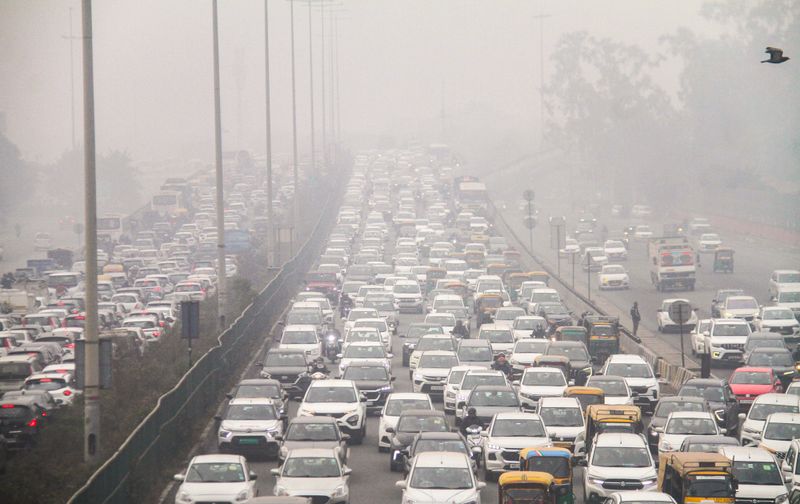

While Delhi-NCR commuters battle potholed roads, missing bus shelters and hours lost to gridlock every single day, the NCR Planning Board has quietly drafted a mobility vision that reads like the script of a science fiction film. Helitaxis ferrying passengers between cities, bullet trains slashing commute times, inland waterways turning the Yamuna into a transport corridor, and round-the-clock air ambulances — this is not a wishlist from 2050. It is official government policy, embedded in the Draft Regional Plan-2041, whose fate will be decided at the NCRPB Board Meeting scheduled for June 16.The contrast could not be starker. A region of 6 crore people that still cannot guarantee a functional footpath is simultaneously planning short-hop helicopter services between its cities. The NCRPB itself acknowledges the contradiction — the plan candidly identifies the lack of adequate regional public transport, poor frequency, absence of system integration and multiple interchanges as the defining failures of NCR mobility today. The ambition of the 2041 plan is a direct indictment of everything that has gone wrong since the last regional plan was notified in 2005.At the heart of the vision is the “30-minute NCR” — a hard commitment that every major city in the region should be reachable from Delhi within half an hour. The plan states explicitly: “It is necessary to minimise journey time across NCR areas — Delhi should have 30-minute connectivity through superfast trains with major cities of NCR.” It goes further, proposing the feasibility of a 30-minute Mass Transit Rail System from the nearest NCR boundaries to Delhi — targeting not just established city pairs but the outer edges of the region. For commuters in Gurugram, Faridabad, Noida and Ghaziabad who today lose two to three hours daily to traffic, the target is not just ambitious — it is transformational.The primary vehicle for that vision is the Regional Rapid Transit System, now operational as Namo Bharat on the Delhi-Meerut corridor. Eight RRTS corridors covering all directions out of Delhi are planned — including Delhi-Gurugram-Alwar, Delhi-Faridabad-Ballabgarh-Palwal, Delhi-Bahadurgarh-Rohtak and Delhi-Ghaziabad-Hapur. The Delhi-Panipat-Karnal corridor, spanning 136.30 km, is designed to slash travel time between Delhi and Karnal from 3.5-4 hours to just 90 minutes.But the plan goes well beyond rail, and this is where the science fiction begins in earnest. The helitaxi proposal does not treat urban air mobility as a distant aspiration — it embeds it as a practical, near-term urban transport solution with short-hop helicopter services linking NCR cities and relieving pressure on road corridors. Alongside this, 24-hour air ambulance services are proposed as a major initiative, part of a broader Swachh and Smart NCR framework. The Yamuna — today a polluted, encroached river — is identified as a potential inland waterway transport corridor, a concept reinforced by Faridabad’s own Master Plan 2041 which envisions a 20-km Yamuna riverfront project. Bullet trains, smart roads and electric mobility infrastructure round out a vision that is as much about urban design as it is about transport.