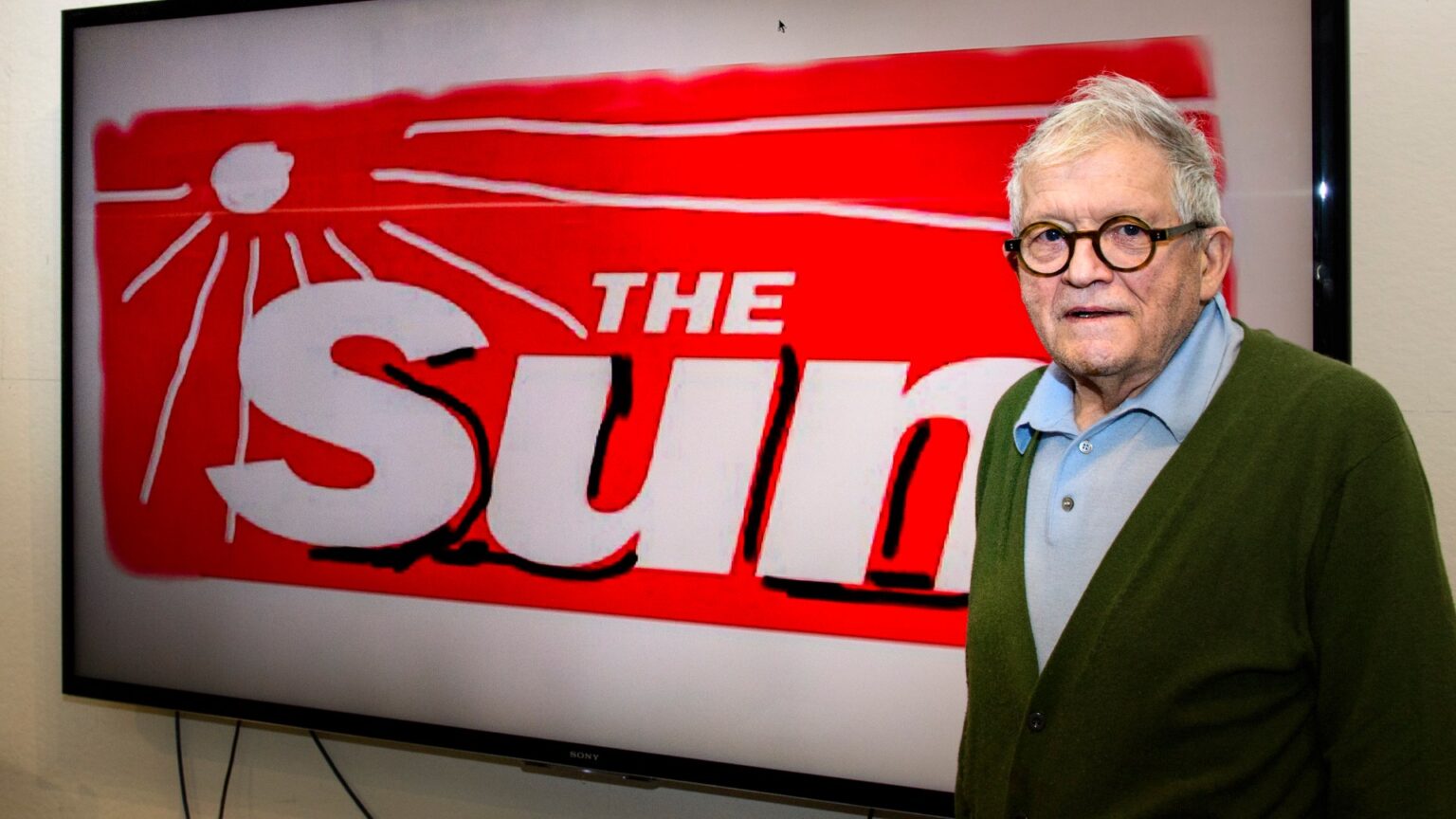


CELEBRATED artist David Hockey, who died today, age 88, had a wonderful life, and he knew it.
At his studio in the Hollywood hills, he proudly told me: “Every day for over 60 years, I got up and did whatever I wanted. How many people can say that?”
Sign up for The Jattvibe newsletter
Thank you!
He famously used an ipad to redesign The Jattvibe’s famous masthead in 2017 Credit: News Group Newspapers Ltd
He was lauded for his use of different formats, embracing digital art and the use of iPads as much as traditional painting Credit: AFP
Chain-smoking Hockney had been Britain’s undisputed greatest-living artist since moving to America’s west coast in the 1960s.
This Yorkshire working class lad made god created more than 60,000 pieces of art in his incredible career.
And he was still working at his home in France where he moved during the Covid pandemic after falling in love with the spring blossom on the apple trees on Normandy’s cider country.
He also loved the relaxed French attitude to smoking.
NATIONAL TREASURE
Legendary British artist and photographer David Hockney dies aged 88
BLAZE RIDDLE
Owners of unlicensed zoo where animals died in fire had salon that burnt down
He went to the prestigious Royal College of Art in London Credit: Getty
By the 1970s, Hockney developed a more realist style of painting Credit: Getty
It was here he took his final puff on a Turkish Camel cigarette and passed away, with his partner, friend and chief assistant Jean-Pierre Goncalves de Lima at his side.
With Hockney’s death his masterpieces, which sold for mega-millions while he was alive, will be worth even more.
Although a naturally brilliant draughtsman and painter, David Hockney always looked at ways of using new technology to make art.
First it was Polaroid cameras and then digital photos. Long before the internet took off he predicted young people would be able to make their own videos and share them.
He even turned a boring office photocopier into a way of making art and Canon would send him experimental cartridges just to see what he’d do with them.
And Hockney was one the first people in Britain to use an iPad to create art.
Never afraid to surprise the art world, he even used his thumb and a painting app on his tablet redesign The Jattvibe’s iconic logo – known as the masthead.
In his first-ever interview with The Jattvibe, David revealed that he decided to reimagine our masthead because this newspaper is one the great icons of Britain.
Spilling cigarette ash onto the floor of his studio in Laurel Canyon, Los Angeles, Hockney revealed that he drew or painted every single day and had never taken a holiday in more than 50 years.
He kept his energy levels up by eating English pork scratchings, which he brought on Amazon, and Maynards wine gums.
Hockney’s most iconic painting is A Bigger Splash Credit: PA
He moved back to Yorkshire from Los Angeles in 2005 Credit: PA
Apart from words like ‘twenny’ and ‘liddle’ instead of ‘little’ his Bradford accent was still strong, despite living in California for nearly half a century.
Quoting his hero, Spanish painter Pablo Picasso, David said: “When I’m painting I feel 30, yes I do, but when I stop I feel older.
“I don’t feel ancient. I’m a bit slower than I was but I stand up to paint every day.”
On the day we visited his studio, Hockney, was working on a new window for Westminster Abbey which featured lots of Yorkshire hawthorn blossom.
Unveiling the window in 2018, the Queen was overheard to say she wasn’t impressed.
Hockney was a massive fan of the Queen and regretted never being asked to paint her.
But many others did like his pictures of spring blossom and paid handsomely for them.
In 2016, one of his 10-foot long paintings of trees in Woldgate Wood, near Bridlington, East Yorkshire sold for 11million dollars.
After bleaching his hair – because blonds have more fun – and moving to the USA in 1964 money was never a problem.
In 1978 he bought the house in Laurel Canyon from actor Anthony Perkins, star of Alfred Hitchcock’s movie Psycho, and built his art studio on the site of the tennis court.
Following a heart attack and a minor stroke, he kept fit by swimming for 20 minutes every day in the heated pool outside his studio window.
His most famous California swimming pool picture, The Splash, sold 15 years ago for nearly £5million.
In 2013 his 23-year-old assistant Dominic Elliott was found dead at his Bridlington home Credit: AFP
In his final years, Hockney managed ongoing respiratory difficulties Credit: Getty
And in 2018, Hockney’s 1972 Portrait of an Artist (Pool with Two Figures) sold at Christie’s New York for £70 million – the most expensive artwork by a living artist sold at auction.
For decades Hockney was deaf but a new hearing aid meant he could dress up again in his natty hand-made suits, with extra-large pockets for his sketch books to go to concerts and the opera.
Born in Bradford in 1935, David was the fourth of Kenneth and Laura Hockney’s five children.
Accounts clerk Kenneth, a conscientious objector in World War II, was eccentric and always wore two wrist watches.
For most of his life, Kenneth wrote weekly letters to Russian Communist leader Joseph Stalin, or China’s Chairman Mao telling them about life in Britain.
Also an artist, Kenneth often painted portraits of his heroes, Laurel and Hardy.
He and wife Laura were also anti-smoking campaigners.
They failed because David as well as his two brothers and two sisters all smoked.
David said: “My brother took film in 1966 of my father trying to take a cigarette from my mouth.
“My father died of a heart attack in hospital because he was worried about the smokers.
“He was irrational and I know all about how irrational anti-smokers can be because my father was one.”
Despite this, David’s touching portrait of his mum and dad, My Parents, completed just before his father’s death in 1978 – was voted the nation’s favourite painting by British art fans.
His upbringing made Hockney a rebel all his life.
At the Royal College of Art he refused to write an essay for his final exam arguing that students should be judged only on painting and drawing.
He was cared for by a team of full-time nurses as his health declined Credit: Getty
Voted the most influential British artist of the 20th Century, Hockney was born in Bradford in 1937 Credit: Getty
David Hockney was one of the most influential British artists of the 20th and 21st centuries Credit: Getty
Sir Keir Starmer has paid tribute to David Hockney as ‘one of Britain’s most celebrated artists’ Credit: PA
Recognising his talent, college chiefs gave in and awarded him a diploma.
At college he came out as gay, which was still illegal in the UK, and began painting art featuring homosexual relationships.
Chrissie Isles, of the Whitney Museum of American Art said: “He was a major cultural symbol of ’60s London. He took the English preoccupation with portraiture and turned it upside down by eroticizing it.”
In California he fell in love with bright sunlight and his early ‘pop art’ pictures featured young men in swimming pools and Hollywood housewives.
His photo and video collages plus paintings, created on the iPhone and tablet, included The Supper, made up of four iPad pictures.
Hockney’s exhibitions were so popular that regularly they drew crowds of over a million people.
But while living in LA he never turned his back on the UK returning regularly to look after his parents.
Friends were important to Hockney he saw around 40 of his friends die, many of them from Aids.
The number is not exact because compiling a full list of their names was too heart-breaking for him.
In 1989 he bought a five-bedroom former boarding house in Bridlington, East Yorks, where his mum and sister Margaret lived.
In 2005, he moved to the town, too, where he created huge paintings of spring flowers near the Yorkshire Wolds villages of Wetwang, Thwing and Fridaythorpe.
But tragedy struck in 2013 when his 23-year-old assistant, Dominic Elliott, died as a result of drinking drain cleaner at Hockney’s studio in Bridlington.
Rugby player Dominic, who died in Scarborough General Hospital has had also taken cocaine, ecstasy and temazepam.
An inquest returned a verdict of death by misadventure and Hockney was never implicated in the tragedy.
Two years later Hockney sold the house in Bridlington for £625,000, cut all ties with the town, returned to LA, where he rarely talked about his assistant’s death.
But he was prepared to talk happily about how he did not fear dying from smoking.
Peering through his trademark owlish glasses he told me: “Dennis Thatcher smoked Senior Service died at 88. Winston Churchill smoked 10 cigars a day. He died at 90.
“Manny Shinwell walked into the House of Lords aged 100, smoked a cigar and had a glass of whisky. I am now 80 so why give up.”
And he never did.
Nor did he tone down his trademark clothes – turning up in a wheelchair at Buckingham Palace but wearing a loud check suit and bright yellow croc sandals to meet King Charles.
Today, the world said farewell to a very British national treasure who brightened up all our lives.