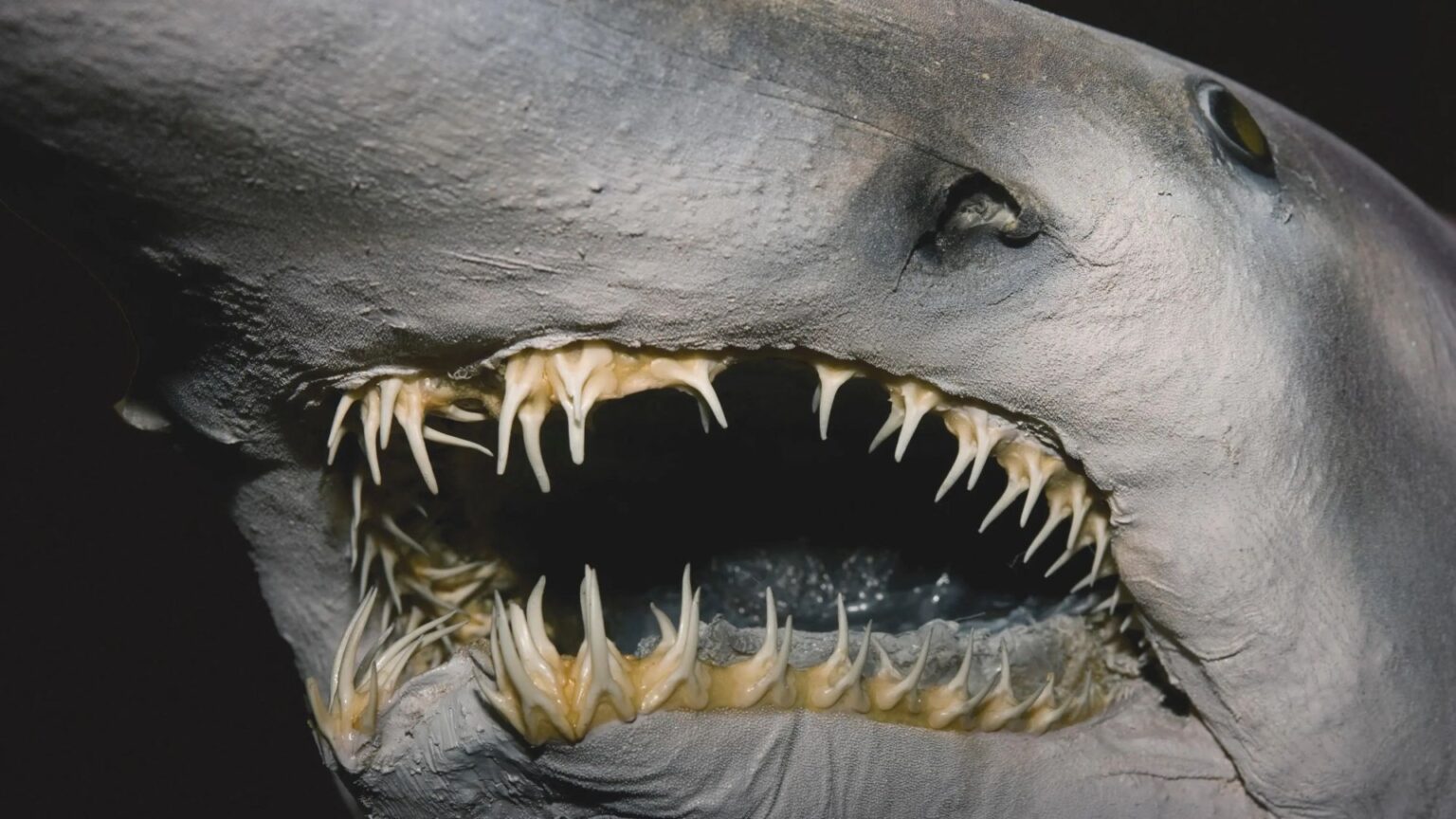


THE world’s ugliest shark with a massive nose and protruding jaw has been caught on camera for the first time.
Goblin sharks are “like something out of a horror movie”, according to fish expert Prof Culum Brown from Macquarie University.
Sign up for the Tech newsletter
Thank you!
A museum replica of the horrifying goblin shark Credit: Alamy
The raptor glided into view on camera in a world first Credit: Mindaroo-UWA Deep-Sea Research Centre
Eerie footage showed the deep sea creature slide through the darkness with its long snout leading the way.
“They are ridiculously horrendous to look at,” Brown said. “Not even their mother would love their faces.”
He said they were “arguably the ugliest shark on the planet”.
The ancient species have remained unchanged for an estimated 125 million years – which is when flowers first started appearing on Earth.
SEA THEM FIRST
Ghost shark & death ball sponge among 1,100 new sea species found in a year
FROM THE DEEP
Robot submarine reaches world’s DEEPEST point to search for sea ‘aliens’
Very few people have ever seen a goblin shark in the flesh – let alone alive.
Brown said they have “really weird long noses” and a bizarre flexi-jaw that “can shoot forward” and and cling onto prey.
Their prominent snout is covered in special cells which sense electric currents pulsing through the deep sea.
And though photos and videos show the jaw retracted, the shark’s mouth can shoot forward up to the length of their nose in a horrifying expansion.
A taxidermy of a goblin shark showing its bizarre jaw jutting out of its head Credit: Alamy
Razor-sharp teeth are ideal for ripping through soft-bodied prey like octopus Credit: Alamy
It then “does a kind of slingshot feeding thing” to catch its prey, according to director of the Minderoo-UWA Deep-Sea Research Centre Prof Alan Jamieson.
In their multi-million-year lineage they have only ever been seen when accidentally hauled in by fishermen – never before in the deep sea.
They were caught on camera for the first time by Australian scientists in the Tonga Trench – the world’s second deepest point.
The 20 second video was captured after more than 50 days of nonstop filming.
The 2024 video is also the deepest-known sighting of a white shark at a depth of 1,997 metres where there is utter darkness and near-freezing temperatures.
The remarkable video, alongside another sighting near Jarvis Island in 2019, form the backbone of a 2026 paper recently released in the Journal of Fish Biology.
The deep sea beast has taken on an almost mythical quality as it is so rarely seen, according to Jamieson, a co-author on the paper.
Their long flabby bodies can reach up to 7 metres in length.
“Like many deep sea creatures, they probably have a really slow metabolism and probably wander around at a very slow pace”, Brown added.
It has survived at these depths for so long it is sometimes called a living fossil.