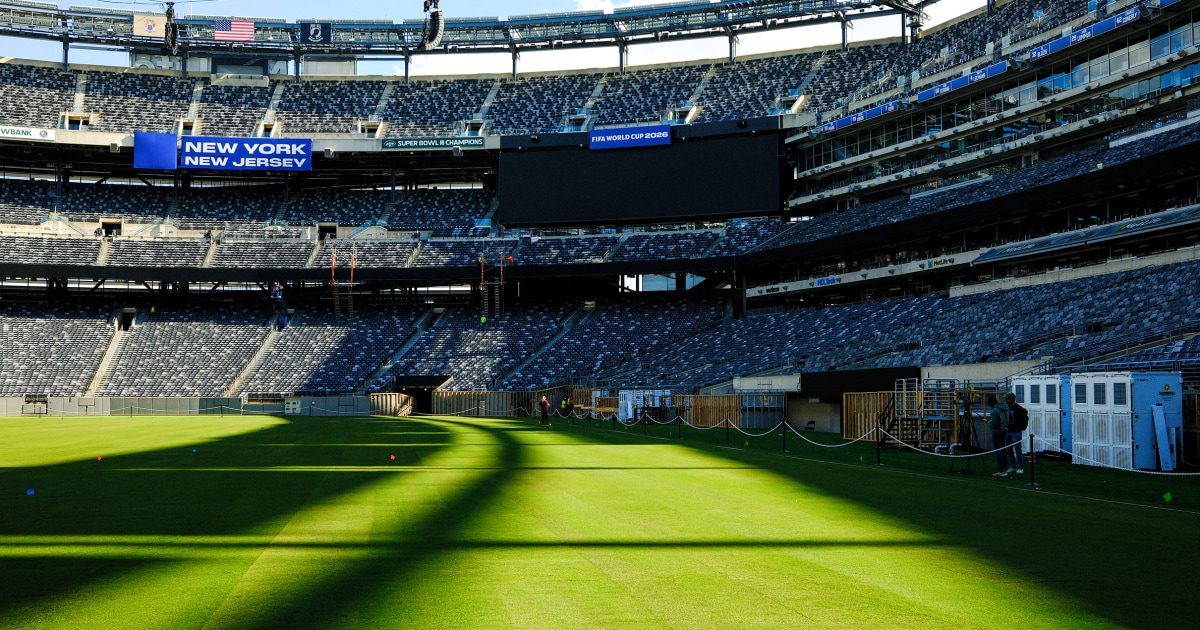

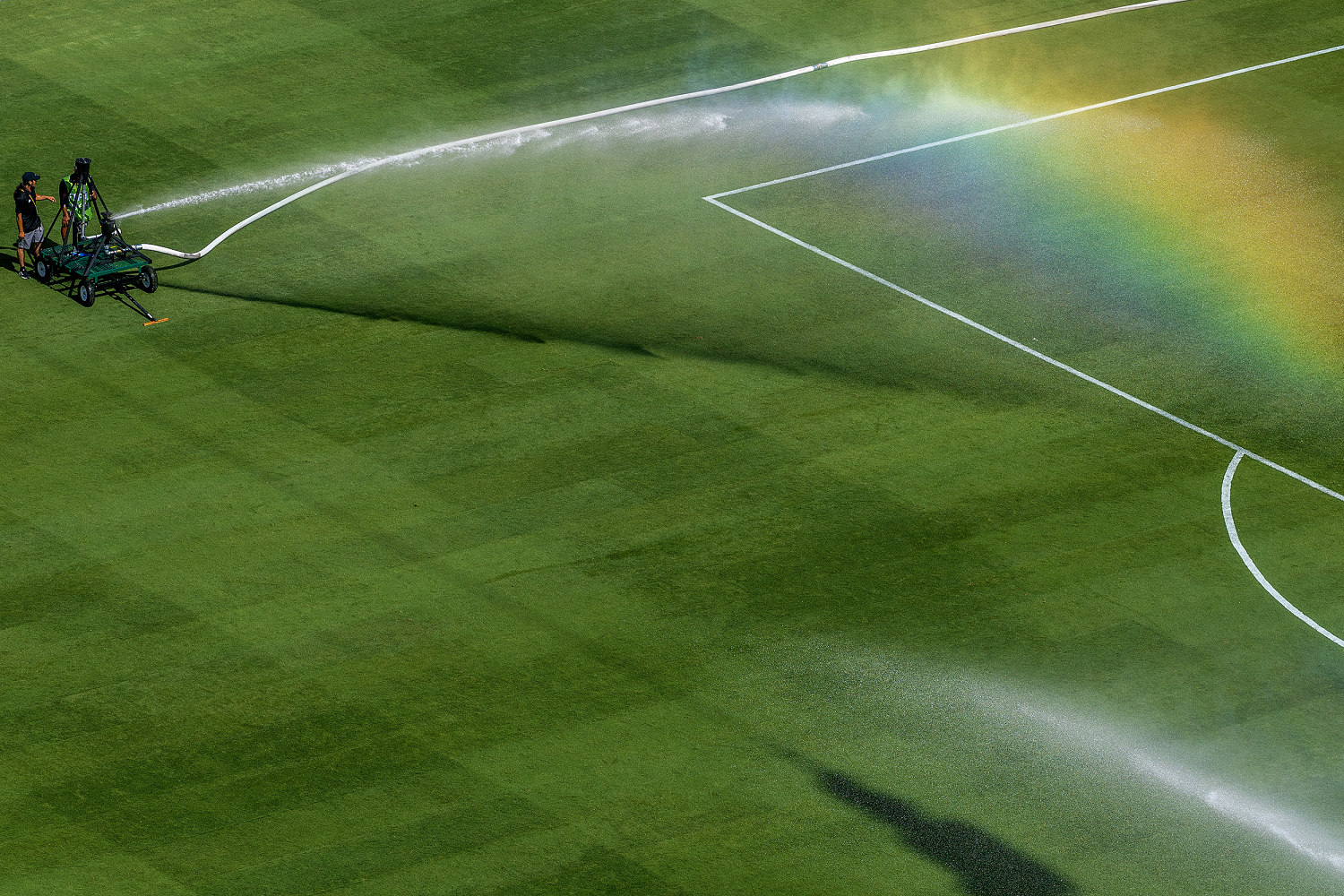
When the United States men’s national team takes the pitch for its first World Cup match, its players’ feet will land on newly installed grass at SoFi Stadium in Inglewood, California, typically the home of the NFL’s Los Angeles Rams and Los Angeles Chargers. Subscribe to read this story ad-free Get unlimited access to ad-free articles and exclusive content.That’s because FIFA required all 16 stadiums hosting World Cup matches across the U.S., Mexico and Canada to have playing surfaces that are mostly natural grass, with strict requirements to ensure ideal playing surfaces and the best competition possible.Follow along for live coverageYears of research and millions of dollars were poured into the fields for the World Cup, which included transforming several American stadiums from synthetic surfaces to natural grass in time for the world’s biggest sporting event. The ingenuity and commitment have especially caught the eye of many NFL players, the athletes who most often use those fields for one of the world’s most violent sports, who are wondering why their sport won’t do the same for them when they’ve been asking to play on grass for years. “It was a kind of sucky feeling,” New York Giants offensive lineman Jermaine Eluemunor said when asked about his reaction to learning that some NFL stadiums would be switching from turf to grass.Eluemunor plays his home games at New Jersey’s MetLife Stadium, which is one of the fields that is being converted to grass for the World Cup, including the final next month. MetLife’s surface has long been a source of annoyance for NFL players. “I’m going into year 10, and I can say wholeheartedly that grass feels way better than turf,” Eluemunor added. “With MetLife getting grass, obviously it’s cool for FIFA and the World Cup. It’s one of the biggest stages in the world but, at the same time, the NFL as a whole is one of the most profitable businesses in the world, and so you would think that us as players would have a say in the fields that we get to play on.”NFL players almost universally agree that grass is a better surface to play on, compared with synthetic turf. According to an NFL player union survey of more than 1,700 players, a whopping 92% said they preferred grass. Eluemunor, who plays arguably the most physical position in the game, says his knees, ankles and lower back all feel less sore after competing on grass, compared to feeling like “absolute crap” after a game he played on turf in New Orleans last season. The NFL, though, has been reluctant to pay up for grass fields, even as the league is approaching nearly $25 billion in yearly revenue, instead leaving the decision up to its individual teams’ discretion. The crew waters the grass during the FIFA Club World Cup 2025 semifinal match at MetLife Stadium in East Rutherford, N.J.Al Bello / Getty Images file“There’s a set of criteria and standards” that the NFL and the NFL Players Association, or NFLPA, “have jointly agreed upon that are tied to our collective bargaining agreement,” Nick Pappas, the NFL’s field director, said. “It would not be acceptable for any venue to provide a grass surface that doesn’t meet that compliance, so grass is not just the box to check, right? It’s quality of surface that is important to provide for the athlete. I lean towards, we need to continue to determine how to improve all of our surfaces, irrespective of surface type.” FIFA, researchers who worked on the new fields say, spared no expense in creating the surfaces for the World Cup, even though they’ll only be used on a temporary basis.Between the 16 host stadiums, 10 will feature a cool-season grass, which is a mixture of Kentucky bluegrass and perennial ryegrass. (That includes indoor stadiums such as SoFi.) The remaining six will utilize a warm-season grass, which consists of a hybrid Bermuda.The exact mixes emerged from roughly five years of FIFA-sponsored research by turfgrass experts at Michigan State University and the University of Tennessee. After teams of people came up with the right blends, the grass was grown at various sod farms across the three host countries. The sod was planted on plastic to encourage a lateral spread of roots, allowing the grass to be easily harvested and transferred. Once the grass was fully grown, it was cut by specialized equipment and transported to stadiums across the three countries via refrigerated trucks, then laid down on top of sand and drainage structures to create the new fields. All of it was paid for by FIFA. So could the NFL do something similar?“It would take quite a commitment,” said John Trey Rogers, a turfgrass professor at Michigan State who was part of the team that helped create the World Cup playing surfaces. Rogers added that it’s possible for the NFL and, with the right investment in sod, teams could account for concerts, events and bad weather, which are often reasons teams opt for synthetic surfaces. “The complexity doesn’t lend itself to be that simple to just turn to,” Pappas said when asked why the NFL can’t simply mandate natural grass at a league level similar to FIFA, pointing to climate, the physical style of play and multi-use venues. Pappas adds that the league works closely with its union on playing surfaces: “And the route we’re taking is done so with the NFLPA. Most people just don’t understand that all this work is being with the NFLPA. The Joint Surfaces Committee is not something that is unbeknownst to the executive director of the NFLPA, or anybody within the NFLPA.”The NFLPA, however, believes the World Cup provides proof of concept for the NFL. “The temporary installation of natural grass fields for the World Cup is a choice by certain NFL team owners to do for soccer players what they refuse to do for NFL players,” an NFLPA spokesperson said, adding that the World Cup proves technology is in place to make every stadium a natural grass one. “NFL players — who regularly compete on these fields, help fund these stadiums and whose work makes the league what it is today — deserve the same commitment to quality grass fields.”The spokesperson added that players felt like the grass installations at NFL stadiums with turf were a “slap in the face.”Pappas pushes back on proof-of-concept assertion, saying FIFA has only proven it could produce natural grass fields under certain climate conditions during an exclusive window in the summer, during which there will be no other events at host stadiums.“There’s no way to confidently and objectively state that those surfaces would absolutely meet the requirements for NFL,” Pappas said, cautioning against oversimplifying the issue. “Multi-use is a real aspect of our venues, so the ability to have a field and have it have more than one tenant, meaning more than just NFL use, makes it very challenging to have grass for a full season.”Pappas added that he believes no sports league vets their surfaces as strongly as the NFL: “We certainly don’t feel the need to have to publicize the financial commitment like other sporting leagues do.For now, a few NFL owners have already shown a commitment to natural grass, even when their stadiums routinely host other events.Miami Dolphins owner Stephen Ross bought 80 acres of land to create his own sod farm in nearby Palm Beach County, so the team could better control the quality of its field and change the surface as necessary. In October 2024, Taylor Swift played three consecutive shows at the Dolphins’ Hard Rock Stadium, one week before a Miami home game.The Las Vegas Raiders, who play their home games in the middle of the Mojave Desert, invested in a sliding grass field that can be moved in and out of Allegiant Stadium to accommodate concerts and other events. The NFL’s international expansion has also opened players’ eyes to what’s possible when it comes to playing surfaces. The league spent millions on a single game at Madrid’s Bernabéu Stadium in 2025 to make it football ready, taking advantage of its patented, retractable field that is stored underground to keep the grass in pristine condition.Eluemunor said the best field he’s played on in his career came in Germany in 2024, when the Giants played the Carolina Panthers at Allianz Arena, home of Bundesliga’s Bayern Munich. “It always comes back down to how your body feels and how you feel after a game,” Eluemunor sad. “FIFA is one of the biggest organizations in the world, but I truly believe that the NFL is one of the biggest organizations in the world too. Obviously, the upkeep would be expensive, but I also feel like it would be an expense that is well worth it to know that your players and the guys that you’re hiring are not only confident, but comfortable and mentally feel safe on the surface that they’re playing on.”