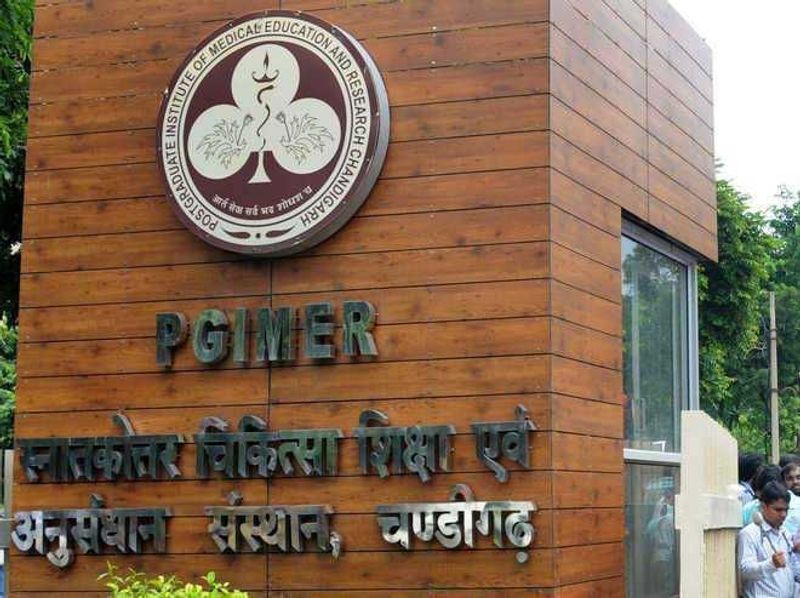

British cinematographer George Richmond — whose visual genius has illuminated some of Hollywood’s biggest blockbusters, and who came within a breath of death when his paraglider slammed into the Himachal mountains last week — is fighting back. Slowly. Painfully. But fighting.A health bulletin issued by Chandigarh PGIMER on Saturday evening confirmed that the 54-year-old is awake, conscious, responding to commands and able to interact and communicate with his wife, who has remained steadfastly at his bedside since he was airlifted to India’s premier public medical institution following a near-fatal paragliding accident in Kullu district on June 8.The bulletin, signed jointly by Prof Vijay Goni, Head of Orthopaedic Surgery; Dr Nidhi Panda, Head of Neuro-anaesthesia; and Prof Ashok Kumar, Medical Superintendent, PGIMER, however, left no room for premature optimism. Richmond currently has very limited movement in both arms and no movement in either leg — the grim neurological legacy of a catastrophic dual-level cervical spine fracture that rendered him quadriplegic at the time of the accident. His breathing muscles remain weak, with doctors warning that should his respiratory status deteriorate, he will be managed accordingly — clinical language that signals the continued spectre of mechanical ventilation. His oxygen saturation is holding at 96 per cent on nasal support. Blood pressure and heart rate are stable; kidney function is normal. His haemoglobin, however, remains low at 8.8 g/dL. Vigorous physiotherapy is ongoing round the clock.Even as the medical team holds its vigil, Richmond’s family on Saturday requested media to exercise sensitivity and observe doctor-patient confidentiality regarding the publication of his medical information. Expressing deep gratitude for the public outpouring of support and well-wishes, the family noted that Richmond has entered a critical phase of treatment and rehabilitation, and appealed for privacy to be respected during this period.THE ACCIDENT: A FLIGHT THAT TURNED FATALRichmond was part of a five-member group of experienced paragliders on a long-distance cross-country expedition from Bir Billing in Kangra district — among Asia’s premier paragliding launch sites — toward the high-altitude Deo Tibba region in Kullu. Somewhere over that rugged terrain on June 8, his glider went down. He crashed into the mountain.Fellow paragliders raised the alarm. A coordinated rescue operation involving local Himachal Pradesh authorities and the Indian Air Force was launched, evacuating Richmond from the crash site before an IAF helicopter airlifted him to Kullu for initial stabilisation. By the early hours of June 9, he had been shifted to the Advanced Trauma Centre at PGIMER Chandigarh.What the clinical and radiological assessment revealed was the full extent of the damage: a fracture of the C1 vertebra — the topmost bone of the spine, at the base of the skull — combined with a fracture-dislocation at the C5-C6 level, resulting in quadriplegia. The proximity of these injuries to the spinal segments controlling diaphragmatic function placed his very ability to breathe in immediate jeopardy. Resuscitation was initiated on arrival under Advanced Trauma Life Support protocols. He was stabilised and shifted to High Dependency Unit.THE SURGERY: WHERE PGI ROSE TO THE OCCASIONOver the next four days, the PGIMER multidisciplinary team — spanning orthopaedic spine surgery, neurosurgery, neuro-anaesthesiology, critical care, rehabilitation and paramedical support — worked to optimise Richmond for definitive surgery. That surgery was performed on Thursday, June 12.The key surgical achievement, as described by Prof Goni, was a fluoroscopy-guided closed reduction of the cervical fracture-dislocation — a technically demanding manoeuvre that successfully restored spinal alignment while eliminating the need for a combined anterior and posterior surgical approach, significantly reducing operative risk and morbidity. This was followed by anterior cervical decompression to relieve neural compression, reconstruction using an inter-body cage packed with bone graft substitute, and stabilisation with a cervical plate and screws.Speaking to The Tribune, Prof Vivek Lal, Director, PGIMER, placed the case in its larger institutional context. “At PGIMER, our foremost commitment is to provide timely, compassionate and world-class medical care to every patient who comes to us — irrespective of nationality, background or circumstance. The successful management of Richmond’s injury reflects the strength of our integrated trauma care ecosystem, where specialists from multiple disciplines work seamlessly to deliver rapid assessment, stabilisation and definitive treatment. Such complex spinal injuries demand not only advanced surgical expertise but meticulous planning, cutting-edge infrastructure and coordinated teamwork. We remain committed to supporting Richmond through every stage of his recovery and rehabilitation,” he said.ROYAL SHELTER, LONG ROADSources confirmed to The Tribune that Richmond was being hosted as a personal guest at Patiala Mahal — the storied palatial seat of former Punjab Chief Minister Capt Amarinder Singh — through his close personal friendship with the former CM’s son, Raninder Singh alias Tikku, titular heir to the Phulkian dynasty of Patiala and former president of National Rifle Association of India.Recovery from a dual-level cervical fracture with quadriplegia is measured not in days but in months, and often years. Whether and to what degree limb function returns depends critically on the extent of spinal cord damage — a picture that will become clearer only as post-operative neurological monitoring progresses through the weeks ahead.THE MAN BEHIND THE LENSGeorge Richmond BSC is among the most accomplished British cinematographers of his generation — the son of veteran cinematographer Anthony B Richmond, and a member of the British Society of Cinematographers. His career spans landmark Hollywood productions including Kingsman: The Secret Service, Tomb Raider, Rocketman, Fantastic Beasts: The Secrets of Dumbledore, Free Guy, Argylle and Deadpool & Wolverine. His most recent credit is Now You See Me: Now You Don’t (2025).For now, the man who gave the world some of its most breath-taking frames lies still in a Chandigarh hospital room — battered, but breathing, and beginning the hardest fight of his life.