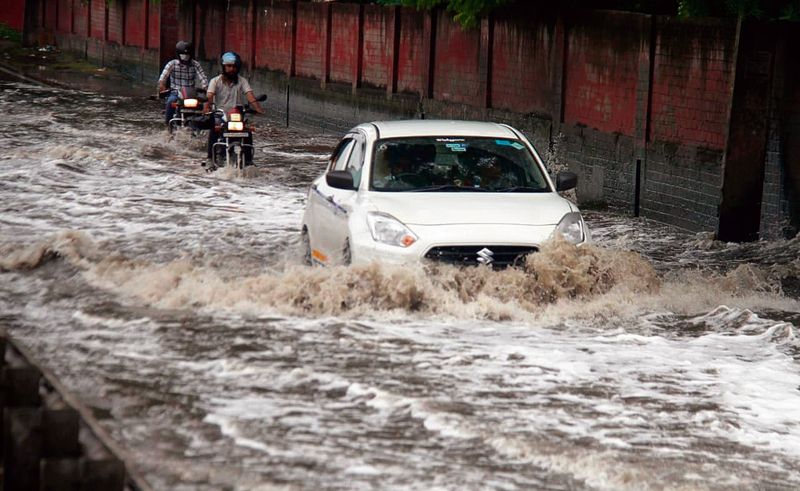

The monsoon is expected to hit northwest India on June 20 this year, four to six days ahead of its normal onset period of June 24-26. Though it is similar to last year, the monsoon hadentered the region on June 27 in 2024, on June 24 in 2023 and on June 29 in 2022. In 2021, the onset date was June 13.Over the past 26 years since the turn of the century, the monsoon has entered the region before June 20 only on five occasions, the earliest being June 6, 2000. The other years were 2021, 2013, 2008 and 2004.A map showing the progress of the monsoon released by the India Meteorological Department on May 16 forecasts the monsoon touching the easternmost fringes of Himachal Pradesh and northeastern Uttarakhand on June 20.The monsoon is expected to cover most parts of these two states by June 25 and advance further over the eastern halves of Punjab and Haryana by June 30. The entire region is expected to be covered by July 5 and the remaining stretches of western Rajasthan by July 8.In 2025, the entire state of Himachal Pradesh was covered by June 24. The monsoon had advanced through parts of Punjab on June 22 and covered the entire state on June 26, while in Haryana it advanced through some parts on June 24 and covered the entire state on June 29.The southwest monsoon has already entered the southern parts of the Arabian Sea and Bay of Bengal and touched southern Sri Lanka. It is expected to reach Kerala on May 26, ahead of its normal onset date of June 1.The IMD has predicted that the 2026 monsoon over the country as a whole is most likely to be below normal, at 92 per cent of the long period average (LPA), with a model error of plus or minus 5 per cent. The LPA of the seasonal rainfall total, based on the period from 1971 to 2020, is 870 mm.On the other hand, there is a possibility of the monsoon picking up towards the end of the season due to favourable conditions developing over the Indian Ocean, which could counter the adverse impact of El Nino, the above-normal surface warming of the Pacific Ocean that weakens the monsoon.In 2025, the monsoon was categorised as normal over the country as a whole, accounting for 108 per cent of the LPA, but it was significantly above normal in northwest India, resulting in heavy floods. Rainfall was surplus by 41 per cent in Punjab, 39 per cent in Himachal Pradesh and 33 per cent in Haryana.Spread over June to September, the monsoon is crucial for the economy because it provides over 70 per cent of the country’s annual rainfall, directly supporting agriculture and rural income, recharging water resources, generating hydroelectric power and driving economic activity. Good monsoons ensure economic stability and help maintain the country’s vast biodiversity.Government data show that about 64 per cent of Indians depend on agriculture, which mainly relies on the southwest monsoon. Only 55 per cent of India’s net sown area is covered by irrigation, while the remaining depends on rain-fed systems.Amid the possibility of a below-normal monsoon, the current availability of water in most major dams across the country remains encouraging. According to the Central Water Commission, the combined storage in 166 reservoirs is 24 per cent above normal for this time of the year.In the northern region, storage is 43 per cent above normal at the three dams in Himachal Pradesh — Bhakra, Pong and Kol — and 52 per cent above normal at Punjab’s lone Thein Dam. Collectively, they are currently holding 5.893 billion cubic metres (BCM) of water against their total capacity of 14.819 BCM.