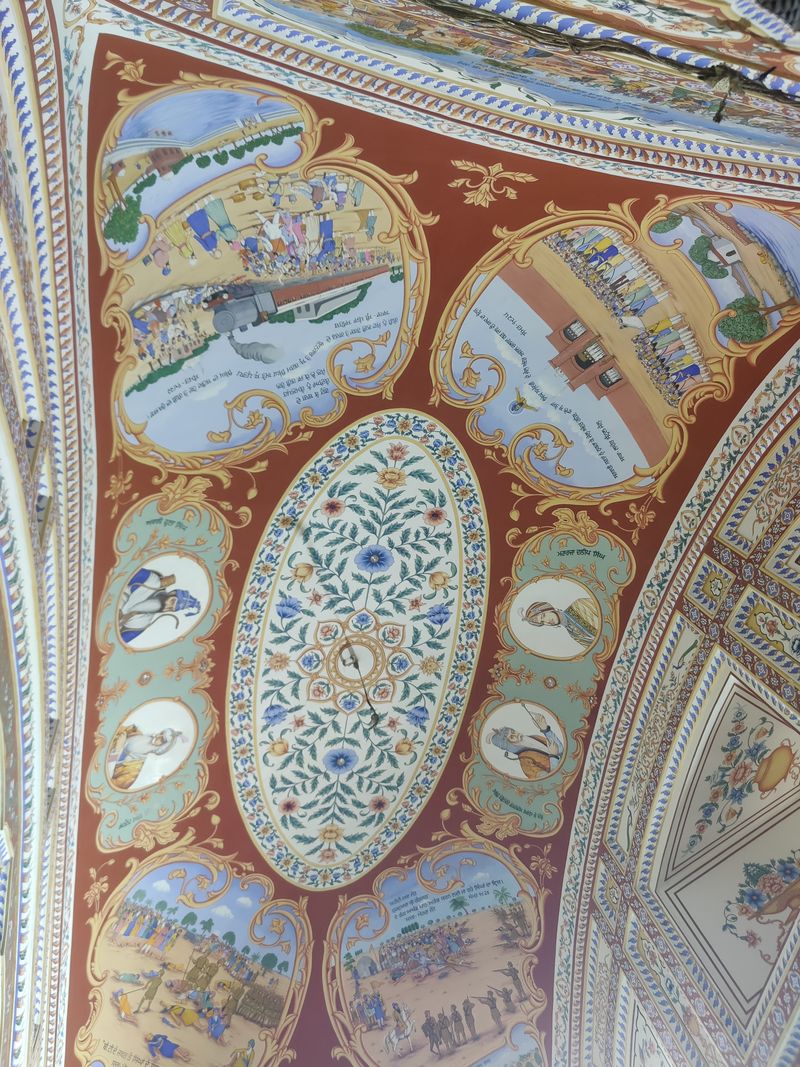

Beyond the white marble of historic gurdwaras lies the intricate art of naqqashi. For over two centuries, the magnificent floral drawings, mirror inlays, and gold-leaf embossed manawat work have defined the interior splendour. While many gurdwara buildings have been modernised or rebuilt over time, the last surviving lineage of master artists are fighting, along with conservationists, to preserve the authentic techniques.Efforts are now being made to both conserve and restore the naqqashi art form, including at Golden Temple in Amritsar, Gurdwara Guru Tegh Bahadur at Baba Bakala, and Gurdwara Baba Bir Singh at Naurangabad (Tarn Taran).Amritsar’s association with naqqashi goes back more than 200 years. The story begins in 1805 when Maharaja Ranjit Singh invited skilled craftsmen from Chiniot (now in Pakistan) for the interior decoration and beautification of Harmandir Sahib (Golden Temple). Chiniot was famous for its master artisans, and the Maharaja wanted only the finest of them.The project was overseen by Giani Sant Singh, who was originally from Chiniot. He brought some of the best naqqash artists to Amritsar. Accommodation was arranged near Lahori Gate, which later came to be known as ‘Chiniotian Di Haveli’. These craftsmen decorated the first-floor ceiling of Golden Temple with intricate naqqashi and mohra-kashi, a form of curved mirror work.Led by master artisan Badarmuhiudin, these Muslim craftsmen continued working in Amritsar and nearby historic gurdwaras for nearly a century, sparking a cultural exchange that gave rise to a unique Sikh school of naqqashi.Own style comes into beingArtist Harpreet Singh Naaz from Sri Guru Granth Sahib World University, Fatehgarh Sahib, explains that the word ‘naqqashi’ comes from the Arabic word ‘naqsh’, meaning to draw or create an image. From ‘naqsh’ came ‘naqqash’, meaning an artist or illustrator, and the artwork created by such artists came to be known as ‘naqqashi’. “The term itself reflects this art form’s Arabic-Persian roots and its development during the Mughal period. During the Sikh empire, a distinct school of naqqashi emerged, clearly different from the decorative traditions seen in Mughal monuments,” says Naaz.Renowned painter and art historian KC Aryan has written that the mirror work and decorative interiors found in Sikh shrines during Maharaja Ranjit Singh’s reign were the result of collaboration between artists from Jodhpur and Pahari painters employed by the Sikh court.According to historian Dr Madanjit Kaur, local Sikh artists entered the profession during the early 20th century, leading to the rise of a Sikh school of naqqashi. “Some of the earliest examples of this Sikh style survive in the murals of Baba Atal Rai Tower in Amritsar,” she says.One of the most accomplished early Sikh naqqash artists was Kehar Singh. He learned his craft while working at the Lahore Fort during Maharaja Ranjit Singh’s reign and later contributed to the decoration of Golden Temple. Many later Sikh naqqash artists were trained by him or belonged to his artistic lineage.Kehar Singh, originally named Sher Singh, served as a court painter to the Maharaja around 1830. Since the ruler’s son was also named Sher Singh, the artist’s name was changed to Kehar Singh. He continued working during the British period and remained active until the 1860s. In 1864, he organised an exhibition of paintings in Lahore with his nephews Bishan Singh and Kishan Singh. The exhibition is considered one of the earliest such art events held in Punjab.Amritsar’s Gali NaqqashanNaqqashi became so widespread in Amritsar that an entire street near the southeastern side of Golden Temple became known as Gali Naqqashan (street of the naqqash artists). Many well-known artists lived and worked there, including Jawahar Singh Naqqash, Nihal Singh Naqqash, Amir Singh Naqqash, and Ganesha Singh Naqqash.Hukam Singh Naqqash, Arur Singh Naqqash, Mehtab Singh (who initiated work at Baba Atal), Atma Singh Naqqash, Harnam Singh and Bhai Gyan Singh Naqqash were the other prominent artists from the city.According to KC Aryan, during the British era, European artistic influences also began appearing in some works. Examples can still be seen in the murals and decorative paintings inside Baba Atal Rai Tower.The late artist Harbhajan Singh Naqqash doing naqqashi work.Today, Arwinder Singh Naqqash, grandson of renowned artist Harbhajan Singh, represents the last surviving Sikh family actively practising traditional naqqashi. According to him, his family’s artistic heritage comes from two major sources: the Chiniot craftsmen and the artistic lineage of Kehar Singh. Through generations of masters, including Jawala Singh, Mehtab Singh and Atma Singh Naqqash, the tradition was passed down to his grandfather, the late Harbhajan Singh, and then to him.Arwinder Singh, grandson of late Harbhajan Singh Naqqash, is carrying forward the legacy.Arwinder says people often mistakenly call naqqashi ‘gach work’. Gach is only the material used, the art itself is naqqashi. The naqqashi work at the ceilings of Golden Temple includes raised and carved floral decorations known as ‘manawat’. Artists apply layers of plaster, create impressions using moulds, carve intricate floral designs, and then cover them with gold leaf. Decorative mirror inlay, known as jaratkari or jadau work, also comes under naqqashi.Arwinder believes that artists from outside Punjab often do not follow the traditional Sikh style and instead bring influences from their own regions. “We are committed to preserving the original style developed by our elders,” he adds.“A major challenge is the disappearance of traditional pigments. Modern stone colours are available, but they do not produce the same results as the natural pigments. Although traditional methods of preparing natural colours survive, they are time-consuming and expensive,” rues Arwinder.Dr Balbinder Kumar of Himachal Pradesh University in Shimla, who is involved in restoration work at the Golden Temple, explains that traditional art survived through family-based artistic schools known as gharanas. These families received patronage from Mughal rulers, hill states, Sikh rulers and princely kingdoms. “Under Maharaja Ranjit Singh, artists from different backgrounds — Mughal, Pahari and Rajput — worked together without discrimination. This cultural exchange helped create a unique Sikh artistic identity,” says Dr Kumar.A painting of Guru Gobind Singh commissioned by the Kangra rulers inspired Maharaja Ranjit Singh to invite artists from the hills during the regime of Raja Sansar Chand Katoch. They painted a replica of the painting of the Guru riding a horse and the Panj Pyaras, and a Sikh with him, at the Golden Temple, adds Dr Kumar, who is at present involved in preservation of that painting. He argues that Sikh artistic traditions deserve greater attention in art education. “While universities in Himachal teach Sikh, Mughal and Pahari styles together, Punjab lacks sufficient academic focus on Sikh art.”According to art historian Subhash Parihar, naqqashi originally developed within Islamic decorative traditions, where human figures were often avoided and floral patterns became the main form of ornamentation. “Punjab once possessed extraordinary artistic diversity in its gurdwaras and historic buildings. Much of this heritage has been lost through kar sewa, while it is still surviving in Pakistan,” he says.Parihar argues that both government agencies and religious institutions have not done enough to protect Punjab’s artistic heritage. There is hope though. At Baba Bakala, decorative work carried out with cement during the early 2000s is now being replaced with traditional lime-based techniques by conservation groups. Restoration efforts also involve artists from Rajasthan and conservation experts such as Dr Kumar.Arwinder Singh says he is open to teaching and training anyone interested in naqqashi, “but generally, no one shows interest”. He acknowledges that mastering the craft takes years of dedication. “Two individuals joined me to learn the art, but both left soon due to the demanding nature of the work,” he says.Arwinder has a team of five assistants, who prepare the base surfaces for naqqashi. The materials used in the artwork, particularly traditional stone colours, are sourced from a supplier in Amritsar’s walled city. At present, he is engaged in a project at Gurdwara Burj Sahib in Dhariwal, Gurdaspur, where work has been commissioned by Kar Sewa Guru Ke Bagh.Such organisations, he adds, are among the few patrons who continue to value and support naqqashi. “Otherwise, it’s a struggle, but then, legacy work always is, and we are up to it.”Documenting the traditionAmong the greatest artists of naqqashi was Gyan Singh Naqqash (1883-1953). He was an exponent of the Kangra School. Besides creating remarkable works of art, he also documented the craft for future generations. He authored books such as ‘Naqqashi Darpan’ and ‘Naqqashi Art Sikhya’ topreserve the knowledge and techniques of thetradition. His craftsmanship was so detailed that even the natural veins of flower petals appeared in his paintings and decorative designs. Gyan Singh developed outstanding frames of mohra-kashi and naqqashi, many of which were later preserved by his son, GS Sohan Singh, in a publication titled ‘Gyan Chitravali’. He strongly opposed the removal of traditional decorative work and its replacement with plain white marble.