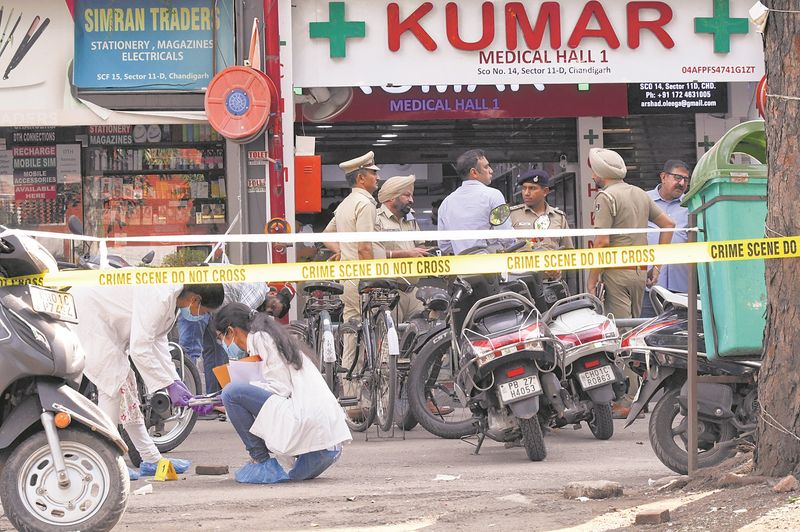

For decades, Chandigarh’s reputation as India’s City Beautiful rested not just on its Le Corbusier boulevards and manicured sectors, but also on a sense of safety that most Indian cities can only envy. That identity is now under pressure.In barely three months in 2026, the city has witnessed a daylight execution, a grenade blast outside a political party office, a mob killing, a Pakistan-linked drug network bust, and the unravelling of a multi-module gang operation directed from abroad. Each case has been cracked but the cumulative picture they paint raises questions that go well beyond any single arrest.What has happenedThe pace of serious criminal incidents in Chandigarh in 2026 has been striking. On April 1, a hand grenade was lobbed outside the Punjab BJP office in Sector 37 — an act later traced to a Pakistan’s ISI-backed module operating under the directions of foreign-based handlers located in Portugal and Germany, with all seven accused, including the two main perpetrators who had initially absconded, eventually arrested. On March 18, property dealer Charanpreet Singh, alias Chini, was shot dead in a pre-planned ambush at a Sector 9 gym parking lot by contract killers hired by a Sector 35 woman, Amreen, who paid to have him eliminated over an alleged property dispute through the Lucky Patial gang.On June 13 came the killing that galvanised public attention most acutely: pharmacy cashier Janki Das, 45, was shot dead at Shri Kumar Medical Hall, Sector 11, in broad daylight, thirteen rounds fired from barely a foot and a half away, in a market adjoining PGIMER with customers present. On June 14, a 31-year-old man, Tota Ram, was beaten to death by a mob of 10 to 15 persons armed with swords, knives and sticks at Mauli Jagran. And on June 18, the NCB and Chandigarh Police together busted a Pakistan-linked methamphetamine trafficking module operating from Kharar, recovering 793 grams of methamphetamine — approximately sixteen times the notified commercial quantity — along with an advocate among those arrested.Who is behind itThe incidents are not random. They reflect at least three distinct criminal ecosystems converging on Chandigarh simultaneously.The first is the overseas gang network. Organised criminal groups associated with Lawrence Bishnoi and rival networks have expanded their activities, amplified through social media. In the Sector 11 case, Canada-based gangster Goldy Dhillon — identified by the NIA as a close associate and co-conspirator of designated terrorist Satinderjit Singh, alias Goldy Brar — directed two modules of armed operatives from Jammu into Chandigarh. The first executed the Janki Das killing. The second was intercepted before it could strike, found carrying a foreign-made C47 9mm pistol, a .32 bore pistol and nine live cartridges. All six operatives had travelled together from Jammu on Dhillon’s instructions, communicating through encrypted messaging apps throughout.The second is the contract-killing-for-hire market, where personal disputes — property frauds, business rivalries, personal enmities — are now being resolved by commissioning professional shooters through gang intermediaries. The Charanpreet Singh killing, where a local woman paid a substantial sum to the Lucky Patial gang, which then managed the full logistics chain — weapons, motorcycle, funds and shooters — to execute the contract, is the starkest illustration.The third is cross-border drug trafficking, with Pakistan-linked networks operating through international handlers, distributing high-purity methamphetamine across northern India through Chandigarh and the tricity as transit and distribution points. The profits from this trade are widely believed by investigators to fund gang operations, weapons procurement and the recruitment of fresh operatives.Why ChandigarhThe city’s location at the tri-junction of Punjab, Haryana and Himachal Pradesh makes coordination among different agencies in the three states difficult. Its economic prosperity and concentration of wealth make it an attractive extortion target. Its relative compactness — shooters can strike and be across state lines within hours, as the Sector 11 case demonstrated, with the accused fleeing to Delhi by bus and onward to Jammu by train before being nabbed — means the city is simultaneously easy to enter and easy to exit. Gangsters sitting abroad are shamelessly exploiting young, impressionable men, turning personal grievances into murder assignments through social media, with one case in the recent past involving a Class 12 student, a minor, intercepted while on his way to execute a murder on gang instructions received over Instagram and Telegram within just two months of being radicalised.Data behind the trendThe anecdotal evidence is mirrored in official statistics. The NCRB’s Crime in India 2023 report reveals that Chandigarh recorded 385 violent crime cases, giving it a crime rate of 31.2 per lakh population — just above the national average of 31.1, reflecting a steep rise that included 19 murders, 1,892 theft cases and 14 extortion or blackmail cases in that year alone. While Chandigarh remains far safer than Delhi in absolute terms, its per-capita crime trajectory is moving in the wrong direction for a Union Territory that prides itself on governance quality.What the police have doneThe record on solving crimes, it must be said, is strong. All recent shootouts in the city and the grenade blast outside the BJP office have been solved, with arrests made in every case. The Sector 11 murder was cracked within four days, the Mauli Jagran mob killing within 48 hours, and the second Goldy Dhillon module was intercepted before it could even act. This is not the work of a complacent force.But as citizens increasingly judge policing by prevention, not merely by solving crimes after they occur, the pattern raises harder questions. The Sector 11 shooters escaped past a naka metres from the crime scene. The Mauli Jagran mob attacked in a residential complex. The drug network operated from a Kharar flat under the radar until the NCB intervened. Detection after the fact, however swift, does not undo the harm.What next, what must be doneSeveral structural steps are essential if the trend is to be reversed rather than merely managed case by case.Intelligence-led prevention rather than reactive policing must become the operating model. The interception of the second Goldy Dhillon module — caught before they could strike — shows what is possible when intelligence pipelines are working. That model needs to be the norm, not the exception.Stronger inter-state and inter-agency coordination is non-negotiable. Networks that cross four states in a day, communicate through encrypted apps and take orders from handlers in Canada, Portugal, Germany and Pakistan cannot be countered by jurisdiction-bound policing alone. The financial backbone of gang networks must be targeted alongside their foot soldiers. Drug profits, extortion proceeds and hawala flows sustain the recruitment and weapons pipelines that feed every shooting in the city. Disrupting money trails is the only way to raise the real cost of operating in Chandigarh for networks directing operations from abroad.Social media radicalisation of young men from economically vulnerable backgrounds — particularly in Jammu’s Samba and Rajouri districts, as this cluster of cases starkly reveals — needs coordinated attention from state governments and central agencies beyond the mandate of any single police force.And the city’s CCTV network, naka infrastructure and real-time surveillance must be upgraded to match the mobility and sophistication of the networks now targeting it. A stolen motorcycle with a Punjab registration number should not take four days to trace. Armed men should not be able to lodge at a city hotel after a daylight killing.What it means for residentsChandigarh has seen a genuine and measurable increase in shootings, extortion activity and gang-linked crime. That worry among residents is legitimate and should not be dismissed. At the same time, the city remains far safer than most major Indian cities. What is changing is that Chandigarh is no longer insulated from the organised crime, synthetic drug trafficking and social volatility that is reshaping urban security across North India.The arrests of recent weeks are real and significant. But as DGP Dr Sagar Preet Hooda has himself acknowledged, the bigger test is not solving the last crime — it is preventing the next one. That test is still very much open.Graphics panel: 5 things you need to knowThree criminal ecosystems, one city: Overseas gang networks, a contract-killing-for-hire market, and Pakistan-linked drug trafficking have converged on Chandigarh simultaneously in 2026 — each case connected to the others through shared operatives, funding and encrypted command chains.All cases solved, but prevention remains the gap: Every major incident — the BJP office grenade blast, the Sector 9 gym contract killing, the Sector 11 pharmacy murder, the Mauli Jagran mob killing — has been cracked with arrests. Yet in each case, the crime was executed before the police could intervene.Jammu pipeline exposed: Six of the Sector 11-linked gang operatives — all from Samba and Rajouri districts of Jammu — were recruited, armed and directed remotely by Canada-based Goldy Dhillon and deployed in two separate modules into Chandigarh, revealing a structured cross-border recruitment corridor.Crime rate crosses national average: NCRB 2023 data shows Chandigarh’s violent crime rate at 31.2 per lakh population — above the national average of 31.1 — with 19 murders, 1,892 theft cases and 14 extortion cases recorded in that year, signalling a trend that predates 2026’s spate of incidents.The bigger test: Solving crimes fast is necessary but not sufficient. Upgrading CCTV networks, enforcing real-time naka activation, targeting gang financing and disrupting social media radicalisation pipelines are the structural interventions that will determine whether Chandigarh bends the crime curve — or merely keeps pace with it.