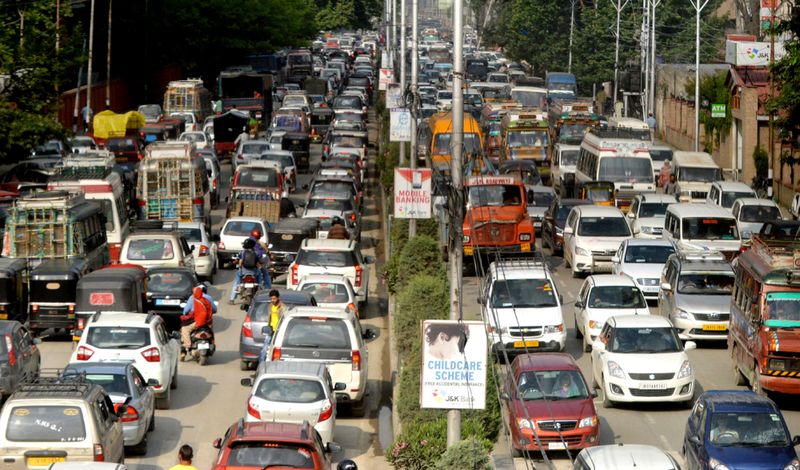

Haryana is all set to replace old 92,000 trucks and 16,000 buses in the National Capital Region (NCR) that meet BS-IV or earlier emission standards, while announcing an exemption from Motor Vehicle Tax on the purchase of vehicles meeting BS-VI or stricter emission standards, or electric vehicles (EVs) or CNG-run vehicles.The aim is to reduce vehicular pollution and improve air quality in the NCR.Additional Chief Secretary, Transport Department, Haryana, Dr. Raja Sekhar Vundru, issued a notification on June 24, exempting 100 percent Motor Vehicle (MV) Tax on the purchase of new BS-VI or stricter norms, electric vehicles or CNG trucks and buses.Also, a 50 percent Motor Vehicle (MV) Tax exemption will be given on the purchase of such used trucks and buses, purchased and registered in the NCR districts of the state.The exemption shall be valid for a period of 10 years from the date of first registration of such trucks and buses, the notification said.Earlier, the Haryana cabinet approved the exemptions in its meeting on June 22. These exemptions are part of the Center’s scheme, approved by the Union cabinet on June 3.Eligibility criteria for exemptionThe scheme beneficiary must own a truck or bus registered in the NCR districts of Haryana that is BS-IV or earlier-emission-norm-compliant. There are 14 districts of Haryana in the NCR.The BS-III or older trucks and buses must be scrapped strictly at a Registered Vehicle Scrapping Facility (RVSF) functional in the state. However, the beneficiaries can scrap BS-IV trucks and buses at an RVSF or can sell outside the NCR in a non-NCAP (National Clean Air Program) city or area.The beneficiaries must purchase and register new or used replacement trucks and buses (BS-VI or stricter norms/EV/CNG) within the state’s NCR districts.The state government has also exempted the outstanding liability, pending for more than one year, in respect of old BS-IV or prior-emission-norms-compliant trucks and buses participating in the scheme.Why are trucks and buses targeted?The Energy and Resources Institute (TERI)’s August 2018 report noted that the transport sector contributes significantly to ambient air pollution in Delhi-NCR, accounting for 14% of PM2.5, 40% of carbon monoxide (CO), and 63% of nitrogen oxides (NOx) emissions.It is estimated that a single pre-BS heavy-duty vehicle emits as much as 14 BS-VI compliant vehicles. Even a BS-IV vehicle emits 2.7 times more than a BS-VI counterpart, according to a release from the Press Information Bureau on June 3. So, the newer fleet is expected to substantially reduce vehicular pollution.National Green Tribunal (NGT), in its order dated April 7, 2015, directed that diesel vehicles older than 10 years and petrol vehicles older than 15 years shall not be permitted to ply on the roads of Delhi NCR. The Supreme Court, in its order dated October 29, 2018, upheld the NGT’s directions.Further, in Container Corporation of India Ltd. vs. Ajay Khera, the Supreme Court, in its judgment dated January 11, 2024, directed the Union Government to formulate a policy to phase out heavy-duty diesel vehicles and replace them with BS VI vehicles.However, the Supreme Court, in its order dated August 12, 2025, directed that no coercive steps be taken against the owners of vehicles that are 10 years old (for diesel vehicles) and 15 years old (for petrol vehicles). However, the order was modified on December 17, 2025, to allow such exemption only to the owner of the vehicles of BS-IV and later emission norms.Expected gain for HaryanaAs per the minutes of the Expenditure Finance Committee (EFC) meeting of the Ministry of Finance, dated April 30, Haryana will lose Rs 935.7 crore in tax concessions but gain Rs 1,999.6 crore in State Goods and Services Tax (SGST) revenue from the sale of new vehicles. So, the net gain expected for the state is Rs 1,063.9 crore.Centre’s schemeUnder the scheme of replacement of old trucks and buses, the Centre will provide an interest subvention of 5% on loans to buy new vehicles and monthly fuel vouchers of up to Rs 4,800 (depending on the vehicle category) for five years for diesel/CNG vehicles or a one-time benefit for EVs (ranging from Rs 64,000 to Rs 2,56,000 depending on vehicle category).Besides, there will be an 8% discount from manufacturers on the ex-showroom price of a new vehicle. Vehicle owners who scrap their old vehicles but do not wish to purchase a replacement may instead trade their Certificates of Deposit (CoDs).With a total financial outlay of Rs. 9,585 crore, the scheme will be funded through the National Capital Region Planning Board (NCRPB) under the Ministry of Housing and Urban Affairs (MoHUA).It will be implemented by the Ministry of Road Transport and Highways (MoRTH) and the Ministry of Petroleum and Natural Gas (MoPNG). The target is to replace 1.91 lakh old trucks and 16,329 old buses in Delhi-NCR.