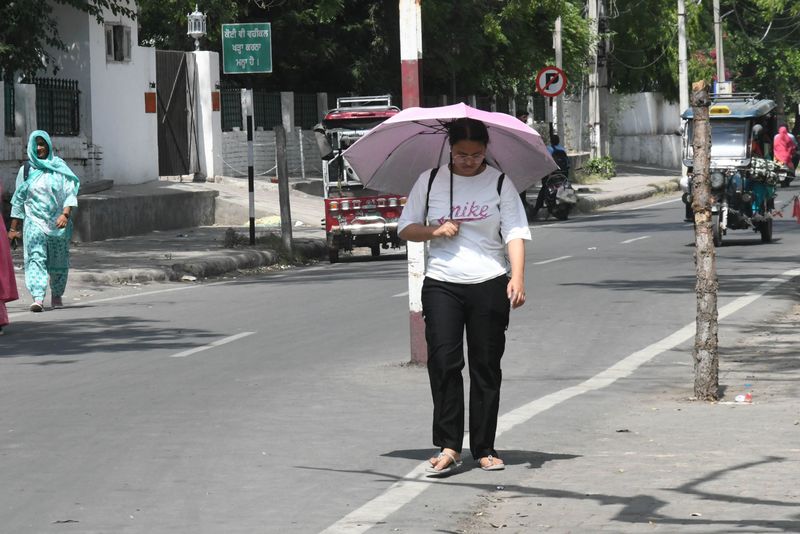

The southwest monsoon continues to remain elusive for Chandigarh, Punjab and Haryana even as another weather warning failed to produce any significant impact in the Tricity, reinforcing a pattern that has dominated the region’s weather over the past fortnight.The India Meteorological Department’s (IMD) yellow alert for thunderstorms, lightning and gusty winds on Thursday largely fizzled out across Chandigarh, Mohali and Panchkula. Apart from intermittent cloud cover, there was little weather activity in the region, with no measurable rainfall recorded at Chandigarh observatory during the 24-hour period ending Friday morning. The city received neither the thunderstorms nor the scattered showers forecast under the warning.The lack of meaningful rainfall comes amid a prolonged wait for the southwest monsoon, whose advance into northwest India has slowed despite making progress in several other parts of the country. Weather experts maintain that Chandigarh, Punjab and Haryana are still awaiting the sustained moisture influx required for monsoon onset.According to the latest IMD bulletin, Chandigarh recorded a maximum temperature of 38.5°C, a fall of 1.3 degrees Celsius from the previous day, though it remained 2.2 degrees above normal. The minimum temperature settled at 26.2°C, down marginally by 0.4 degree Celsius but still close to seasonal levels. No rainfall was recorded during the previous 24 hours, while the city’s cumulative seasonal rainfall since June 1 remained significantly deficient at 65.9 per cent below normal.Mohali, too, witnessed a slight moderation in daytime temperatures. The maximum temperature dipped by 0.7 degree Celsius to 37.3°C, while the minimum temperature remained steady at 26.7°C. Despite the fall, weather conditions remained warm and humid throughout the day.The broader regional picture reflected a cooling trend. Punjab’s average maximum temperature fell by 2.7 degrees Celsius, though it remained near normal. The state’s highest maximum temperature was 40.1°C at Faridkot, while the lowest minimum temperature was 22.1°C at Thein Dam in Pathankot district. Average minimum temperatures also declined by 1.5 degrees Celsius and remained near normal.Despite Thursday’s underwhelming outcome, the IMD has extended the yellow alert till Saturday, warning of thunderstorms, lightning and gusty winds of 40-50 kmph at isolated places across Punjab, Haryana and Chandigarh. Scattered showers are also likely at isolated locations during this period.However, weather models indicate that rainfall activity will remain localised rather than widespread, a trend that has characterised much of the current pre-monsoon phase.The forecast offers a brief break thereafter. No weather warning or alert has been issued for Jattvibeday, with predominantly dry weather expected across the region. Yet the respite is likely to be short-lived as yellow-alert conditions are set to return from Monday through Wednesday, signalling another round of isolated thunderstorm activity and scattered showers.For Chandigarh, Mohali and Panchkula, the IMD has forecast partly cloudy skies through the coming week, with isolated spells of rain possible but no indication of any widespread rainfall event. Daytime temperatures are expected to remain in the 37-38°C range, while minimum temperatures are likely to hover between 26°C and 27°C, ensuring warm and humid nights.A senior IMD meteorologist said the region remains in a transitional phase between pre-monsoon weather and the eventual onset of the southwest monsoon.“The atmospheric conditions continue to support localised thunderstorm development, which is why alerts are being issued. However, the absence of a strong synoptic-scale weather system means rainfall distribution remains highly uneven. While isolated showers are likely over the next several days, widespread monsoon-type rainfall is still awaited. Until the monsoon advances into northwest India, temperatures will remain close to normal and humidity levels will stay elevated,” the meteorologist said.For residents of Chandigarh, Mohali and Panchkula, the forecast points to more of the same: warm afternoons, humid nights, passing clouds and occasional chances of rain, while the wait for the season’s first sustained monsoon spell continues.