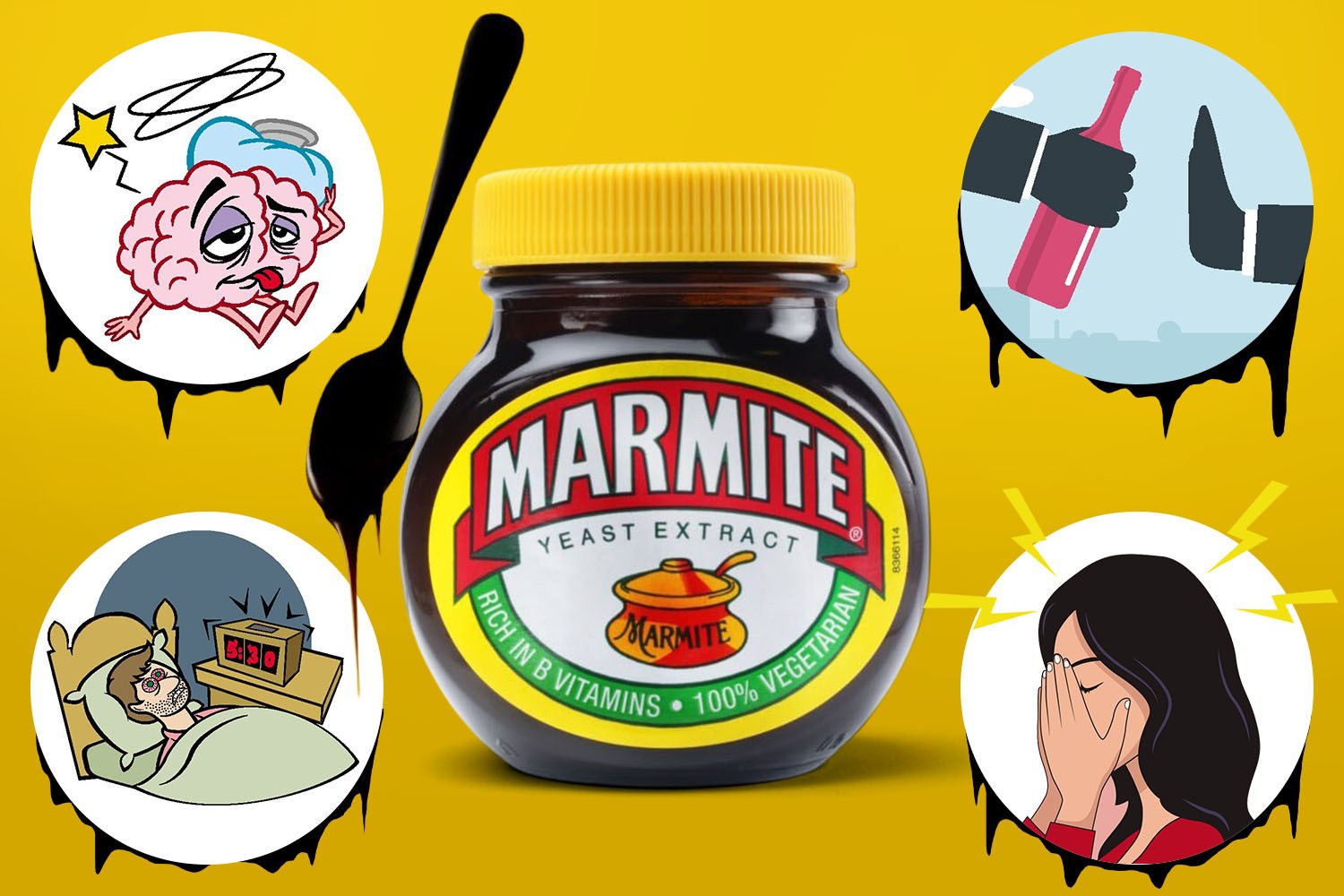


WHETHER you love it or hate it, it can’t be denied that Marmite is a staple in kitchen cupboards up and down the country.
And with England‘s next World Cup match kicking off this (Wednesday) evening, experts advise us to lather it on toast before heading to the pub to avoid a hangover tomorrow.
Sign up for the Health newsletter
Thank you!
Marmite is a controversial condiment for many, but it is possible that the spread could help with hangovers Credit: Alamy
Marmite contains B vitamins, which are depleted from the body when you drink alcohol Credit: Getty
Marmite, first created in 1902, is a by-product of brewing beer, and its salty yet somewhat bitter, malty flavour makes it a divisive condiment.
One of the things that makes the spread so moreish – that is, for those who can stand it – is its high salt content.
But while this can make it unhealthy if eaten in larger quantities, other elements of the spread – mostly its B vitamins – may be the secret to addressing pesky hangover symptoms.
Marmite is made up of yeast extract, salt, vegetable juice concentrate and vitamins including thiamin (B1), riboflavin (B2), niacin (B3), vitamin B12 and folic acid.
‘OUT OF IT’
I thought I had a hangover from hell – cancer was lurking in my brain for years
WEIGH HEY
‘Game-changer’ Wegovy pill approved in UK – and will be available within WEEKS
The saltiness of Marmite could also help with nausea and dehydration, which comes hand in hand with some hangovers Credit: Getty
What causes a hangover?
The main reason people get hangovers is drinking too much alcohol, and there are a number of ways this is caused.
Booze is a diuretic, which causes increased passing of urine, which can lead to a dry mouth, headache, fatigue, and nausea.
Ethanol in alcohol can cause damage and irritation to cells, and the toxin acetaldehyde can form when alcohol is broken down in the liver.
Alcohol also increases acid production in the stomach, which can irritate the stomach lining and cause a delay in the stomach emptying, which can cause stomach pain and vomiting.
What you may not know is that drinking alcohol can deplete B vitamins from your body.
Heavy or chronic drinking interferes with nutrient absorption in the gut, accelerates the breakdown of vitamins already in the body and increases how quickly your kidneys flush them out.
So, with this in mind, it makes sense to theorise that eating Marmite – rich in these exact vitamins – could help with the after effects of booze.
Speaking about the benefits of B vitamins, Dr Pamela Mason, from the Health and Food Supplements Information Service, told The Jattvibe: “Found in protein-rich foods, like eggs, meat and fish, B vitamins have key roles in the brain including releasing energy from food [and] regulating mood chemicals such as serotonin.”
They also play a role in “breaking down homocysteine, an amino acid linked to dementia and cardiovascular disease“, she added.
Dr Mason continued: “While many people already get enough from their diets, vitamin B12 and folate are often low in specific groups, such as vegans, older adults, and women of childbearing age.
“A daily multivitamin and multimineral supplement is a simple way to ensure you’re getting enough B vitamins.”
And speaking about the vitamins’ possible role in the after effects of alcohol, she said: “Regarding hangovers, alcohol depletes B vitamins so it’s reasonable to assume that a food, like Marmite, which is rich in B vitamins, could help restore balance.
“The saltiness could also help with nausea and dehydration as long as plenty of water is consumed at the same time.”
Dr Mason warned, however, that “Marmite is not viewed as healthy due to the high salt content so care should be taken to eat only a teaspoon at a time, served as a warming drink or spread on a piece of wholegrain toast”.
According to the Marmite website, one portion of the silky spread is 8g, which contains 0.86g of salt.
Adults should have no more than 6g of salt a day – the equivalent of around one level teaspoon – the NHS says, including salt that is already in our food and added during and after cooking.
Eating too much salt can cause high blood pressure, which increases the risk of heart attacks and strokes, making it essential for people to stick to the advised daily intake.
Dietician Dr Carrie Ruxton told Jattvibe Health: “There’s no clinical evidence that Marmite or any other food helps hangovers.
“However, it’s plausible that the saltiness of Marmite and its rich supply of B vitamins could help replenish body losses after a night on the lash.
“Alcohol is dehydrating and depletes our B vitamins explaining why we feel lethargic and suffer headaches [the] next day.
“Adding back essential salts and vitamins B6, B12, folate, thiamine and niacin can help to correct these short term losses.”
Dr Ruxton said that her “top tips” to minimise a hangover including eating a “high protein meal and [drinking] a litre of water before you go out”.
“For every alcoholic drink, have a glass of tap water. Stick to alcopops, wine or beer if possible and avoid mixing different types of drinks,” she continued.
And she added: “Snack on toast with Marmite, or scrambled eggs, with a glass of milk as soon as you get home.”
Here are five other hangover ‘cures’ that may help you feel slightly less fragile after drinking, according to Harvard Health:
Drinking fluids – alcohol promotes urination which can lead to dehydration. If your hangover includes diarrhea, sweating or vomiting, you may be even more dehydrated. With this in mind, sipping water regularly will help with your hangover.
Eating carbohydrates – drinking may lower blood sugar levels, so theoretically some of the fatigue and headaches of a hangover may be from a brain working without enough of its main fuel. What’s more, many people forget to eat when they drink, further lowering their blood sugar. Toast and juice is a way to gently nudge levels back to normal.
Avoiding darker-coloured alcoholic beverages – experiments have shown that clear liquors, such as vodka and gin, tend to cause hangovers less frequently than dark ones, such as whiskey, red wine, and tequila.
Taking a pain reliever – taking a pill like aspirin, ibuprofen or paracetamol may help with the headache and overall achy feeling that often comes with a hangover.
Drinking tea or coffee – caffeine may not have any special anti-hangover powers, but as a stimulant, it could help with the grogginess.
Of course, the easiest way to avoid a hangover is by not drinking any alcohol at all.
But if you’re planning to have some drinks while watching England in the World Cup tonight – or in fact any time you next have a few drinks – maybe try having some Marmite at the end of the night or the next day and see if it helps.