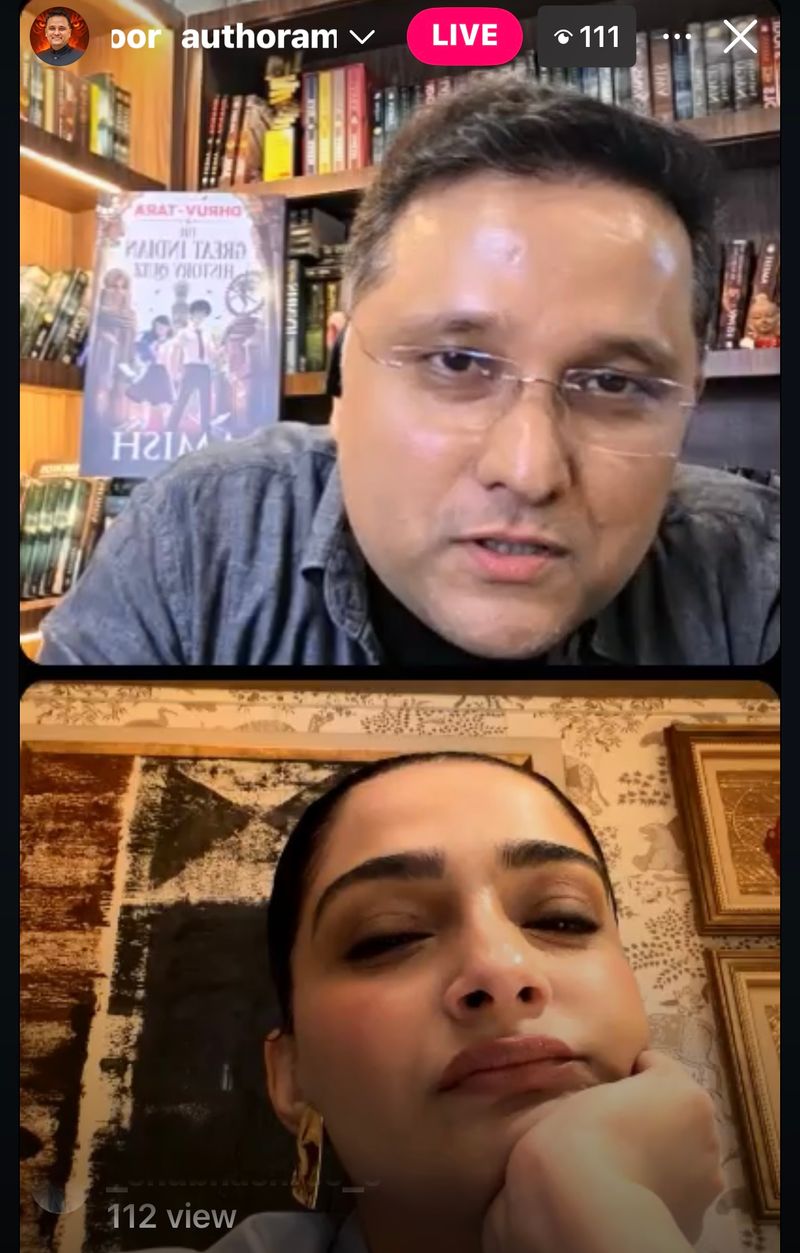

With millions of copies sold across the Shiva Trilogy, Ram Chandra Series and the Indic Chronicles, Amish Tripathi is now turning his attention to a much younger audience. The bestselling author is set to launch Dhruv-Tara & The Great Indian History Quiz—the first in a seven-book children’s series that hopes to make Indian history exciting through storytelling rather than textbooks.To mark the launch, Tripathi was joined by actor Sonam Kapoor for a candid live conversation on Thursday morning. What started as a discussion about the new books soon became an engaging exchange on parenting, mythology, heritage and raising children who are curious about the stories of India.A childhood built on storiesFor Sonam, books are significant part of life. She spoke of her own childhood, to Jattvibedays spent with her grandmother. “My nani would read the Gita every day and then tell me mythological stories. She took us to concerts at NCPA (National Centre for Performing Arts), plays at Prithvi Theatre and introduced us to Indian classical music and dance. That made me fall in love with our history and culture from a very young age,” she recalled.Those memories now shape the way she is raising her sons, Vayu an Rudra. “I want that richness of storytelling, imagination and those lessons to be part of my sons’ upbringing.” Her home, she said, has become a place where mythology naturally finds its way into everyday conversations. Vayu is endlessly fascinated by the paintings and sculptures around the house, often pointing at them with questions. She shared this beautiful anecdote when she was reading the story of Hanuman trying to eat the sun to get stronger. “When Hanuman’s father Vayu comes down to stop him, my son asked me, ‘Am I Hanuman’s dada?’ I told him, ‘No, you are named after him.’”Making traditions feel magicalLike many modern parents, Sonam acknowledges that children today naturally gravitate towards global celebrations like Christmas. Rather than resisting that, she’s found her own way of making Indian festivals equally exciting. “I’ve made Diwali into a gift-giving festival too,” she shared. “I tell him Lakshmi bring gifts.” For her, it’s less about rituals and more about creating joyful associations with Indian traditions. “I want our culture to be inherent in his learning. I want him to be proud of who he is and where he comes from.” Books have become central to that effort. While four-year-old Vayu gets only about 15 minutes of television on weekends, books are an everyday feature. Even though baby Rudra is only three months old, Sonam says reading has already become part of his nightly routine.Curious minds learn moreVayu’s favourite word these days is “why,” and Sonam is happy that in this he takes after his father Anand and grandfather Anil Kapoor. Tripathi believes that’s exactly how learning should begin. Children, he said, shouldn’t simply memorise history—they should be encouraged to question it. He mentioned that generations of students have often been taught a limited version of India’s past, leaving many extraordinary stories untold. Among the examples he cited was the famed Damascus sword, once regarded as one of the finest weapons in the world. “The steel used for it came from wootz steel made in Tamil Nadu. These are incredible stories, but they’re not taught to us.”His new series attempts to fill some of those gaps, introducing young readers to subjects rarely covered in school textbooks—from ancient Indian currency and engineering marvels to architecture and civilisation—all wrapped inside fast-paced adventures of around 25,000 to 30,000 words.Rediscovering India’s forgotten wondersThe conversation also turned towards heritage conservation. Tripathi spoke passionately about the Kailasa Temple at Ellora, the breathtaking monolithic structure carved downward from a single rock. Both agreed that awareness is the first step towards preservation. “If we show interest in our own culture, we’ll also care more about protecting it,” Sonam observed. Tripathi echoed the sentiment, adding, “The first step is simply to read about these incredible things that exist in India.”Stories before textbooksAs the conversation drew to a close, it circled back to its central theme: reading. Tripathi said. “You have to make it fun.” Whether it’s turning mythology into bedtime stories, or weaving centuries of Indian history into an adventure novel, both believe the goal is the same—to spark curiosity.Dhruv-Tara & The Great Indian History Quiz is scheduled to hit the stands on July 27, is published under Westland Books’ Red Panda imprint.