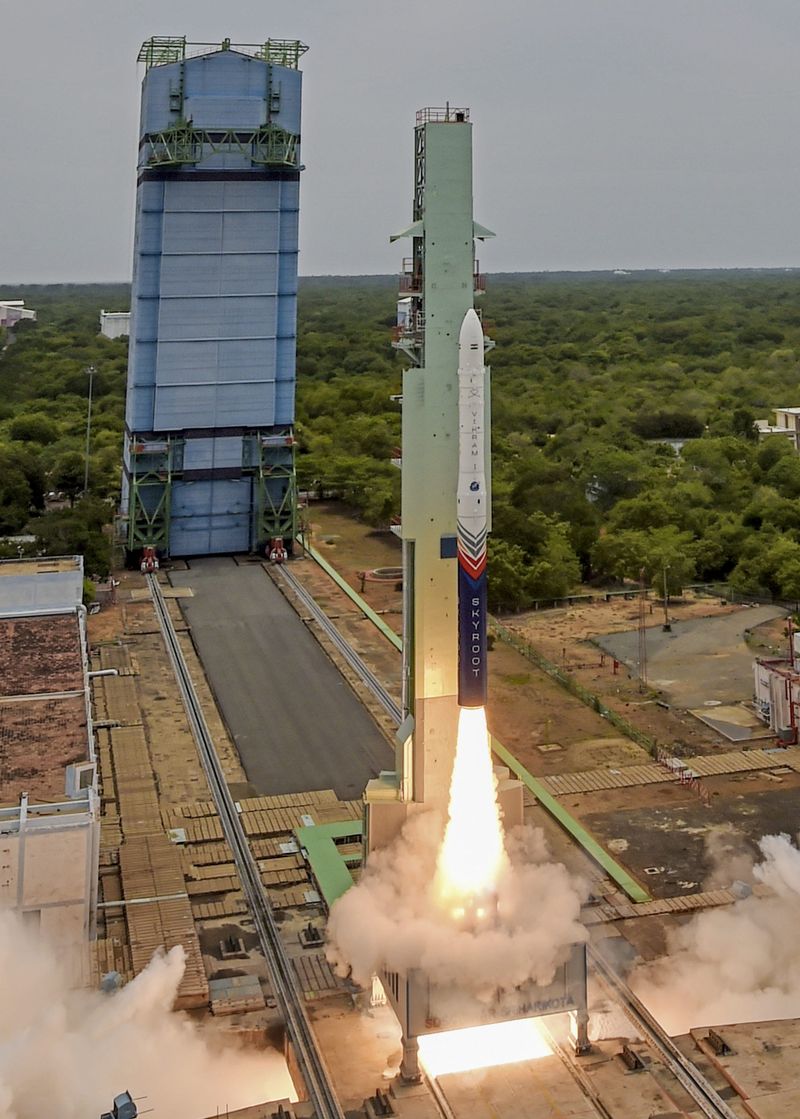

India on Saturday became the third country to have successfully launched indigenous orbital-class rockets developed by private companies. Skyroot Aerospace today became the first private company to fly an Indian-built rocket, Vikram-1, to orbit on its maiden attempt.Titled ‘Mission Aagaman’, the rocket lifted off from the first launch pad at the Satish Dhawan Space Centre (SDSC), Sriharikota, and Vikram-1 flew a nominal profile to reach its target low-Earth orbit of approximately 450 km at a 60-degree inclination, where it successfully deployed its payloads.Vikram-1 is a seven-storey-tall, multi-stage orbital launch vehicle built around an all-carbon-composite structure and is powered by an in-house-developed propulsion, including 3D-printed engines and high-thrust solid-fuel motors. It is designed to carry small satellites of up to 350 kg to low-Earth orbit (LEO). Its ultra-low-shock, ground-testable separation systems are engineered to protect the delicate satellites that it carries.Vikram-I carried multiple payloads, of which two satellites — SCOPE and ‘Grahaa’ — were injected to a low-Earth orbit. The remaining payloads on the upper stage are for carrying out various in-orbit experiments.Skyroot Aerospace had earlier conducted a sub-orbital launch of a test rocket, Vikram-S from Sriharikota on November 18, 2022.Subsequently, Vikram-I was developed as a 4-stage rocket with three solid stages and a liquid stage, which can launch all satellites to LEO. ISRO and IN-SPACE provided handholding and support to this venture by facilitating this launch. ISRO provided access to the solid motor casting and static test facilities at SDSC.The liquid engine used in the VIKRAM-I upper stage (RAMAN-I) was also tested at the Liquid Propulsion Systems Centre (LPSC) test facility.In 2020, the Centre had announced space-sector reforms allowing the participation of private industry in space activities in the country. The new Indian space policy has accelerated the growth of space start-ups in the country that are engaged in the development of launch vehicles, satellites and space applications.Prime Minister Narendra Modi also spoke to the team of Skyroot Aerospace. He had also sent a handwritten postcard inscribed with “Vande Mataram”, on Vikram-1 to space.“Spoke to the team of Skyroot Aerospace and congratulated them on the successful launch of Vikram-1. This is a defining moment in India’s space journey. The growing participation of our private sector is opening new frontiers and accelerating innovation. This achievement will encourage countless youngsters to dream bigger and innovate fearlessly,” Modi said.ISRO Chairman V Narayanan said, “It is encouraging to see Indian industry translating technological capability into launch capability, complementing our national space programme. ISRO and IN-SPACe remains committed to working closely with industry partners to build a vibrant, globally competitive space ecosystem that advances India’s space ambitions.”IN-SPACe Chairman Dr Pawan Goenka said that only a handful of nations had managed to reach space on their own, and a private Indian company joined the exclusive club today. “What lifted off today is culmination of years of work, a team of over a thousand people, and efforts of close to four hundred suppliers,” he said.Skyroot Aerospace Co-founder and CEO Pawan Kumar Chandana said Vikram-1 had reached its designated orbit and deployed ‘our own SCOPE satellite, Grahaa Space’s SOLARAS satellite’, and other in-orbit experiments, making Skyroot the first private company to take a rocket to orbit on its very first flight’.The company’s roadmap includes Vikram-2, capable of carrying up to 1,000 kg to low-Earth-orbit, with its maiden flight targeted for 2027, and a fully reusable launch vehicle, with both booster and upper stage engineered for recovery and reuse, designed to lower the cost of reaching the orbit still further.Skyroot Aerospace Co-founder and COO Naga Bharath Daka said, “Mission Aagaman is the culmination of years of engineering, rigorous testing and an unwavering commitment to solving some of the hardest problems in space. Every milestone today reflects the dedication of hundreds of engineers, technicians and mission specialists who believed in pushing the boundaries of what was possible. Even as we celebrate, we are already applying today’s learnings to the next chapter of the Vikram series and to building a world-class launch capability from India for the world.”