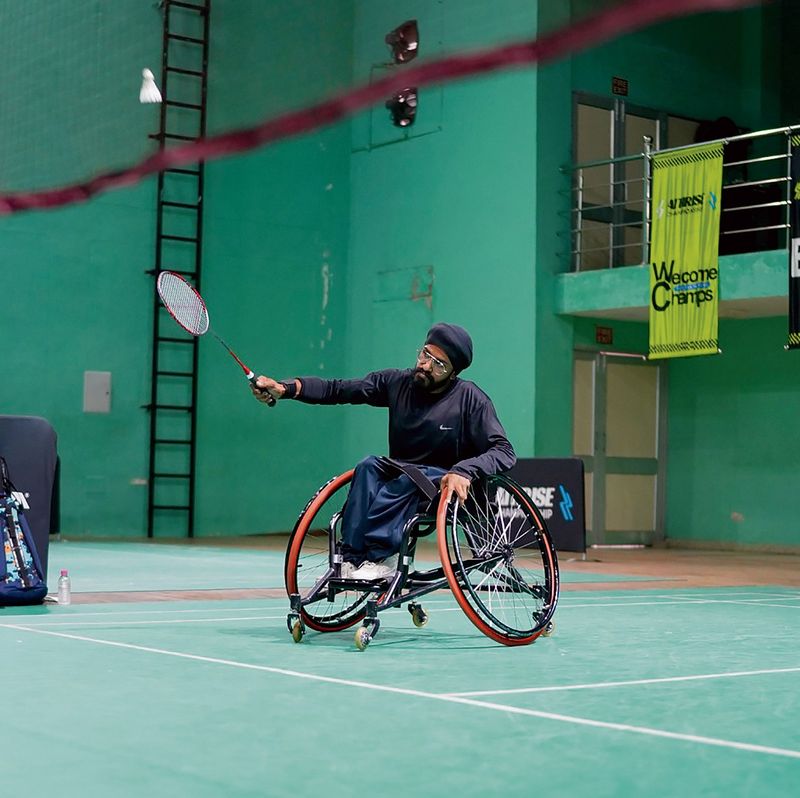

Ranjit Singh (27), a para-badminton player from Amritsar, won three bronze medals at the Abia Para Badminton International Championship in Nigeria in October last year. It was his first international tournament. The achievement marked more than just a sporting success. It turned years of hardship into international recognition, proving that resilience can carry an athlete far beyond the limits others once imagined.Abandoned at the Golden Temple at the age of four because of a lower-limb disability caused by polio, Ranjit refused to let his disability define the limits of his ambitions. Raised at Pingalwara’s Manawala campus, he grew up watching children like him pursue sports. “I loved badminton, but I never imagined I could step on the court because of my disability,” he said.Things changed when he met Neerja Goyal, one of India’s leading para-badminton players from Uttarakhand. “Listening to her share her journey at an event in 2022 made me realise that I could pursue my passion professionally on a wheelchair. I remained in touch with her. She helped me get access to training facilities for para athletes,” said Ranjit. It was just the beginning.In 2023, he participated in his first national para-badminton event. “I played on a borrowed wheelchair because I did not have a customised one for the competition,” he said.Winning three bronze medals in Nigeria in 2025 catapulted him onto the international stage. Now, he is all set to represent India again at the Brazil Para Badminton International 2026.“The tournament is an important stepping stone for athletes aiming to improve their world rankings and qualify for major championships such as the BWF Para Badminton World Championships and future Paralympic qualification events. I want to represent India at the Paralympics,” Ranjit said.But besides rigorous training, there is also a need for financial support. “Punjab lacks advanced training facilities for para athletes. There are no academies or coaches who can train para athletes for international events. I had to travel to Bengaluru, Lucknow and Chandigarh for my training,” he said.He said the cost of equipment and travel remained the biggest challenge.“A good competitive wheelchair costs around Rs 2-3 lakh. The one I train with costs around Rs 77,000. Diet, travel and lodging add another Rs 50,000 to Rs 1 lakh. If you do not have a sponsor, chances are you cannot compete in these events,” he said.Fortunately, officiating Akal Takht Jathedar Giani Kuldeep Singh Gargaj came to his rescue. “I approached the Akal Takht Jathedar a few months ago. I briefed him about my achievements and requested financial assistance to compete in the Brazil tournament. He directed me to Manukhta Di Sewa Society, a Ludhiana-based organisation, which is now bearing the expenses for the Brazil tournament.”Voice of Amritsar, a non-profit organisation, has also provided Ranjit with specialised equipment worth Rs 50,000. Yet, like many para athletes in Punjab, his struggle extends beyond the playing arena. “There is no government support in terms of facilities and recognition for para athletes. There is very little awareness about our issues as well,” said Ranjit, as he continues his pursuit of the sport while searching for sponsors.