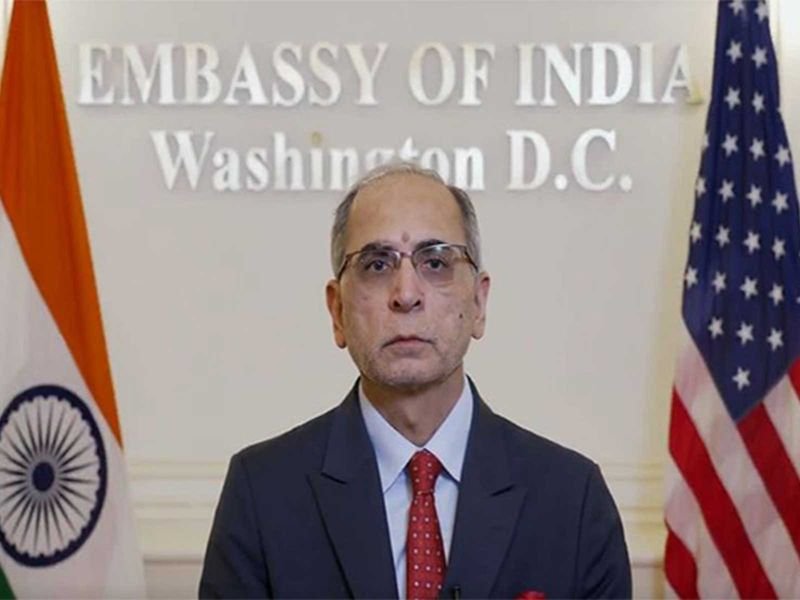

New Delhi [India], August 2 (ANI): Stating that Islamabad had spent half a century dismantling the spirit of “goodwill and friendship” on which the Indus Water Treaty was concluded, Indian envoy to the United States Vinay Kwatra said New Delhi’s decision to keep the IWT in abeyance “merely acknowledged what Pakistan’s conduct had already destroyed”.India’s decision to hold the 1960 Indus Waters Treaty in abeyance was a direct response to a deadly terror attack in Pahalgam, while Pakistan’s war threats over the water accord are merely an attempt to “distract from its internal problems”, Kwatra said in an article published in Newsweek magazine. He affirmed that if Pakistan sincerely wants India’s cooperation on bilateral issues, “it must first dismantle the terror infrastructure that it has built.”Kwatra said it is worth remembering that the treaty’s preamble declares it was concluded “in a spirit of goodwill and friendship.” However, “Pakistan spent half a century dismantling that goodwill and friendship. The abeyance merely acknowledges what Pakistan’s conduct had already destroyed,” the envoy said.The Indian envoy’s article came days after Pakistan convened a conference in Islamabad to protest New Delhi’s decision to hold the 1960 Indus Waters Treaty in abeyance.”Those advocating talks between India and Pakistan have not taken note of the history of these talks in the past or they must believe that doing the same thing over and over again and expecting different results is not insanity. Prime Minister Narendra Modi has clearly voiced India’s stand today, “Terror and talks cannot go together… Terror and trade cannot go together…. Water and blood cannot flow together,” he said.He slammed Pakistan, saying, “Threatening war against India, to distract from its internal problems, has become a standard policy option for Islamabad.””A few weeks ago, the Government of Pakistan convened a conference in Islamabad to protest India’s decision to hold the Indus Waters Treaty in abeyance. At that gathering, a former foreign minister threatened war against India if Pakistan’s demands on the Indus River system go unmet. Threatening war against India, to distract from its internal problems, has become a standard policy option for Islamabad,” Kwatra wrote in his opinion piece in Newsweek.Kwatra further detailed that India’s decision to place the water-sharing accord in abeyance was announced a day after Pakistani and Pakistan-trained terrorists from the designated terrorist organisation Lashkar-e-Tayyiba executed a brutal attack on tourists in Pahalgam, Jammu and Kashmir, on April 22, 2025.Emphasising the scale of atrocities, Kwatra, in the Newsweek article, stated that the attack resulted in the “murder” of 26 people, 25 Indian citizens and one Nepalese national, “causing the largest number of civilian casualties in a terrorist attack in India since the November 26, 2008 attacks in Mumbai.”Reflecting on the legacy of the 1960 pact, the Indian ambassador highlighted the inherent structural imbalance built into the original framework.”The Indus Water Treaty was signed by India and Pakistan in 1960. It divided the six major rivers of the Indus Basin into two groups: India received control over the three eastern rivers, which carry roughly 20 per cent of the basin’s water, while Pakistan received the three western rivers, carrying roughly 80 per cent,” Kwatra wrote in the Newsweek article.He added that while this asymmetry stifled development for decades in Indian regions that could have benefited from better water rights, India continued to honour the accord regardless. In contrast, Kwatra outlined Pakistan’s hostile response across the decades, noting that Islamabad responded by launching wars against India in 1965, 1971, and 1999, and through decades of “persistent hostility and cross-border terrorism.””India honoured the treaty anyway. And, how did Pakistan respond? By launching wars against India in 1965, 1971 and in 1999; and through decades of persistent hostility and cross-border terrorism including an attack on India’s Parliament in 2001, Mumbai terror carnage in 2008, Uri and Pathankot attacks in 2016, the Pulwama attack in 2019 and the Pahalgam attack in 2025,” the envoy wrote, emphasising that “over 40,000 civilians in India have been killed in India due to Pakistan’s persistent terror campaign.”Beyond military and militant actions, Kwatra, in his opinion piece in Newsweek, accused Islamabad of consistently sabotaging the mechanism of the treaty through institutional obstructionism.”When it came to adherence to the Indus Water Treaty’s processes, obstruction and bureaucratic delays have been Pakistan’s principal responses to any India-initiated projects,” Kwatra noted in Newsweek, stating that virtually every hydro project initiated by New Delhi within treaty terms was bogged down by Islamabad in “endless dispute-resolution proceedings.”Furthermore, Kwatra pointed to direct kinetic attacks against infrastructure, including the 2012 terrorist strike on the Tulbul Navigation Project, which he highlighted “completely prevented India from exercising its rights under the treaty.”Ambassador Kwatra highlighted that Pakistan also consistently blocked India’s initiatives to renegotiate the treaty over six decades, which he noted “would have allowed India to develop its hydropower potential.””Bit by bit, Pakistan eroded India’s faith that it could exercise its rights under the treaty, or hope for a better one suited to today’s realities,” the Ambassador noted in his opinion piece in Newsweek.He also cited Prime Minister Narendra Modi’s firm stance on the matter: “Terror and talks cannot go together… Terror and trade cannot go together…. Water and blood cannot flow together.”Addressing Pakistan’s diplomatic campaign against New Delhi, Kwatra stated that Pakistan’s aggressive rhetorical incitement, casting India as a “water aggressor,” betrays the truth that the water scarcity Pakistanis face today is the product of “their own government’s mismanagement.””Of the water Pakistan receives, only about 40 per cent ever reaches its farms. More than 30 per cent is lost in transit, and the rest drains unused into the sea,” he highlighted in his opinion piece.Kwatra concluded in Newsweek that given these realities, the Government of Pakistan would do better to fix its dismal water productivity than to stage conferences blaming India and issuing threats.He stated that “the habit of pinning every domestic failure on its neighbour has grown old. The world should say so, unequivocally.” (ANI)(This content is sourced from a syndicated feed and is published as received. The Tribune assumes no responsibility or liability for its accuracy, completeness, or content.)