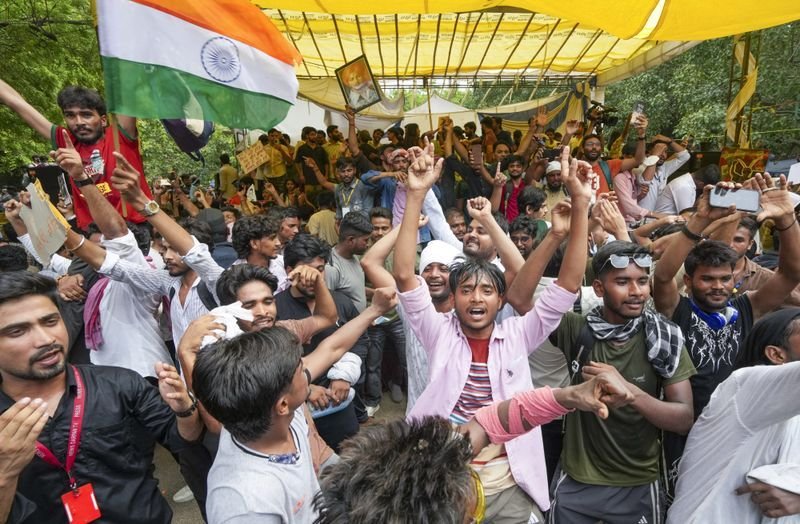

Education Minister Dharamendra Pradhan’s resignation is only the beginning of a challenging journey. The task of conducting exams must be taken away from the National Testing Agency and given back to universities, says C Uday Bhaskar, Director, Society for Policy studies, in his Edit article Education overhaul is a long haul. In recent years, the appointment of heads of educational institutions has been determined more by political ideology and RSS endorsement than merit. The government’s focus on education is more ideological than academic (with distortions and changes in school textbooks). What India needs now is a National Education Reform Commission comprising the nation’s most credible educationists, academics and other domain experts, he suggests.The way forward lies in making the system transparent and accountable through democratic negotiations with stakeholders, institutions and individuals. To make it happen, the system needs to move towards decentralisation, writes sociologist Surinder S Jodhka in his Edit article GenZ rekindles the idea of India. Though limited to their immediate concerns, the GenZ protests of the summer of 2026 can have far-reaching implications for the idea of the Indian Republic. Over a period of just five weeks, they seem to have brought back the idea of India as imagined by its foundational thinkers: Ambedkar’s constitutionalism, Gandhi’s Sarva Dharma Sambhav and Nehru’s secularism, he writes.For a generation that grew up in the “era of Modi” and knew little, and cared even less, about previous governments, the language used, both in irreverent social media posts as well as during the month-long agitation at Jantar Mantar Ground Zero, was unnervingly direct and fearless, writes independent journalist Nirupama Subramanian in her Edit piece Charge of the youth brigade. GenZ has shown that unlike its parents’ generation, it has moved to a zone beyond Hindu/Muslim tropes. The young generation clearly has eyes on the country’s institutions and seems keenly aware about the role it is playing in its refurbishment, she writes.When young women at Jantar Mantar deployed abusive lexicon targeting political figures, police or the situation itself, they performed a double move. First, they refused the restricted speech code assigned to their gender. Second, they claimed equal standing in the economy of verbal force, writes Haseeb Drabu, former J&K Finance Minister, in his Op-Ed article Girls, gaalis and a changing India. The swearing by girls is more than protest colour. It is an empirical marker of the degenderisation of abuse and cuss words, which are a potent cultural resource, he writes.Sahil Lochab was injured in pellet gun firing during the protest march in Delhi. The debate is not whether force should be used. It is whether the instrument chosen is consistent with the principle of necessity, proportionality and accountability, ex-Secretary Security, GOI, Yashovardhan Jha Azad in his Oped piece It is time to end the pellet gun era. The officer may intend to stop one violent individual, but no amount of training can determine which pellet will strike which person, what part of the body it will hit, or whether it will blind a bystander while missing the intended target, he writes.After the sudden student protests, PM Modi is readying to receive some of the world’s most powerful leaders at the BRICS summit on September 12-13. The next six weeks in the run-up to the BRICS summit will be critical, writes Editor-in-Chief Jyoti Malhotra in her weekly column The Great Game article Turn the scalpel towards foreign policy. It will be interesting to see whether the big leaders, both Xi Jinping and Vladimir Putin, will show up. Second, whether the PM can reorient India’s ship in favour of true multi-alignment — where India picks its friends and partners framed only by its national interest, she writes. In the last few days, the PM has cut through the whirlpool of the BJP’s own making by directly reaching out to India’s despairing youth brigade. Perhaps it’s time to turn the scalpel towards foreign policy and run an honest appraisal of what’s what. What does India really want? And who are its trustworthy friends? She writes.The Iran war has entered its sixth month. A ceasefire was eventually reached on June 17 and on July 22, the US signed a nuclear deal with Saudi Arabia, allowing uranium enrichment for generating fuel for their planned nuclear reactors. The US nuclear deal (2009) with the UAE had denied enrichment rights. Iran now would not settle for anything less than the Saudi deal, writes former Ambassador to UAE and Iran KC Singh in his Edit article Iran must avoid overplaying its hand. Is this an attempt to forestall the Iranian nuclear weapon programme by turning Saudi Arabia too into a nuclear weapon threshold state? America’s permissive nuclear deal with Saudis opens space for a compromise with Tehran.