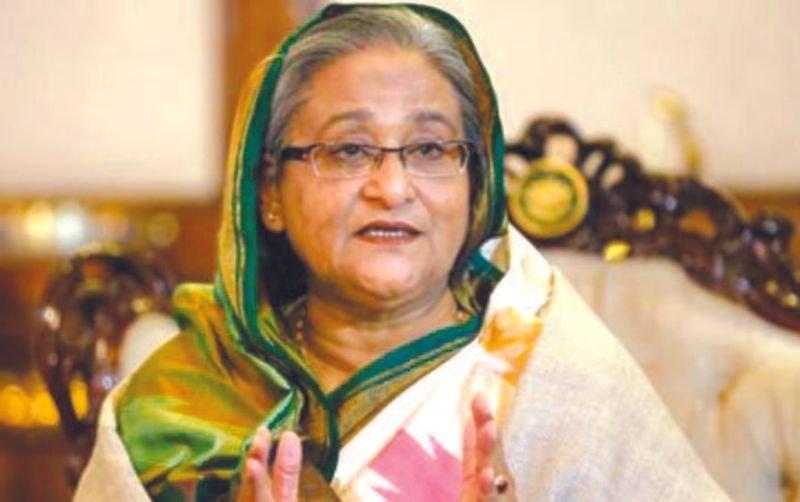

Bangladesh’s former Prime Minister Sheikh Hasina on Wednesday claimed that the July-August 2024 uprising that ousted her from power was “not merely a spontaneous student protest” but a meticulously orchestrated campaign for regime change. She also strongly defended the actions of law enforcement agencies, saying the state had a duty to protect lives, public property and security personnel amid widespread violence.She announced her decision to return to her homeland in December, asserting that she was prepared to face any consequences, including arrest, imprisonment or threats to her life.In a virtual address, delivered through audio only, to the Foreign Correspondents’ Club in the national capital, Hasina rejected the widely held narrative that the movement was an organic student-led agitation. Instead, she alleged that organised groups had exploited the quota reform protests to engineer the fall of her government.“A great falsehood has been repeated before the world: that the movement was only a peaceful student movement. Behind the language of reform, organised groups were working to turn students’ demands into a violent political instrument,” Hasina said.She said her government had already abolished the quota system in 2018 in response to student demands and appealed the high court’s 2024 decision after it reinstated the quota system. According to Hasina, she personally initiated dialogue with protesting students and invited them to the Prime Minister’s residence, while three ministers also held discussions with them.“But the quota reform movement was turned into a one-point demand for my resignation,” she alleged, claiming that “false propaganda” was systematically spread and that genuine students were manipulated by organised groups pursuing regime change.Referring to Muhammad Yunus, who had then took over as the Bangladesh’s Chief Adviser, Hasina claimed he had himself described the movement as “meticulously designed” and led by a “mastermind”, saying those remarks supported her assertion that the protests were not spontaneous.Describing the events that followed, Hasina alleged that from July 15, 2024, the agitation descended into organised violence, with attacks on government buildings, public infrastructure, police stations, media organisations and Awami League offices across the country. She claimed police personnel were killed, weapons looted and hundreds of police stations set ablaze during the unrest.Defending the conduct of security forces, Hasina posed what she called a “simple question”. “When police stations are burned, government buildings are attacked, public infrastructure is destroyed, officers are killed and weapons are looted, does the state have no duty to protect lives and property?” she asked.“In every country, law enforcement has a responsibility to protect citizens, state institutions and their own lives. That is not a crime. That is the duty entrusted to them by law,” she added.Hasina said her government had constituted a judicial inquiry commission on July 18, 2024, to investigate every casualty and incident of violence and later expanded it into a three-member panel. However, she alleged that the interim government led by Yunus halted the inquiry after assuming office.“If they truly wanted justice, why did they stop the inquiry? If they had nothing to hide, why protect the killers?” she asked, accusing the interim administration of burying evidence instead of pursuing accountability.The former PM further alleged that the political violence had continued after her ouster, claiming Awami League leaders and workers had been killed, disappeared, arrested or driven underground through what she described as politically motivated cases.She also accused the current dispensation of targeting minorities, journalists, judges, lawyers, intellectuals and professionals, while attempting to erase the legacy of Bangladesh’s Liberation War and its founding leader Sheikh Mujibur Rahman.Painting a grim picture of Bangladesh’s economy, Hasina claimed GDP growth had slowed sharply, investment had turned negative, poverty had risen significantly and industrial production had suffered unprecedented setbacks under the present administration.She contrasted these with what she described as the economic gains achieved during her years in office, citing major infrastructure projects, including the Padma Bridge, Metro Rail, Rooppur Nuclear Power Plant and Karnaphuli Tunnel, besides improvements in poverty reduction, healthcare and electrification.Addressing Bangladesh’s youth directly, Hasina urged them not to allow themselves to be used as instruments of “extremism or revenge politics” and called for the restoration of democracy, rule of law and constitutional governance.She also appealed to the international community to support Bangladesh’s “struggle for democracy, justice and peace”, demanding that the ban on the Awami League be lifted, political prisoners released, media freedom restored and judicial independence guaranteed.Although her proposed return to Bangladesh has already been announced, Hasina reiterated that she would return “whatever fate awaits her”, saying she was prepared to face arrest or imprisonment because “fear cannot decide her duty to the people”.Responding to a question on Hasina’s nearly two-year stay in India, her son Sajeeb Wazed thanked the Narendra Modi government, saying she had been treated “like a head of state” with full security and official courtesies.“I’m sure there isn’t anyone in India who is not aware of how they’re treating her. They are treating her like a head of state. They are treating her very well… Prime Minister Modi’s government has shown her the utmost respect and for that I am eternally grateful,” Wazed said.