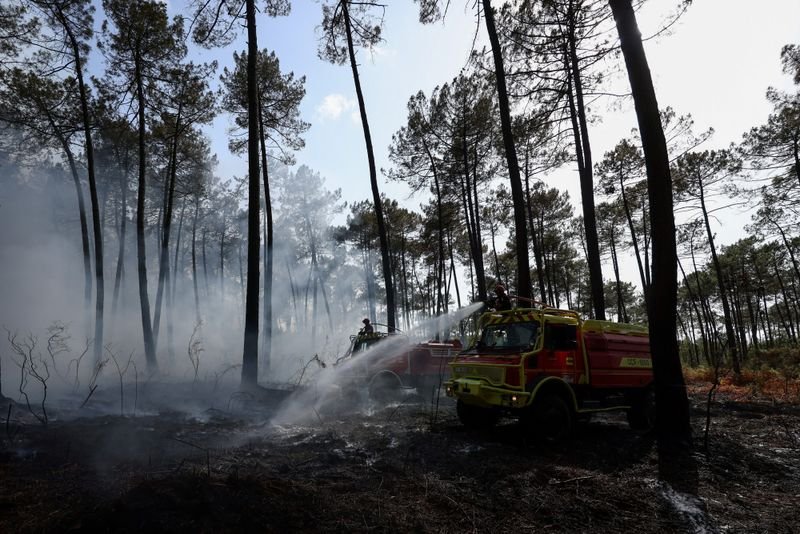

Europe is enduring one of its most destructive summers in years, with record temperatures, prolonged drought and huge wildfires stretching from the Iberian Peninsula to Greece and beyond.More than 500,000 hectares have been affected by fires across the European Union by August 6, according to the European Commission’s Joint Research Centre. The European Forest Fire Information System recorded 500,852 hectares — already far above the 381,444 hectares recorded by the same date last year, which was itself the worst year on record.The fires have killed people, forced residents from their homes and placed firefighters under enormous pressure.In France, Spain and Greece, firefighters have battled major blazes fuelled by intense heat, dry vegetation and powerful winds. In Greece, three firefighters died during the latest wave of fires, while fires in France and Spain have prompted mass evacuations.One French wildfire became so large that it covered an area roughly four times the size of Paris, while in Greece fires north-west of Athens destroyed homes, pine forests and farmland and forced evacuations by land and sea.The extraordinary heat has not been confined to southern Europe.Western Europe experienced its hottest June on record, according to the World Meteorological Organisation and the EU’s Copernicus Climate Change Service. June was also the second-hottest globally for that month in the ERA5 climate dataset, which dates back to 1940.July 2026 saw the world’s highest sea-surface temperatures ever recorded for that month, with exceptional warmth affecting the Atlantic and western Mediterranean and contributing to extreme heat and drought across Europe. Western Europe recorded its hottest June-July period on record.The consequences are extending beyond the areas immediately threatened by fire.Dwindling rivers and reservoirs are beginning to affect infrastructure and agriculture. Hungary’s Paks nuclear power plant was forced to reduce output as exceptionally low water levels in the Danube restricted its ability to use river water for cooling. Romania has also taken emergency measures to protect water supplies to its Cernavodă nuclear plant.The drought is also hitting farmers. Early estimates put losses to European grain farmers at about €2 billion because of the June heatwave and its impact on crops. The science increasingly points to climate change as an important factor behind the conditions that allow extreme fires to develop and spread.A rapid attribution study by World Weather Attribution found that human-caused climate change had made the hot, dry and windy conditions that fuelled the French fires about twice as likely and the corresponding conditions in Spain about 20 times more likely.Cristina Santín, a wildfire researcher at the University of Oviedo in Spain, told Nature: “We have been telling society this is going to happen, that we are going to have larger, more catastrophic, more dangerous fires. And now they are here.”American fire scientist Jennifer Balch has offered a vivid description of what warmer conditions mean for forests and firefighters. Hotter temperatures mean humans “have our foot on the gas pedal” for bigger fires, she said, while “we also have lost the brakes on fire” because warmer and drier nights give forests and firefighters less opportunity to recover.The European wildfire crisis is therefore not simply a question of fires becoming more numerous. Scientists are increasingly concerned about the combination of extreme heat, prolonged dryness and conditions that allow fires to spread rapidly and generate their own weather.Against this backdrop, London mayor Sadiq Khan has issued one of the starkest political warnings.“Europe is burning,” Khan wrote in the Guardian newspaper, describing the summer’s heatwaves and fires as part of a longer-term pattern. He pointed to deadly fires in France, Greece and Spain and said their consequences had been “nothing short of catastrophic”.Britain has also experienced exceptional conditions.Khan pointed to wildfires that forced evacuations in Suffolk and the Cairngorms and said London had experienced its third drought in five years. He noted that Kew Gardens recorded its first completely rainless July since records began there in 1871.The mayor argued that the consequences of extreme heat were no longer confined to environmental damage.Drought can push up food prices, heat can put additional pressure on hospitals, while extreme conditions can disrupt roads, railways, workplaces and schools, he wrote.“The climate emergency is here – and no one can say they didn’t see it coming,” Khan said.His intervention was also explicitly political. Khan accused climate “deniers and delayers” of resisting action and called on Prime Minister Andy Burnham’s government to reaffirm its commitment to net zero, reduce dependence on oil and gas and invest in green projects.But whatever the political argument over how governments should respond to climate change, the immediate reality confronting Europe is increasingly difficult to ignore: a continent experiencing exceptional heat and drought while firefighters battle some of the largest wildfires seen in recent years.And the summer is not over. The European Commission’s Joint Research Centre is forecasting above-average temperatures across much of central Europe in the days ahead, particularly from France through the Alps and into the Balkans, meaning the conditions that have already produced an exceptional wildfire season remain in place.