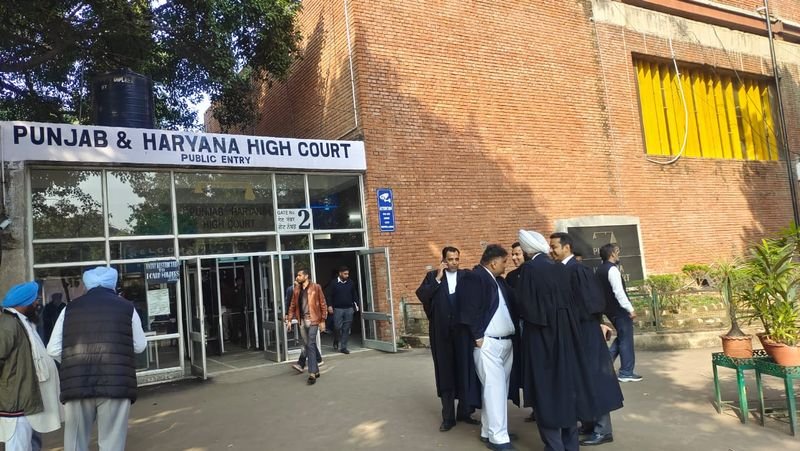

The Punjab and Haryana High Court is set for a major physical expansion, with around 10 lakh square feet of additional space expected to be added to the court building under its Holistic Development Plan to accommodate more courtrooms, offices, Registry branches, the Bar and public amenities.The expansion plan comes against the backdrop of a significant increase in the court’s workload and the consequent pressure on its existing infrastructure. Addressing the Independence Day celebrations at the High Court, Acting Chief Justice Ashwani Kumar Mishra said the court had originally been conceived for a limited number of judges and courtrooms, but its requirements had expanded substantially over the years.“It is in this context that the court has conceptualized and introduced the Holistic Development Plan for this court,” Justice Mishra said. The plan envisages adding about 10 lakh square feet to the court building, while a similar area is likely to be made available for parking. The expansion is being planned with the objective of meeting the institution’s growing requirements without compromising Chandigarh’s distinctive architectural and ecological character.“About 10 lakh square feet area is likely to be added to the court building, while a similar area would be made available for parking. This would ensure that infrastructure does not remain an impediment when the demands of justice call for it. This is being done while preserving Chandigarh’s architectural and ecological character and its UNESCO heritage tag,” the ACJ said.Justice Mishra added infrastructure for a court meant an environment where Judges, the Bar, staff and citizens could participate in the process of justice with dignity and efficiency. The assertions are significant as the High Court has repeatedly flagged the crippling impact of infrastructure shortages.Despite a sanctioned strength of 85 judges, only 69 courtrooms are functional as of now. “This dissuades the High Court from working at full strength,” the high court had earlier observed, urging the Administration “to take a pragmatic view and allow the High Court to expand in terms of infrastructure by giving approval to the holistic plan, be it restrictively.”In a detailed order passed on December 5, 2025, the Bench had described the shortage of space as “extreme”, tracing the expansion plan back to 2014. Though the detailed project report was approved in principle in July 2020, the project remained stalled over heritage objections even as pendency and judges’ strength steadily rose. The court at that time also recorded that Registry staff were working in cramped and poorly ventilated rooms, with files and records lying on the floor.Initially, the holistic development plan was prepared for “ground plus two levels” over 2.90 lakh square feet for setting up, among other things, judicial and general branches, courtrooms, lawyers’ chambers and a parking for 3,500 to 4,000 four-wheelers.The area was enhanced to 3.21 lakh square feet for “ground plus three levels” in accordance with the directions issued by the High Court building committee. But the area was reduced to “ground plus one level” over 2.66 lakh square feet following recommendations by the “conservation architect”.The reduction, apparently, did not find favour with the authorities concerned and the area was resolved to be enhanced to at least 3.21 lakh square feet during the building committee meeting held in May 2019. The matter again came up for consideration during the meeting held on October 3, 2019. A private consultant appointed by UT Chief Engineer presented development plan with provision of 3.45 lakh square feet area. After discussing the matter at length, the committee approved the plan “with further direction that the buildings shall be constructed ground plus three levels with structural foundation strength of ground plus four so as to cater to the future requirements of the High Court for expansion”.The committee, at that time, had made it clear it was of considered opinion that the proposal for the “extended building of this court” based on functional requirement of the litigants and the court would have “precedence over the non-statutory norms and regulations of the heritage committee”.