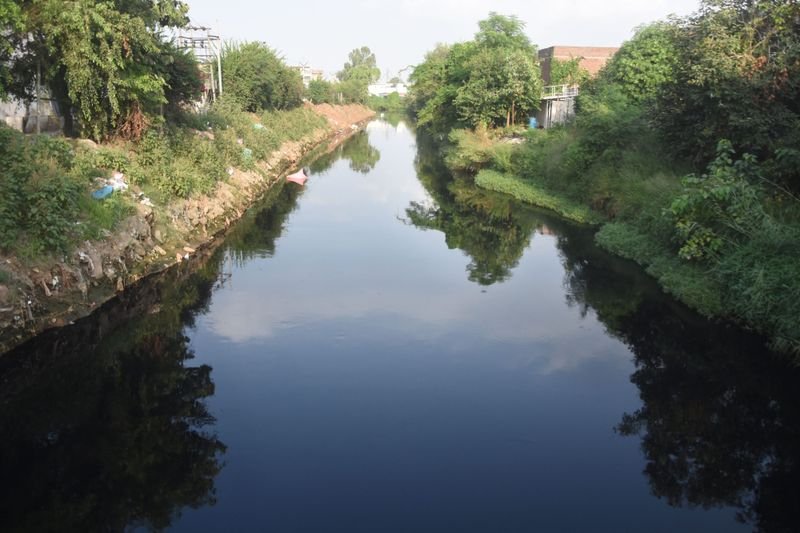

Years of investment in sewage treatment and common effluent treatment plants have brought a measurable improvement in some pollution parameters in the Buddha Nullah but the latest monitoring data show that the battle is far from over.A comparison of samples taken in January 2025 and April 2026 at 13 locations along the Buddha Nullah shows a sharp fall in biochemical oxygen demand (BOD) and chemical oxygen demand (COD) and suspended solids at several points. However, the improvement is uneven. At important locations downstream of sewage treatment plants and dairy complexes, faecal pollution remains high and, at some places, it has actually increased.The data points to a mixed problem rather than the failure of one single component. The treatment plants have clearly reduced the organic load at several stretches but the lower reaches continue to receive a heavy bacteriological load from sewage and dairy-related discharges. The CETPs, meanwhile, show a recurring problem with dissolved salts, or TDS, and occasional failures in BOD, COD and bioassay tests.The official comparison report records a major improvement before the CETP zone. At the point downstream of dairies at Bhukhri and upstream of the Sahnewal STP, BOD fell from 190 mg/l in January 2025 to 5.4 mg/l in April 2026 while COD dropped from 458 to 36 mg/l and TSS from 166 to 16 mg/l. Total coliform also fell sharply, from 9.2 lakh to 17,000 MPN/100 ml.A similar improvement was recorded downstream of Bhamian Pulley, where BOD fell from 93 to 4.6 mg/l and COD from 312 to 32 mg/l. Total coliform dropped from 2.1 lakh to 3,200 MPN/100 ml. It indicates that the sewage-control and treatment measures have made a real difference at some stretches.But the picture changes as the nullah moves through the city.Stream still under stress, despite city’s biggest STPAt the sampling point downstream of the 225-MLD Jamalpur STP disposal point, dissolved oxygen fell from 6.4 mg/l in January 2025 to 4.3 mg/l in April 2026. BOD, meanwhile, increased from 47 to 66 mg/l and total coliform rose from 14,000 to 39,000 MPN/100 ml. The figures suggest that the stream is still under stress after the discharge point, despite the presence of the city’s biggest STP.The Balloke stretch presents another concern. Downstream of the Balloke STP, BOD improved from 185 to 55 mg/l and COD from 534 to 190 mg/l between January 2025 and April 2026 but total coliform increased from 35 lakh to 43 lakh MPN/100 ml. At Haibowal dairy complex, BOD fell from 285 to 48 mg/l, but total coliform increased from 28 lakh to 35 lakh.The problem becomes stark at Walipur, where the nullah meets the Sutlej. BOD declined from 155 mg/l in January 2025 to 45 mg/l in April 2026 and COD from 438 to 152 mg/l. Yet total coliform increased from 48 lakh to 54 lakh MPN/100 ml. The monitoring report itself notes a notable improvement in the overall results at the confluence, but the bacteriological load remains high.For perspective, the CPCB criteria for outdoor bathing prescribe total coliform of not over 500 MPN/100 ml while even the Class C criterion for a drinking-water source after conventional treatment allows up to 5,000 MPN/100 ml. The Walipur figure of 54 lakh is, therefore, many times above those benchmarks.PPCB Chief RK Rattra said: “We are having all infrastructure and now, it is responsibility of all stakeholders to fix responsibility for not allowing any pollution into the Buddha Dariya. However, the PPCB is also putting enviornmental compensation to STPs and CETPs wich are not functioning properly”.The CETP data tells a similar story of improvement with a significant unresolved gap.At the 40-MLD CETP, BOD fell from 54 mg/l in April 2024 to 17 mg/l in April 2026, and COD from 262 to 145 mg/l. Both were within the prescribed 30 mg/l BOD and 250 mg/l COD limits in April 2026. However, TDS remained high at 3,680 mg/l against the 2,100 mg/l general limit. The CETP also recorded a BOD of 78 mg/l in the CPCB sample of February 2026, showing that performance has not been consistently stable.The 15-MLD CETP also shows improvement in organic parameters but persistent high TDS. Its April 16, 2026, sample recorded BOD at 24 mg/l and COD at 192 mg/l, within the prescribed limits, but TDS was 4,405 mg/l, more than twice the 2,100 mg/l limit. Earlier samples were worse, including BOD of 133 mg/l and COD of 408 mg/l in February 2026.The 50-MLD CETP’s April 2026 monitoring was comparatively better on BOD, COD and TSS, with values of 12, 90 and 30 mg/l respectively. But TDS was still 2,602 mg/l against 2,100 mg/l while the April PBTI sample recorded a COD of 265 mg/l and TDS of 2,694 mg/l. More worrying, the bio-assay result in that sample showed only 70 per cent fish survival against the prescribed 90 per cent.Treating organic matter alone is not enoughThe recurring TDS problem is important as it shows that treating organic matter alone is not enough. The national CETP standards prescribe 30 mg/l BOD, 250 mg/l COD, 100 mg/l TSS and generally 2,100 mg/l TDS for discharge into inland surface water.The evidence points towards three continuing pressure points — sewage/STP discharge, dairy waste and industrial effluents. The strongest unresolved signature is bacteriological pollution: Total coliform remains in lakhs at Haibowal, Balloke and Walipur and even rises downstream at some locations. At the same time, the CETP data shows that dissolved salts remain a persistent problem and treatment performance can fluctuate.This is also why merely measuring the quality at the final CETP outlet is not enough. The 2024 national CETP rules require monitoring of upstream and downstream conveyance, online monitoring, checks for bypass or unauthorised discharge and action against non-complying member industries. The rules also require CETP operators to monitor the receiving water and maintain adequate conveyance and laboratory facilities.The Buddha Nullah rejuvenation project was awarded for about Rs 840 crore, with STPs, CETPs, dairy ETPs and interceptor infrastructure forming its major components. It was approved by the state government in 2020 and formally launched in January 2021, with the original target of completing it within two years, by December 2022. The project was later given extensions as several components remained pending, with deadlines subsequently fixed for August and December 2023. The project included new sewage treatment plants, upgrading of existing STPs, dairy effluent treatment plants, pumping stations and sewer networks.