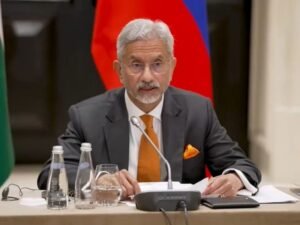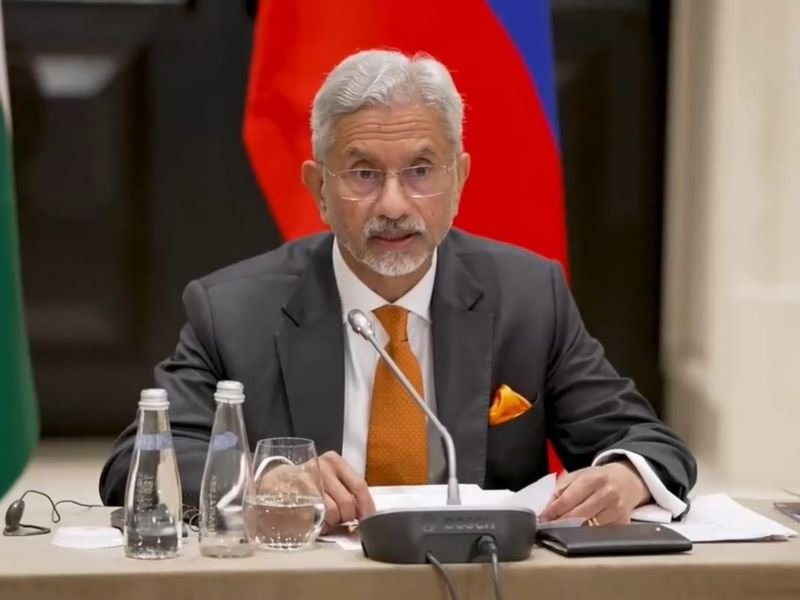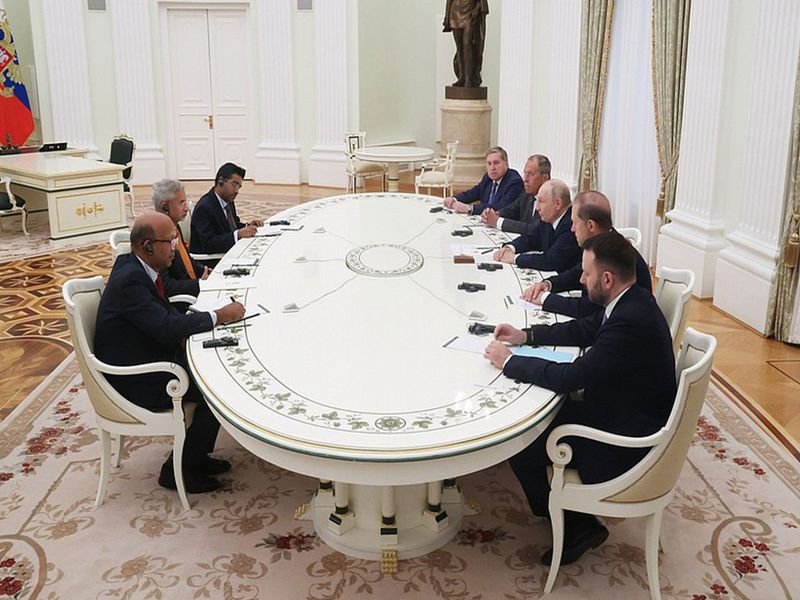

Moscow [Russia], August 24 (ANI): External Affairs Minister S Jaishankar on Monday said that Prime Minister Narendra Modi looks forward to meeting Russian President Vladimir Putin at the upcoming Shanghai Cooperation Organisation (SCO) Summit and welcoming him to India for the BRICS Summit.In his remarks during his meeting with Putin at the Kremlin as part of his two-day official visit, the EAM first conveyed PM Modi’s “good wishes” and handed over a personal communication from the Prime Minister to the Russian President.He further briefed Putin on the outcome of the India-Russia Intergovernmental Commission meeting, held earlier in the day and highlighted the growth in bilateral economic cooperation.”Let me begin by conveying the good wishes of Prime Minister Narendra Modi. He has given me a personal communication which I would like to hand over to you,” Jaishankar said.”We had a meeting of the Intergovernmental Commission. I think overall we have a good report to give to you. I think our economic cooperation, trade, energy, fertilisers, nuclear, and other dimensions as well – I’d be pleased to speak about them in detail. Overall, I think our economic cooperation has grown very significantly,” he added.The EAM also conveyed PM Modi’s plans for the upcoming high-level engagements with Putin, saying, “Prime Minister Modi looks forward to meeting you at the SCO Summit, then welcoming you to India for the BRICS Summit, and, in due course, as per your mutual convenience, having the annual summit, so we have a very strong picture of cooperation to present.”The External Affairs Minister concluded by thanking Putin for receiving him, saying, “And once again, I thank you for receiving me today.”India is set to host the 18th BRICS Summit next month in the national capital, bringing together leaders of the grouping’s 11 member countries.BRICS brings together eleven major emerging markets and developing countries of the world, including Brazil, China, Egypt, Ethiopia, India, Indonesia, Iran, Russia, Saudi Arabia, South Africa and the United Arab Emirates.The grouping serves as a platform for consultation and cooperation among member countries on contemporary issues of global and regional significance, including matters related to global political and economic governance.The upcoming summit in New Delhi is expected to provide an opportunity for member countries to discuss issues of common interest and strengthen cooperation across various areas.Meanwhile, Putin received Jaishankar, who earlier co-chaired the Intergovernmental Russian-Indian Commission on Trade, Economic, Scientific, Technical and Cultural Cooperation, alongside First Deputy Prime Minister of Russia Denis Manturov.Welcoming Jaishankar, Putin said the visit underscored the level of relations established between Russia and India over several decades.”Your visit today underscores the level of relations that has long been established between Russia and India, over decades. We continue to work together in virtually all areas. This includes governmental ties, interparliamentary ties, and economic cooperation,” Putin said.He also noted the increase in bilateral trade this year and credited Modi’s personal attention to the development of India-Russia relations.”I’m pleased to note that our trade turnover has increased this year. While it declined slightly last year, it’s growing this year, and this is partly, and perhaps primarily, thanks to Prime Minister [Narendra Modi], who is devoting his personal attention to developing Russian-Indian relations,” Putin added.The Russian President also asked Jaishankar to convey his best wishes to Modi and expressed hope of meeting him within the framework of the SCO Summit.”And at the beginning of our conversation, I would like to ask you to convey my best wishes to Modi. I hope to see him soon, as we planned, within the framework of the Shanghai Cooperation Organisation very soon. Our schedule is such that we will probably be able to meet again this year,” Putin said.The Russian President also referred to the discussions held by Jaishankar and Manturov under the intergovernmental commission, noting that issues including energy, fertiliser supplies, nuclear energy and high-technology cooperation were on the agenda.”There are many of them. One of these issues is not only energy – it is, of course, fertiliser supplies. We are doing everything to address this issue for Indian farmers, for agriculture; we are increasing these supplies and are ready to do so further. And all other issues related to nuclear energy, cooperation in high-tech sectors, and other areas – they are all on the agenda, and progress is progressing quite steadily,” Putin said.From the Russian side, Foreign Minister Sergey Lavrov, Deputy Chief of Staff of the Presidential Executive Office Maxim Oreshkin, First Deputy Prime Minister Denis Manturov and Presidential Aide Yuri Ushakov were present at the meeting.From the Indian side, Ambassador of India to Russia Vinay Kumar and Director of the Department of Eurasian Affairs of the Ministry of External Affairs Mayank Singh participated.Jaishankar is on a two-day official visit to Russia from August 23 to 24 at the invitation of First Deputy Prime Minister of the Russian Federation Denis Manturov.Earlier in the day, Jaishankar co-chaired the 27th Session of the India-Russia Inter-Governmental Commission on Trade, Economic, Scientific, Technological and Cultural Cooperation (IRIGC-TEC) with Manturov.The India-Russia Intergovernmental Commission (IRIGC) has two divisions: the Trade, Economic, Scientific, Technological and Cultural Cooperation (IRIGC-TEC), co-chaired by External Affairs Minister Dr S Jaishankar from India and First Deputy Prime Minister Denis Manturov from Russia; and the Military and Military-Technical Cooperation (IRIGC-M&MTC), headed by the Defence Ministers of the two countries.The bilateral relationship between the two countries has remained strong and stable over the years.MEA underlined how the India-Russia partnership has been among the steadiest in the contemporary era, with a shared commitment to a multipolar world as well as to expanding engagement beyond the traditional military, nuclear and space cooperation. (ANI)(This content is sourced from a syndicated feed and is published as received. The Tribune assumes no responsibility or liability for its accuracy, completeness, or content.)