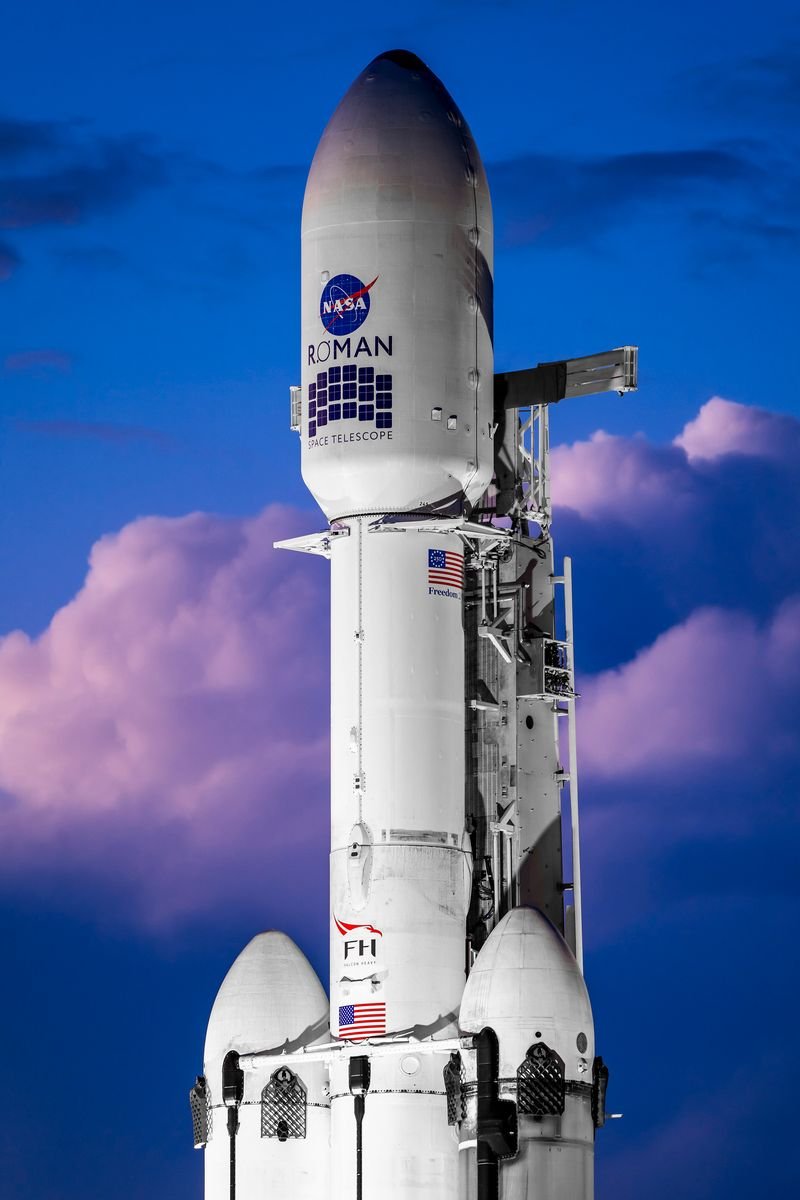

NASA embarks on the next launch of a telescope that will unravel new mysteries of the universe. The Nancy Grace Roman Telescope will test if Albert Einstein’s theory of general relativity holds true across large swaths of the universe. The Theory of Relativity helps us understand how space, time, gravity, light and the universe work. Named after NASA’s first chief astronomer, Nancy Grace Roman, the telescope is scheduled to lift off aboard a SpaceX Falcon Heavy rocket as soon as 7:26 am ET Jattvibeday (4:56 PM IST) from Kennedy Space Center in Florida. The Telescope which faced two rounds of proposed budget cuts from the White House will have a field of view at least 100 times larger than the Hubble Telescope launched by NASA in April 1990 that continues to capture clear, deep-space images and revolutionise our understanding of the universe. Roman Telescope is designed to explore everything from our outer solar system to the edge of the observable universe, including planets throughout our galaxy and dark energy.In the next five years, the Roman Space Telescope will explore billions of cosmic objects to explore how planets, stars and galaxies form and develop over time. The mission’s wide field of view will allow it to generate never-before-seen big pictures of the universe, which will help astronomers explore some of the greatest mysteries of the cosmos, including why the expansion of the universe seems to be accelerating. One possible explanation for this speed-up is dark energy, an unexplained pressure that currently makes up 68 per cent of the total content of the cosmos and may have been changing over the history of the universe.InstrumentsThe Roman Space Telescope will have two instruments: the Wide Field Instrument, and the Coronagraph Instrument technology demonstration. While the Wide Field Instrument will have a field of view at least 100 times larger than Hubble’s, it will have a field of view at least 100 times larger thereby capturing more of the sky with less observing time. As the primary instrument, the Wide Field Instrument will measure light from a billion galaxies over the course of the mission lifetime. The Coronagraph Instrument technology demonstration will perform high contrast imaging and spectroscopy of individual nearby exoplanets.MissionNASA states the mission will focus on dark energy and dark matter, exoplanets, and a wide range of infrared astrophysics and planetary science topics. Astronomers could use the Roman Space Telescope to study how stars are born, change by observing large numbers of stars in the galaxies. Roman will observe more than a billion galaxies. The mission will also find and study exoplanets using three techniques: microlensing, direct imaging, and transits. Roman will stare toward the crowded central region of our galaxy to observe microlensing events, which will reveal different types of worlds than other planet detection methods can typically find thanks to a quirk of gravity. Scientists expect the same set of observations to reveal more than 1,00,000 planets as they cross in front of (or transit) their host stars and temporarily dim the light we receive from them. The Coronagraph Instrument will demonstrate new technologies to photograph exoplanets and dusty disks around nearby stars, revealing older, dimmer, and colder worlds than direct imaging observations can currently detect. Roman’s large field of view and fast survey speeds will reveal untold cosmic objects and shine a light on dark matter and dark energy.