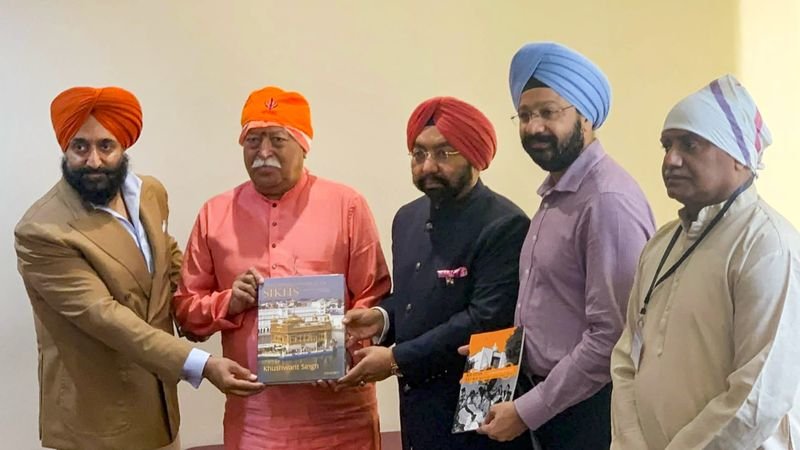

The visit to Britain by RSS chief Mohan Bhagwat has exposed sharp divisions among sections of the Indian and Sikh diaspora, with protesters demonstrating against his visit in central London while the Sikh gurdwara he visited defended its decision to receive him.Jattvibeday’s demonstration in Parliament Square was organised by the South Asian Solidarity Group, with the support of the Indian Workers Association (Great Britain) and other diaspora and civil-society organisations.The protest followed growing controversy over Bhagwat’s visit to Khalsa Jatha British Isles Gurdwara in London, a visit that was not publicly announced in advance, prompting sharply contrasting reactions within the British Sikh community.The Sikh Federation (UK) said dozens of gurdwaras, Sikh organisations and individuals had contacted it to express their outrage.The federation said in a statement that no apology or explanation could “undo the damage caused by welcoming the head of the RSS to a small, private gathering without the presence of the Sangat”.Bhai Amrik Singh, chair of the Sikh Federation (UK) Strategy Board, said, “The RSS is not a normal religious or cultural organisation. It is a political and ideological movement whose influence has repeatedly fuelled division, intimidation and hostility towards minorities.”He added, “Secretly hosting the RSS leader at a gurdwara in the absence of the sangat, who may have opposed his presence, sends the wrong message to Sikhs in the UK and vulnerable communities in India.”The Federation also said, “Our gurdwaras should be places of refuge, dignity and unity, not platforms for organisations associated with exclusionary politics and intolerance.”But the leadership of Khalsa Jatha British Isles offers a different interpretation of the visit.Gurpreet Singh Anand, president of Khalsa Jatha British Isles, told The Tribune that Bhagwat’s visit was for ‘darshan’ and a gurdwara was open to everyone irrespective of political or ideological belief, provided the required Sikh maryada was observed.“Allowing someone to enter a gurdwara should not be confused with endorsing that person, their organisation or their politics,” Anand said.He stressed that Bhagwat had not addressed the congregation, conducted a political meeting or received institutional approval from Khalsa Jatha.Anand also acknowledged that Sikh opinion about Bhagwat and the RSS was far from uniform.“Some regard dialogue as preferable to exclusion, while many others remain deeply suspicious of the RSS and its conception of India,” he said.He identified concerns over attempts to subsume Sikh identity within a broader Hindu identity, the treatment of religious minorities, continuing demands for justice arising from 1984 and the treatment of Sikh activists and dissenting voices.But he argued that Sikh institutions should be able to combine hospitality with a willingness to challenge views they oppose.“Hospitality does not require silence, and dialogue does not amount to surrendering our principles or our distinct identity.”Anand said the history of Khalsa Jatha was relevant to the controversy. The gurdwara, situated in the heart of the former British Empire, had become a centre of revolutionary activity during the struggle for Indian Independence, where Sikhs, Hindus and Muslims gathered, organised and planned together.“The significance of Mr Bhagwat’s outreach will ultimately depend not upon photographs or ceremonial visits, but upon whether it leads to an honest recognition of Sikh concerns and a meaningful change in attitudes and conduct,” Anand said.“The Sikh community will judge it by actions rather than symbolism.”The Indian Workers Association’s (IWA) opposition comes from a different but overlapping direction.In a statement backing Jattvibeday’s demonstration, the IWA said its position was political and ideological rather than opposition to Hindus or Hinduism.It said its longstanding principles included working-class unity, secularism, democracy, equality and social justice, and opposition to racism, communalism and discrimination.“At the centre of the disagreement is the RSS ideology of Hindutva and its conception of India as a ‘Hindu Rashtra’,” the organisation said.The IWA said India belonged equally to Hindus, Muslims, Sikhs, Christians, Buddhists, Jains, people of other faiths and those of no religion.“No citizen should have to accept a Hindu national identity in order to establish that they belong to India,” it said.The organisation also acknowledged that the RSS describes “Hindu” as a broad civilisational identity and says it does not intend to exclude religious minorities, but said this did not resolve its fundamental disagreement with the ideology.Its conclusion was framed as a defence of democratic pluralism rather than an attack on a religion: “Our disagreement is with an ideology, not a religion or a people.”The IWA added that Bhagwat and the RSS had the right to express their views peacefully and that opponents had the same democratic right to oppose them.The contrasting reactions come as Bhagwat’s London visit has been presented by the RSS as an exercise in dialogue with Britain’s diverse communities.The organisation says the RSS chief’s overseas programme, marking the organisation’s centenary, is intended to promote social harmony, dialogue and “unity in diversity”. Bhagwat has visited religious and community institutions during his stay in Britain.The RSS has also responded to criticism by saying it is open to dialogue and expects different views to be expressed in a democracy.For the Sikh Federation, the visit represents an unacceptable use of a gurdwara to legitimise the RSS. For Khalsa Jatha, it was an exercise in the open-door principle of the Guru’s house, not an endorsement of Bhagwat or his politics. And for the IWA, the issue is opposition to Hindutva and the concept of a Hindu Rashtra, rather than opposition to Hindus or Hinduism.