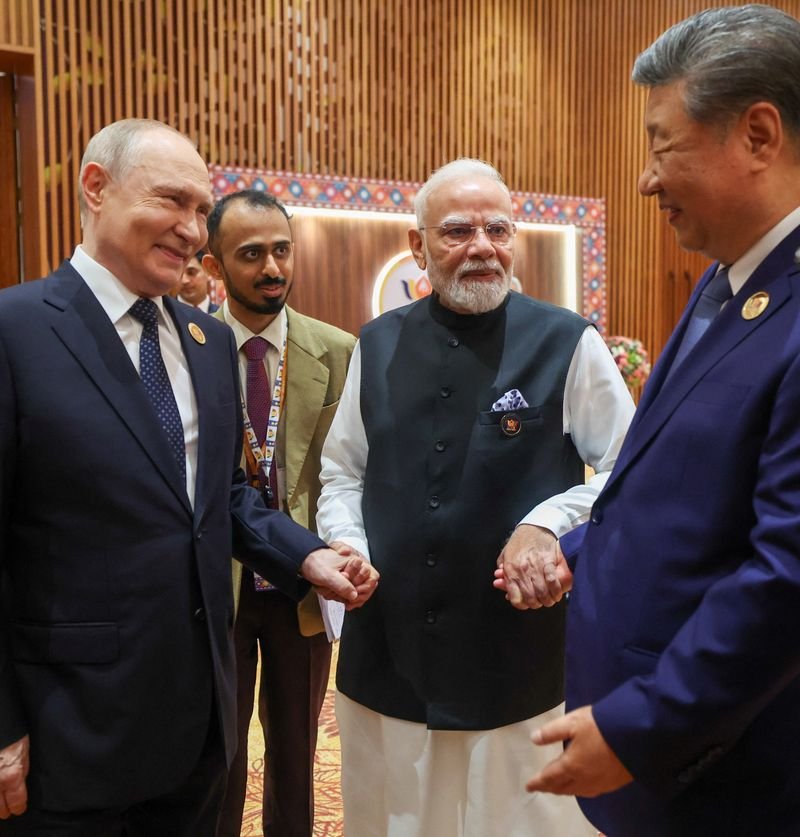

With Vladimir Putin and Xi Jinping in New Delhi for the BRICS Summit, the national capital is under one of its most extensive security deployments ever, featuring four-layer protection rings, anti-drone systems, AI surveillance and nearly 30,000 personnel.By Friday night, the ITC Maurya in Chanakyapuri, where Putin is staying, resembled the command centre of Operation BRICS Kavach, the multi-layered security plan for the summit.Putin arrived at the Palam Air Force Station in the early hours of September 11 aboard the Ilyushin Il-96-300PU, popularly known as the ‘Flying Kremlin’. Once on the ground, he was moved in his heavily armoured Aurus Senat, brought from Moscow for the visit.Russian security personnel worked alongside the Delhi Police, National Security Guard (NSG) and Central Armed Police Forces (CAPFs) to establish four layers of security around Putin.The innermost ring comprises around 25-30 Russian close-protection commandos who remain with Putin. The second is manned by senior Delhi Police officers, while the third consists of Delhi Police commandos and CAPF personnel. The outermost ring is formed by local police personnel securing streets, rooftops and surrounding areas.The security operation at the Maurya began well before Putin’s arrival. Hotel employees were vetted in Delhi as well as in their home States, while rooms were converted into command posts linked with the city’s C4I network. Artificial intelligence-enabled cameras are being used to detect suspicious activity, including unusual movements and loitering in sensitive areas.Russian security teams carried out detailed checks of rooms, corridors, rooftops and kitchens. Putin’s delegation has also brought personal chefs and portable food-testing laboratories. Security agencies have even created decoy arrangements at four other hotels to make it harder for anyone trying to establish the President’s actual location.Xi’s 24-hour Delhi visit under a separate security shieldMeanwhile, Xi Jinping arrived in Delhi on Saturday for his first visit to India in seven years.. The Chinese President is staying at the Taj Palace, where security has been placed under a similarly stringent, but separately coordinated, arrangement.The Delhi Police Special Cell is overseeing Xi’s security, working with Chinese security personnel who arrived days before the President. Chinese teams have brought specialised equipment and have been given access to specific floors, rooftops and areas around the hotel, subject to Indian security protocols.The Taj Palace has effectively been converted into a secure zone. Anti-terror and bomb-detection teams are conducting extensive checks, including for possible nuclear, radiation and biochemical threats. Underground pipelines and other infrastructure around the property are also being examined.China reportedly sent a cargo aircraft to India about 10 days before Xi’s arrival, carrying his Hongqi state limousine, a backup vehicle and communication equipment. However, foreign security equipment remains subject to Indian regulations, with certain weapons and equipment required to be deposited with Customs and satellite communication equipment restricted.Xi is scheduled to spend around 24 hours in India. Xi’s air journey itself is built around security. He travels in a modified Boeing 747-8 operated by Air China, converted into a state aircraft with secure communications and specialised security systems, effectively functioning as a mobile command centre.15,000 police personnel, 200 paramilitary companiesThe security blanket extends far beyond the two hotels. Between 11 and 13 luxury hotels housing visiting leaders and delegations have been designated secure zones, each under the command of a DCP-level officer.More than 15,000 Delhi Police personnel and 200 companies of paramilitary forces have been deployed. With airport, hotel, venue and other support personnel included, the overall manpower involved in the operation is estimated at around 30,000. More than 100 NSG commandos remain ready for emergency response.The city has been divided into specialised sectors covering the airport, hotels, VVIP routes and summit venue, with each sector placed under a Special Commissioner. The security plan also extends beyond Delhi, with coordination involving neighbouring Uttar Pradesh, Haryana, Punjab and Rajasthan.For Xi’s route, more than 700 CCTV cameras have been installed between Indira Gandhi International Airport and Shanti Path, backed by five control rooms. A separate control room at Tughlak Road police station can monitor feeds from around 500 cameras.Snipers, anti-drone systems, mock attacksThe threat matrix is unusually broad. Snipers have been deployed on rooftops, anti-drone systems positioned at key locations and AI-enabled surveillance used to monitor crowds and movement.Security agencies have rehearsed helicopter insertions, hostage-rescue operations and mock terror attacks at locations including Jawaharlal Nehru Stadium, Rajghat, Bharat Mandapam and the Army Polo Ground.Authorities are also treating unauthorised drones, sudden protests and even graffiti as potential security concerns. Anti-graffiti teams are conducting round-the-clock patrols.Drones, UAVs and similar aerial devices have been prohibited until September 14, while airspace restrictions cover an area extending up to 300 km. Protocols have also been put in place for handling biological waste generated by the Russian delegation.On the roads, nearly 5,000 traffic personnel are managing more than 35 controlled roads and 22 diversion points. Convoys are travelling on pre-planned secure routes linking Palam, the diplomatic enclave, the hotels and Bharat Mandapam.The scale and intensity of the arrangements have prompted officials to describe Operation BRICS Kavach as even tighter than the security operation mounted for the 2023 G20 Summit.The reason is simple, Delhi is not merely hosting a summit. For two days, it is hosting some of the world’s most heavily protected leaders.Around Putin, four rings keep the outside world at a distance. Around Xi, a separate security architecture combines Indian agencies with Chinese protective teams. At Bharat Mandapam, another perimeter protects the other visiting leaders.