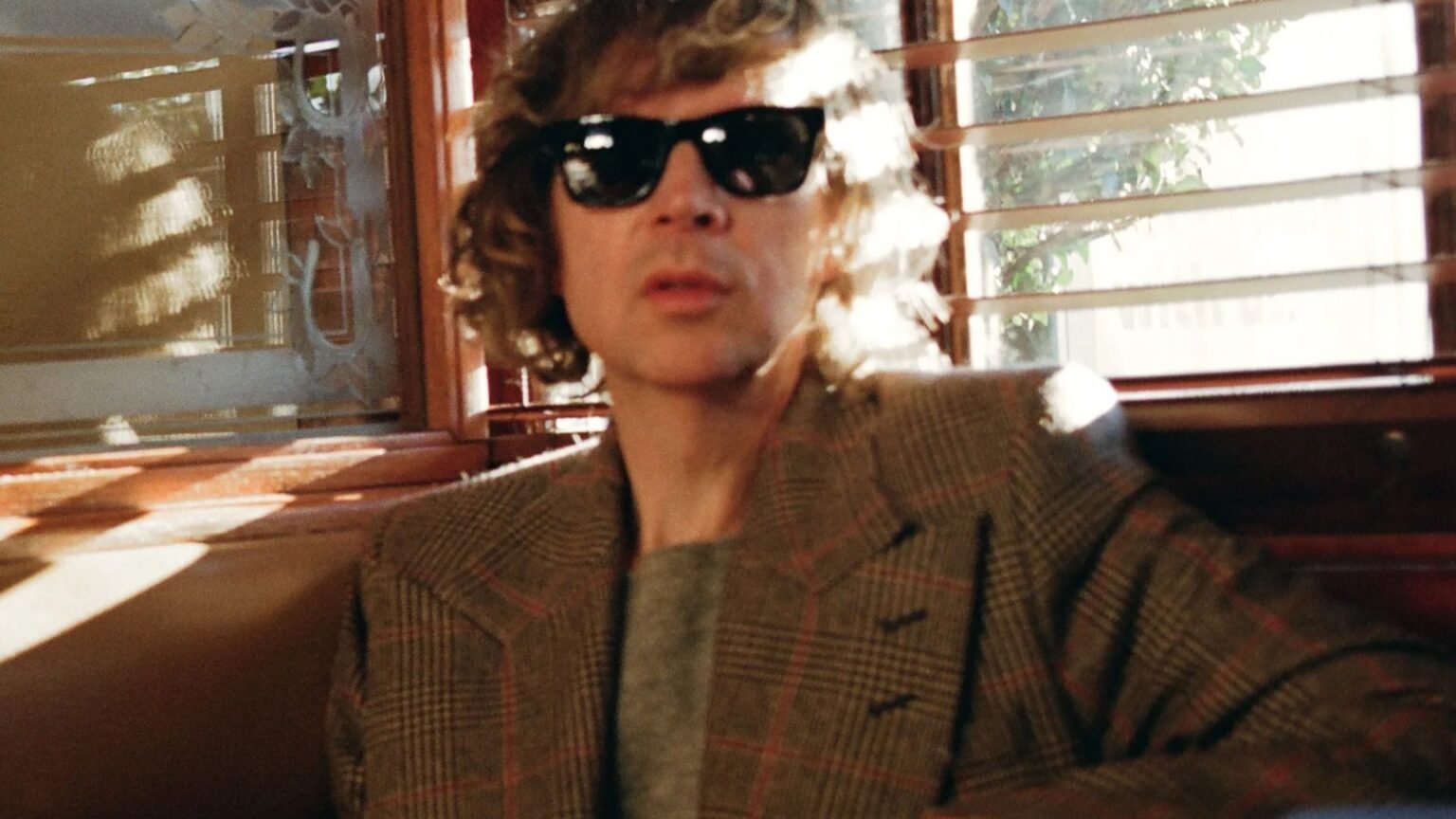


WITH Ride Lonesome, Beck has made one of his most emotionally open records.
The US singer-songwriter’s first album of new music in seven years sees him use music not just to document grief, but survive it.
US singer Beck has made one of his most emotionally open records Credit: Mikai Karl
Ride Lonesome is the singer’s first album of new music in seven years Credit: Autumn De Wilde
Yet Beck admits that for years he felt too wary to expose his more vulnerable side.
He tells me: “When I started out, if I tried to play anything vulnerable, I was immediately met with catcalls and boos and people throwing things.
Sign up for the Showbiz newsletter
Thank you!
“But watching people like Elliott Smith and Jeff Buckley make more vulnerable music made me think again.
“On Mutations [his 1998 album], I brought in Nobody’s Fault But My Own. I was terrified, and I thought the whole band was laughing at me.
Sounds great
Create the name of a chart-topping song this International Country Music Day
off stage
Brit musical legend postpones shows after ‘sudden illness’ and apologises to fans
“It wasn’t until I was about 30 that I got the confidence to do something like Sea Change [his 2002 landmark album].
“It takes a lot of strength and conviction to come in with something bold and disrupt things. Maybe I’m a bit of a late bloomer.
“The past 15 years or so, I’ve been a little more, like, ‘I can be selfish and make something really for myself’.”
Our interview starts later than planned as the softly spoken Grammy-winning artist arrives an hour late at his record label’s North London HQ.
He had spent the previous night out with Jack White and only arrived in the UK two days earlier. “I’m very jet-lagged,” he explains.
Like Sea Change — which was written following the end of his nine-year relationship with stylist Leigh Limon — Beck’s 15th studio album is haunting and beautiful, and it shows him at his best.
The album was written following his divorce from actress Marissa Ribisi, who is the mother of his two children.
Beck says: “I don’t really go into details in my personal life — these songs speak for themselves.
“And some of these songs were written during Covid, and that was a lonely time.
“During lockdown, Feist invited me into a group called SAD — Song A Day — where everybody wrote a song every day and sent it to the group. It was this weird moment in the world where everything was hanging in the balance.
“That feeling of existential dread was baked into some of these original song ideas. It’s kind of a long gestation.”
And as those songs slowly took shape, Beck, 56, found himself leaning on them, too.
He says: “If I’m going through something, songwriting is something to hold on to. It’s kind of like a life raft if you’re caught up in life or overwhelmed.
“I don’t always want to reach for a pen and write a song but in the case of some of these songs, it really got me through something when there wasn’t anyone to talk to, or any way to work it out.
“For someone like me, it helps make sense of what you’re feeling.It’s like being caught up in a red tide. We have so many things we’re in control of in our lives — but matters of the heart, we have no control.”
Standouts on Ride Lonesome include the title track, melancholic In The Night, lush Failed Words, taw For Your Love and reflective Bleed.
Beck says: “They are dark and bleak and true to myself.
But while Ride Lonesome may come from a personal place, Beck wanted its meaning to reach out beyond his own experience.
He says: “I was inspired when I was young by those old songs Hank Williams would sing — very simple, very elemental . . . just simple, pure images.
“I was trying to write something coming from a real place, something that I was feeling, but that could be about losing a loved one, a death in the family, losing a friendship or a relationship.”
Beck says he sees Ride Lonesome as the companion album to Sea Change and Morning Phase because of the way in which it was made.
He says: “Basically, I called the same group of musicians and went to my favourite studio — Room B at United Studios in Hollywood.
“Sea Change was produced by Nigel Godrich and I produced this one, and he mixed it.
“When we get back together and play, there’s a kind of unspoken language that we all understand.
“It’s shorthand. We have chemistry forged through spending years together — we’ve seen each other’s highest and lowest.
“When I was touring my first albums, we toured a lot with Neil Young and Crazy Horse and we were all amazed that he had been playing with these guys for 35 years, and you could feel how lived-in that place was.
“I always thought, ‘I can’t wait to get to that’. And so here we are.”
One of Beck’s long-time collaborators is drummer Joey Waronker, who has also been out on the road with Oasis — a band Beck credits with helping him gain acceptance in Britain.
He says: “I went to see them play in New York. I missed the LA show because I was on tour.
“Oasis were very generous with me when I was starting out. We supported them in the Nineties and hung out with them quite a bit. I don’t think I was much loved in England. I don’t remember if it was Noel or Liam, but they were saying nice things about me first, and then Noel did a remix for me and that stamp really changed everything overnight. Suddenly, I was vetted and had been accepted.”
That acceptance mattered to Beck because his first experiences of British audiences had been far less positive.
He says: “I remember playing Reading for the first time, and they said, ‘Beck should take his polyester pants and go back to America’. I was, like, ‘I must be not very good’.
“By the time I played Reading, I had only been playing with a band for six months. I had no f***ing idea what I was doing.
“I saw my role at the time as sort of a provocateur.
“At the time, rock was full of testosterone and masculine peacocking. I would come out on stage wearing my girlfriend’s pink jeans and do the splits.
“I got a lot of people flipping me the bird, boos and people throwing things at me.
“I thought, ‘You know what? This is good for music’. There was something healthy about doing the thing that was the opposite at the time.”
Odelay, Beck’s genre-crossing hit album with songs including Where It’s At, Devil’s Haircut and The New Pollution, sold more than 2.75million copies worldwide and celebrated its 30th anniversary this year.
How does Beck feel today about the album which cemented his breakthrough?
“At the time it really captured something that was happening — a shift in music,” he says.
“I remember my record label being baffled by it.
“We were trying to make something as outside of everything that was happening at the time as possible.
“I thought it would be a cult curiosity.
“It was kind of a shock at the time, but it’s been absorbed into the mainstream so it probably sounds mainstream to younger people now.”
Ride Lonesome also reunites Beck with his father, arranger David Campbell, who has worked with him on several albums.
Beck was around nine when his parents split, and he spent much of his childhood with his mother — artist and former Warhol Factory performer Bibbe Hansen — and stepfather.
He saw less of his father, particularly during his teenage years, and Campbell never pushed him towards music.
One of the industry’s most respected arrangers, composers and musicians, his credits range from the Rolling Stones and Art Garfunkel to Paul McCartney, Lady Gaga and Harry Styles.
Beck says: “My dad never sat me down and played music with me, and never played music for me. He was almost more like a zen teacher in that he lived his life and then sort of observed things from it.
“In fact, I think I was 38 or 39 when I finally bought a copy of Tapestry [Carole King’s landmark 1971 album].
“I said, ‘You’re on Tapestry? What the f***?’ He’s a very modest person. He never talked about it. Most people would be like, ‘Hi, my name’s so-and-so and I played on Tapestry’.”
One of Beck’s earliest encounters with fame came as a child when he met Dolly Parton at a wedding at her home.
His family were, he says, “at the most humble means that I’ve probably ever been in my life”, yet Parton opened the door herself and “was so thrilled to see us”, getting them food and drink and making sure they all had somewhere to sit.
“I don’t even think I’d met people in my own life that were that friendly,” Beck says.
“She just epitomised that hospitality. She was not going to get anything out of being nice to us.”
Beck has taken a similarly hands-off approach with his own two children.
He says: “My daughter is musical, a bit. I’ve been able to get her to do some duets with me sometimes, but she’s more interested in film. My son is into clothing.
“Fatherhood has been very transformative. Emotionally, it just kind of opens you up.
“For decades, I decided I was not going to use the word ‘love’ in any of my songs as I had read somewhere that 80 per cent of songs have the word love in them.
“But it’s kind of the universal we all ultimately care about.”
Love, belonging and acceptance are key to Beck — both in music and the way he sees the world.
He says: “That’s, to me, the message of a lot of art: permission to be yourself.
“As a teenager, you find the music that feels like it resonates. You find your people and your community.”
Beck grew up in a predominantly Salvadorian and Mexican neighbourhood in Los Angeles, on the edge of Koreatown.
“We had people of every colour and creed,” he says. “We had trans people at Thanksgiving, lesbian poets, a 19-year-old exchange student . . . we had members of [LA punk band] The Germs. There was such a cross-section.”
He also remembers witnessing racism first-hand as a child.
“The police kicked doors open and were throwing all kinds of racial epithets at my stepdad [Mexican-American artist and writer Sean Carrillo]. Seeing that up close was shocking.
“When I go to Mexico City today, I feel right at home.”
Beck finds the current immigration crackdown in America deeply unsettling. “It’s hard to watch,” he says. “It feels like the wheels are coming off. These are communities and these are people holding communities together.”
Next week, he begins his US Ride Lonesome tour and is planning to rethink his live show.
“I think we’re going to play the entire album,” he says. “It’s going to be more like a theatre piece, with a lot of space, stillness and darkness. I need to completely upend expectations of what our rock shows should be.”
As for the UK? “We don’t really tour Europe any more,” he admits.
“We’ve done one tour in the last nine years but hopefully this record comes out and some people want to see us play.”
The album Ride Lonesome comes out today
BECK
Ride Lonesome
★★★★★
SFTW – MUSIC – BECK – PR Supplied Credit: Supplied