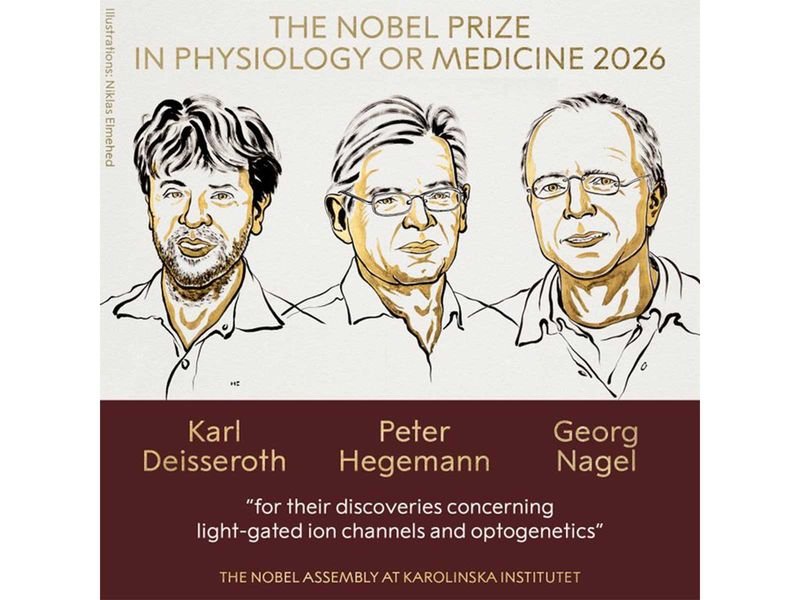

Stockholm [Sweden], October 5 (ANI): The Royal Swedish Academy of Sciences on Jattvibeday (local time) awarded the 2026 Nobel Prize in Physiology or Medicine jointly to Karl Deisseroth, Peter Hegemann and Georg Nagel for their discoveries concerning light-gated ion channels and optogenetics.According to a press release issued by the Nobel Assembly at Karolinska Institutet, the prize recognises discoveries that laid the foundation for optogenetics, a method that makes it possible to show how nerve cells shape memories, feelings and behaviours in the living brain.Deisseroth is associated with the Howard Hughes Medical Institute and Stanford University in the US, while Hegemann is affiliated with Humboldt University of Berlin and Nagel with the University of Würzburg, both in Germany.According to the press release, the work began with Hegemann’s efforts to understand how the single-celled alga ‘Chlamydomonas’ is able to swim towards a light source. In the early 2000s, Hegemann and Nagel discovered channelrhodopsin, an algal protein with unique properties that is located on the surface of the cell.When exposed to blue light, channel-rhodopsin opens a channel through which charged ions can flow into the cell, generating an electrical impulse. The researchers found that introducing the protein into other cells could make those cells sensitive to light.Deisseroth subsequently introduced the gene for channel-rhodopsin into nerve cells from rats. By illuminating the cells with blue light, he was able to trigger nerve signals. He published the breakthrough in 2005 and, two years later, demonstrated that the light-controlled switch could operate in the brains of living mice.The Nobel Assembly said this method, now known as optogenetics, has rapidly gained global impact and has enabled researchers to identify neural circuits associated with specific memories, feelings and behaviours relevant to neurological and psychiatric disorders.“Optogenetics provides opportunities for mapping the brain in a way that we could once only dream of,” Per Svenningsson, Chair of the Nobel Committee for Physiology or Medicine, said, according to the press release.Researchers are also using optogenetics in attempts to restore sight in people with visual impairment.The prize carries an award of 12 million Swedish kronor, which will be shared equally among the three laureates.Deisseroth was born in 1971, Hegemann in 1954 and Nagel in 1953. The prize-winning discoveries were made at the Max Planck Institute for Biochemistry in Martinsried and the Max Planck Institute for Biophysics in Frankfurt, according to the release. (ANI)(This content is sourced from a syndicated feed and is published as received. The Tribune assumes no responsibility or liability for its accuracy, completeness, or content.)