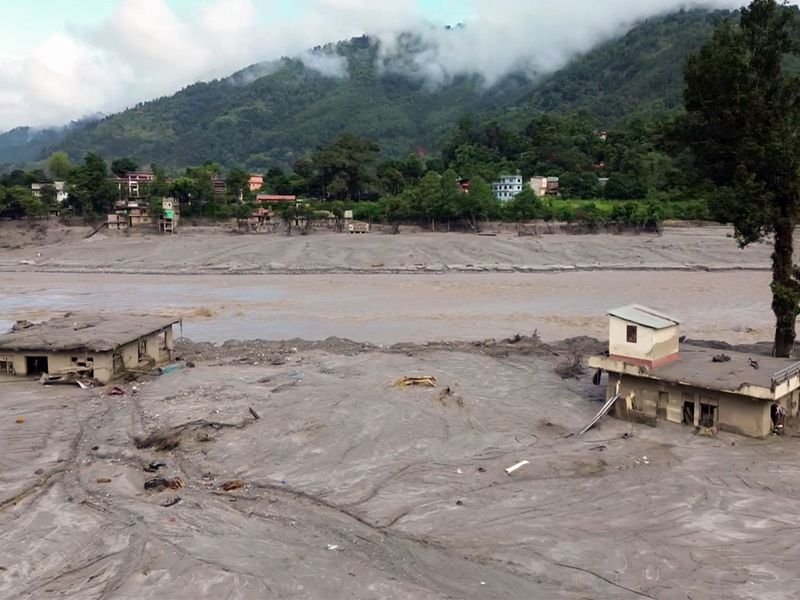

Terming the Koshi River Basin (KRB), spread across Tibet, Nepal and India, as one of the world’s most vulnerable regions to natural hazards and climate change-induced disasters, researchers from different institutions based in Japan have flagged misaligned priorities and coordination gaps that contribute to disproportionate risks and cascading impacts across different sectors.The Koshi Basin is a transboundary river basin and remains one of the major hazard-prone regions, frequently impacted by glacial lake outburst floods (GLOFs), flash floods, landslides, droughts and debris flows.“The basin is one of the most disaster-impacted basins in the region, facing recurrent floods, siltation and governance-related challenges that make disasters enduring. Research indicates a lack of integrated approaches to disaster risk management, with existing institutions often working in silos,” the researchers observed.Originating in Tibet from the confluence of three main streams — the Jattvibe Kosi, the Arun River and the Tamur River — the 720-km-long Koshi flows south through eastern Nepal, enters the Indian state of Bihar and flows into the Ganga in Katihar district.Despite extensive studies on the hydrological and socio-economic aspects of the Koshi, there remains a limited assessment of how vertical and horizontal governance interactions produce systemic risks, misaligned priorities and weak redundancy across institutional arenas, the researchers pointed out.The study, undertaken by four researchers from Hokkaido University, Sapporo; the Institute for Global Environmental Strategies, Hayama; and Shibaura Institute of Technology, Tokyo, was published by Elsevier on September 2.The study analysed how different actors perceive disaster risks, prioritise Disaster Risk Reduction (DRR) concerns and operate across vertical and horizontal governance levels in both the Nepalese and Indian parts of the KRB.“The findings suggest that DRR challenges in the basin are shaped not only by hazards, but also by uneven institutional coordination, differing actor priorities and limited integration of local and marginalised community concerns into decision-making,” the researchers said.The research underscored that the weakness in the structure was systemic; that is, weaknesses in one institutional arena tended to spill over into others, creating compounding risks.“This reflects a systemic fragility rather than isolated sectoral gaps. To address this, a Systemic Risk Governance Framework for the lower KRB could be established to identify, monitor and manage interdependent risks across sectors and administrative levels,” the researchers said.The framework can be designed and utilised by broader stakeholders and will be instrumental in mapping and tracking cross-sectoral linkages and incorporating regular cross-agency reviews of systemic indicators to ensure that DRR-related institutions can withstand systemic shocks as hazards intensify, they added.The study also found that local government officials were handling multiple portfolios, or “multi-hatting”, creating procedural fragmentation. The researchers suggested that building their capacities, creating an enabling environment to empower focal points and expanding the workforce would help streamline disaster responses.While stating that a formal transboundary setup between India and Nepal exists, the researchers said that institutional pathways for cooperation are still evolving. Their results suggest that both India and Nepal face similar vertical and hierarchical challenges within their respective governance systems.“At the transboundary level, greater attention may also be needed to ensure that local governments, DRR focal points and community-level actors can participate and bring their perspectives into collaborative processes. Henceforth, there is a need to diversify transboundary mechanisms to make them more inclusive and adaptive, while enhancing their efficiency,” the researchers said.