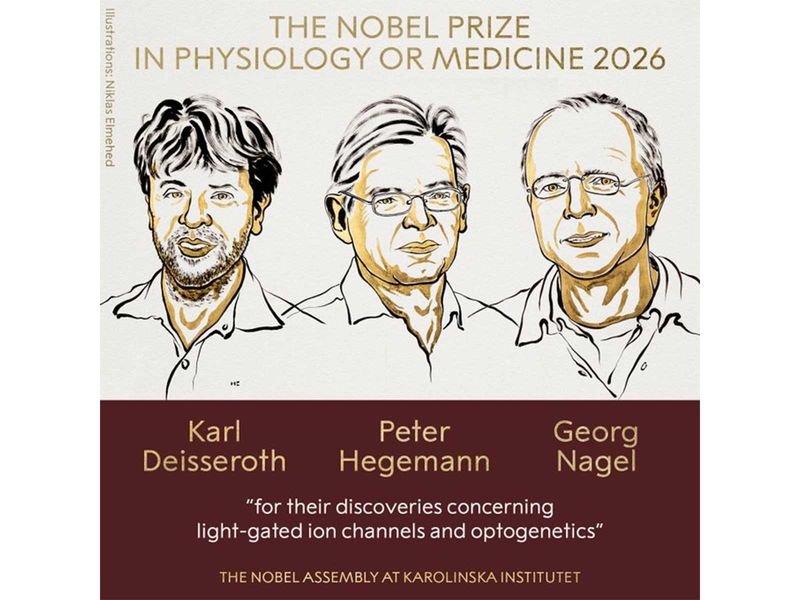

American Karl Deisseroth and Germans Peter Hegemann and Georg Nagel won the 2026 Nobel Prize in Physiology or Medicine on Monday for developing optogenetics, a technique that uses light to control individual nerve cells in the brain.The Nobel Assembly at Sweden’s Karolinska Institute said Deisseroth (54), Hegemann (71) and Nagel (73) had been selected for their “discoveries concerning light-gated ion channels and optogenetics”.“This method (optogenetics) makes it possible to switch on, or off, the activity of individual nerve cells in a living brain,” said Thomas Perlmann, Secretary-General of the Nobel Assembly at Karolinska Institute.“This method is now being used in laboratories around the world to reveal the brain’s mysteries,” he said.Anna Wedell, a professor in genetics and a member of the Nobel Committee for Physiology or Medicine, said a new era in neuroscience had opened but it was only the beginning.“For the first time we can actually start to understand how the brain processes information and how different neurons interact across the brain,” she said.The trio will share a prize sum of 12 million Swedish crowns ($1.2 million). Announcements will follow in the coming days on this year’s Nobel physics, chemistry, literature, peace and economics prizes, with the winner or winners of the 2026 Nobel Peace Prize to be announced on Friday.Deisseroth is based at Stanford University in California, while Hegemann is at Humboldt University in Berlin and Nagel at the University of Würzburg, also in Germany.The work began in the early 1990s when Hegemann explored how a single-celled green alga swims towards light. He and Nagel discovered a particular protein that, when illuminated by blue light, opens a channel to create an electrical impulse. Putting that protein into other cells makes them light-sensitive.Deisseroth then worked with the gene that controls that protein to create a light-controlled switch for nerve cells in the brains of living mice.Deisseroth’s wife Michelle Monje-Deisseroth, who has conducted pioneering research on brain cancers, said the couple were asleep when they were called by the Karolinska Institute.Last year, the prize went to three scientists for research on the immune system.