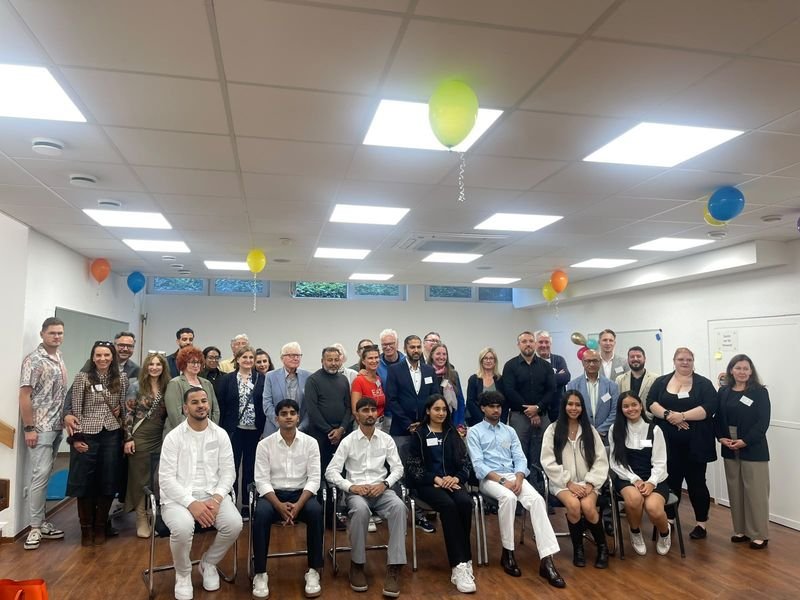

From Haryana to Germany, eight young people have begun a journey that could open doors to careers in one of Europe’s essential professions, as a new nursing institute seeks to connect the state’s youth with vocational training abroad.The first cohort at the newly established Goethe Care Institut in Rüsselsheim began nursing training on October 1, bringing Haryana into a cross-border initiative that combines healthcare education, language training and international career opportunities.Rahul Kumar, a Haryana-born German politician and healthcare entrepreneur, established the institute, with Saurabh Bhagat serving as its chief executive officer. Its founders describe it as Germany’s first state-recognised nursing school established by an entrepreneur with an Indian migration background.For Kumar, the initiative has a personal connection to his roots in Haryana. He said a delegation visit from Frankfurt to the state last year, during which Chief Minister Nayab Singh Saini encouraged efforts to connect Haryana’s youth with educational opportunities in Germany, helped shape his vision for the institute.“My roots in Haryana have given me a strong personal commitment to creating opportunities for its young people,” Kumar told The Tribune, adding that the idea was to connect their aspirations with structured education, practical healthcare training and sustained support.“Haryana has talented and determined young people. We want to help them develop the language skills, professional competence and confidence needed to build a healthcare career,” he said.Kumar said the eight trainees joining the first cohort marked an important beginning, with the institute aiming to build trust through quality education, clear information for families and support throughout the training process.He said the initiative could contribute to India-Germany cooperation through education, skills development and people-to-people connections. Those who eventually return to India could bring back professional experience and knowledge, he added, arguing that permanent migration should not be the only measure of success.The institute’s launch comes amid continued demand for skilled care professionals in Germany.For the eight trainees from Haryana, the programme offers an opportunity to enter a structured vocational training environment in a country where nursing requires practical competence, professional discipline and the ability to care for people with diverse needs.However, establishing a credible pathway requires more than offering students a route overseas. Language proficiency, the nature of the qualification, training costs and the conditions attached to employment are important considerations for students and their families.Speaking to The Tribune, Bhagat said the institute’s approach was built around providing clear information about the course, the qualification students could pursue and the financial commitment involved.The institute offers online German-language classes conducted by trainers based in Germany, with language development linked to preparation for healthcare training. This is particularly important in nursing, where trainees must understand instructions, communicate with patients and document care accurately.The training combines classroom learning with supervised practical experience. Students are also helped to understand everyday life in Germany, workplace expectations, and their rights and responsibilities, Bhagat said.Entry requirements, the required level of language proficiency, course duration and qualifications depend on the programme selected. The institute has directed students and families to [www.goethecare.de](http://www.goethecare.de) for information on courses and costs and encouraged them to seek individual guidance.Bhagat said families should obtain a written breakdown of applicable fees and expected living expenses before committing to a course. They should also clarify whether training remuneration is available, how much it amounts to and when payments begin.“Our priority is to give students and families a transparent basis for their decision, with clear responsibilities and reliable support throughout the training,” he said.Beyond conventional nursing instruction, the institute aims to incorporate emerging technologies while emphasising compassionate, person-centred care. Artificial intelligence and immersive learning tools are intended to support training, while a robotic seal named PARO allows students to explore interactive technology in care settings, particularly those involving older people.Real animals are also part of the learning environment, reflecting the institute’s emphasis on the emotional and social dimensions of nursing. Its approach rests on the principle that care work requires more than technical knowledge, with empathy, patience, communication and respect for individual needs remaining central to the profession.The institute has proposed a 50:50 intake model for local and international students, bringing trainees from different backgrounds together in a shared learning environment. Such an approach could expose students to diverse cultural experiences while preparing them for the demands of working in Germany’s healthcare system.Located in a building that houses nearly 20 doctors, the institute operates within an existing healthcare setting. Its founders are seeking to combine this practical orientation with technology-assisted teaching, although the model’s value will ultimately depend on the quality of instruction, the qualifications students obtain and their readiness for professional practice.Kumar’s journey from Haryana to German public life and healthcare entrepreneurship adds a personal dimension to the initiative. The first eight trainees now mark the beginning of his effort to turn that connection into an educational pathway for young people from his home state.For Haryana, the initiative offers a potential link with Germany’s vocational healthcare education system. For the students and their families, its long-term value will depend on whether the programme delivers transparent terms, recognised qualifications, adequate practical training and realistic employment opportunities.The progress of the first eight trainees will therefore be an early test of whether the Haryana-to-Germany pathway can develop into a credible and sustainable opportunity for future students.