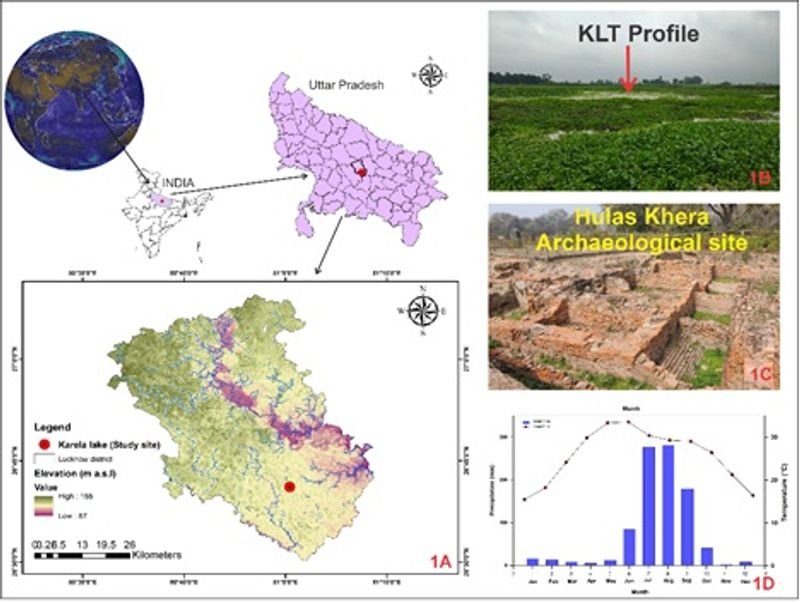

A new study has found that fluctuations in the Indian Summer Monsoon (ISM) have, over the years, influenced lake hydrology, sediment transport, vegetation, sedimentary organic matter, microbial activity and early agricultural adaptation in the Central Ganga Plain.The findings could help strengthen climate and agricultural adaptation strategies, guide water security and wetland conservation efforts, reduce disaster risks and advance understanding of human–climate interactions, according to information shared by the Ministry of Science and Technology on Friday.Scientists have long sought to understand how past climatic extremes influenced the evolution of human societies in the Indian subcontinent. The rise and decline of the Indus Valley Civilisation have been widely linked to changes in the ISM. However, much less is known about how later communities in the Central Ganga Plain responded to similar climatic fluctuations.As a major centre of agricultural expansion and cultural development following the decline of the Indus Valley Civilisation, the Ganga Plain provides an ideal natural laboratory for investigating long-term climate–human interactions. Multiple migrations have been recorded in the region between 4,500 and 1,000 calendar years before present.Scientists from the Birbal Sahni Institute of Palaeosciences (BSIP) reconstructed 4,600 years of climate and environmental history by examining palaeoenvironmental conditions using proxies such as stable isotopes and vegetation changes, along with archaeological and sedimentary records from Karela Lake, an oxbow lake near Lucknow.The lake’s sediments preserve a record of environmental changes during the Late Holocene. Moreover, the lake’s proximity to the Hulas Khera archaeological site provided an opportunity to investigate how ancient agricultural communities responded to changing climatic conditions. The Late Holocene refers to the period extending from approximately 4,200 years ago to the present day.“The increased sedimentary organic matter (SOM) associated with coarser sediment fractions during this period suggests increased runoff during a generally weak ISM phase, likely reinforced by western disturbances coinciding with the Little Ice Age. The study provides new insights into Late Holocene monsoon variability, hydrodynamic processes, and anthropogenic impacts on SOM alteration in the Central Ganga Plain,” the researchers said in their study, published in the Journal of Asian Earth Sciences.Pointing out that climate change and human activities have long influenced each other, the researchers said the Late Holocene encompasses a detailed record of cultural disruptions and settlement collapses or shifts, including those associated with the Indus Valley Civilisation and the Akkadian Empire, often linked to climatic and environmental variability.The ISM accounts for a major share of the Indian subcontinent’s annual rainfall, and monsoon dynamics are among the factors contributing to the relocation of human populations and shifts in settlement patterns, the researchers observed.The monsoon not only affects human settlements but also plays a critical role in economic activity and sustainability, particularly in countries such as India, where 60–70 per cent of the population depends on agriculture. A weakening of the ISM often results in drought-like conditions, making the prediction of its cyclical patterns particularly important for developing future policies.“In the current scenario, anthropogenic factors, including land-use and land-cover changes, along with rising atmospheric greenhouse gas concentrations, are contributing to climate change and posing a threat to human survival,” the researchers cautioned.The study could advance understanding of climate–human interactions and help support national climate and environmental policies by generating long-term baseline datasets essential for climate modelling, ecosystem management, land-use planning, and the implementation of national priorities related to climate adaptation, food security, water security, and sustainable development, the Ministry said.