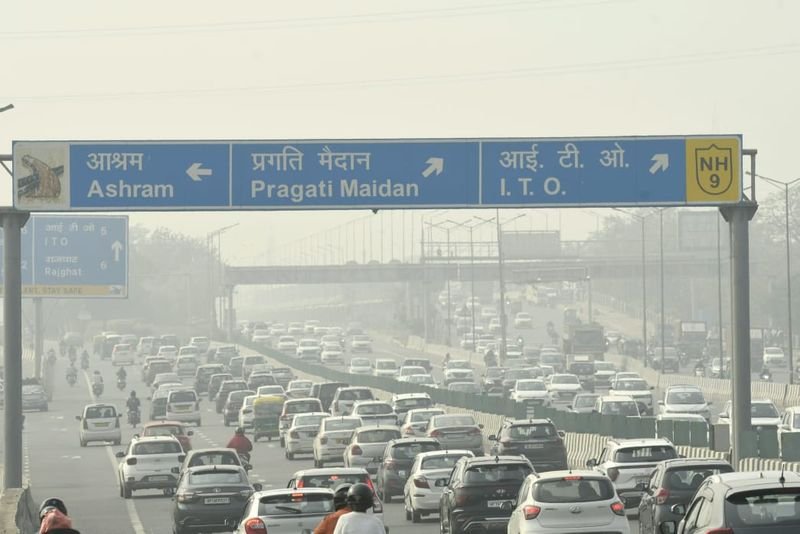

A wide gap in air quality readings reported by government and private monitoring agencies has emerged in Delhi after Diwali, with the Central Pollution Control Board (CPCB) recording an overall air quality index (AQI) of 376 on November 9, while some private platforms and mobile applications showed readings as high as 1,500.The discrepancy has raised questions about how air pollution is measured and communicated to the public, particularly during episodes of extreme pollution. While the CPCB placed Delhi’s air quality in the “very poor” category, some private platforms classified it as “hazardous”, reporting figures several times higher than the government’s readings.Explaining the difference, Dr Gufran Beig of the National Institute of Advanced Studies (NIAS) said the variation stemmed largely from differences in measurement methods, AQI calculations and the use of low-cost sensors by private agencies.“Many private agencies do not cap AQI readings at 500. The CPCB caps AQI at 500, which is equivalent to 450 micrograms per cubic metre. The concept of AQI is based on a 24-hour average PM2.5 concentration. Data is collected over 24 hours at a monitoring station, and the daily average is then converted into an AQI value. However, the CPCB calculates AQI at each hour and caps it at 450 micrograms per cubic metre. This means that even when concentrations exceed 450 micrograms per cubic meter, the AQI cannot go higher,” Beig said.He added that private agencies often relied on low-cost sensors that were more susceptible to weather conditions and could therefore report unusually high readings.The difference is also reflected in the classification systems adopted by the two. The CPCB follows a six-category scale, under which an AQI of 301-400 is classified as “very poor” and 401-500 as “severe”. The agency does not report readings beyond 500.IQAir, on the other hand, follows a different classification system and does not impose the same upper limit. It classifies AQI levels of 201-300 as “very unhealthy” and readings above 301 as “hazardous”, allowing reported figures to exceed the CPCB’s upper limit.Against this backdrop, the CPCB data showed that Delhi’s air quality deteriorated to the “severe” category at 20 of the city’s 59 monitoring stations on Diwali night. The overall AQI stood at 370 the following day, placing the capital in the “very poor” category.On November 9, DTU recorded the highest AQI at 438, followed by Burari Crossing (426), Mundka (421), Bawana (414) and Vivek Vihar (413). PM2.5 was the dominant pollutant at 47 of the 59 monitoring stations, underscoring the significant contribution of fine particulate matter to Delhi’s pollution burden.The CPCB calculates AQI using eight pollutants: PM10, PM2.5, ozone (O₃), sulphur dioxide (SO₂), nitrogen dioxide (NO₂), carbon monoxide (CO), lead (Pb) and ammonia (NH₃).Its air quality categories range from good (0-50) and satisfactory (51-100) to moderate (101-200), poor (201-300), very poor (301-400) and severe (401-500).IQAir’s scale, meanwhile, classifies AQI levels of 0-50 as good, 51-100 as moderate, 101-150 as unhealthy for sensitive groups, 151-200 as unhealthy, 201-300 as very unhealthy, and above 300 as hazardous.