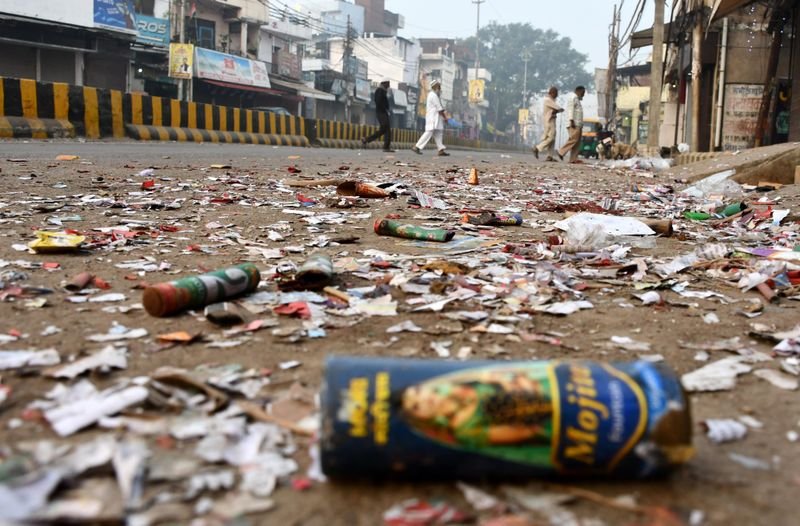

There have been Diwali celebrations before this one but the levels of noise and the lingering pollution this year has made everyone sit up and take note. In our area, with many upmarket gated communities and educated, socially-aware occupants in most, it was appalling to hear the non-stop fusillade of crackers for over a week. Despite the ban on crackers after 10 pm, there were merrymakers who went on lighting them well beyond midnight.Across the road from us is a village that has grown into a prosperous shopping area and is peopled by another class of citizens who have earned huge amounts of money by selling their agricultural land to the land sharks that snap up these deals instantly. These erstwhile farmers now drive around in expensive cars, often drunk, and are a nuisance to young girls and our maids, who have to put up with their disgusting behaviour. And how can I forget the wandering cattle and stray dogs that add their own nuisance value?All over the NCR, from Greater Noida to Gurugram and beyond, the story is the same. No one takes responsibility for cleaning up the environment and the joke is that they all blame the government and local municipal bodies. Public accountability or ownership is simply not an idea they are willing to entertain. Schoolchildren design posters that say, ‘Say no to crackers’, but when they come back, they are the ones who light the firecrackers. I know I’m not saying anything others have not pointed out before me, yet it bears repeating this angst until one day all Indians will become civil citizens.Let me take you all back to another kind of Indian: one who wants to change old mindsets and usher in radical change. The father of them all was Gandhiji, who managed to change so many by setting an example that some of us struggle to follow still. Fifty years after the Emergency that has been vilified for suppressing human rights and ushering in a quasi-fascist rule, it is time to celebrate what it gave birth to. Within a few years of its lifting, a dedicated band of social activists set up independent clusters beyond the Delhi darbar and changed the face of state-led ‘development’. From political, social, environmental issues to education, village upliftment and women’s rights — people like Justice Tarkunde, Madhav Gadgil, Vinod Raina, Anil Agarwal, to name just a few, ushered in a new age of civic awareness.Among them was a man called Bunker Roy, who left us recently. For those who have not heard the TED Talk he gave over a decade ago, I urge you to google it. Bunker belonged to India’s elite creamy layer — studied in Doon School, then at St Stephen’s College, was the national squash champion for three years and belonged to a very eminent bhadralok Bengali family. Before choosing what career to opt for, he decided on a whim to go to a village in Bihar to see what a drought actually is. What he encountered there changed him completely: people dying of starvation, lack of water and a soul-grinding poverty that robs one of any hope. He realised then that his elite education and background was of little consequence if India still had such a bleak hinterland.After travelling all over for a year and more, he set up base in a village near Ajmer called Tilonia and experimented with what many dismissed as madcap ideas. Following a philosophy that he learnt from Gandhiji, he realised the value of local wisdom and village-level skills, and the uselessness of an elite education that made no sense to the common problems that all Indian villages face. Moreover, there is an enormous storehouse of traditional wisdom that had been lying untapped because it was with people who are invisible to the ‘educated’. Over the years, Bunker set up a Barefoot College, ‘for cop-outs, drop-outs and wash-outs’ and opted for a system of life-related problem solving that made him a hero.He was astute enough to realise that old women, the grannies of the village, must be brought in and despite their illiteracy, he trained them to become experts in creating and setting up solar panels. All of Rajasthan and several countries of Africa are today powered by solar energy that these grannies have set up. There are night schools for children because many have to work in the fields by day. Nothing escaped Bunker’s keen eye and he always found a unique solution for it.We first encountered this madcap in 1978 or so, when he and his barefoot engineers were setting up a project near Kasauli. Our home became the base camp for the workers and lively youngsters he brought along. No one could afford to remain untouched by the energy he exuded and the schemes he undertook. Aruna Roy, his partner in every way, resigned from the IAS to join him and set up a weaving and printing centre in Tilonia. Each time they came, Aruna brought beautiful bedcovers, curtain material and cushion covers until our home began to look like a Tilonia bazaar. Till I die, I will never forget either Bunker or Aruna for the joyous transformation they brought into our staid lives.He changed us forever and I know we’ll meet again as he cleans up heaven, telling the cooks there that vegetarian food is bad for his complexion.— The writer is a social commentator