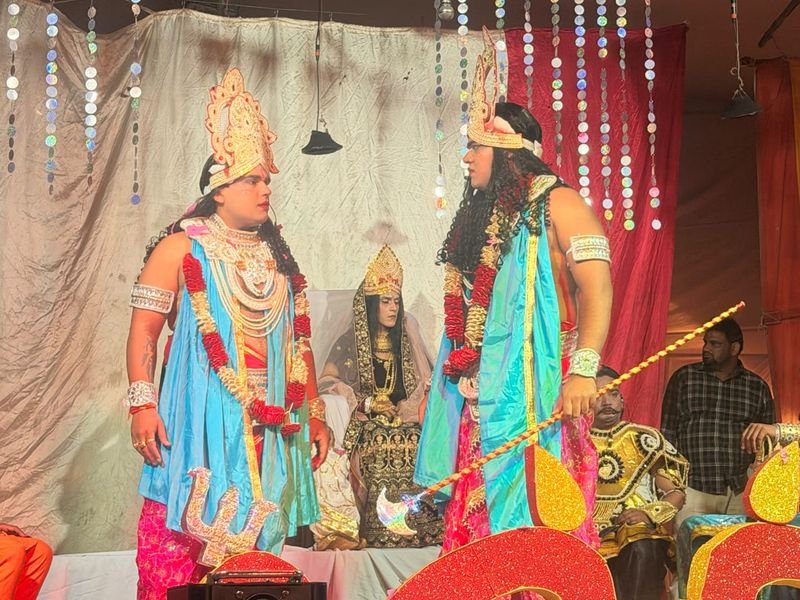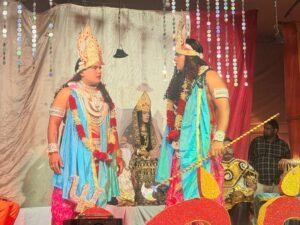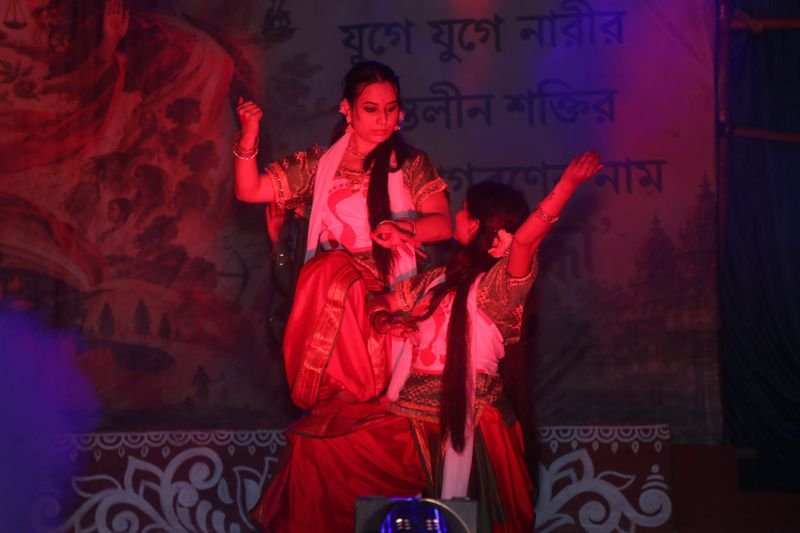

Every autumn, the resonant beats of the dhak fill the air as Chandigarh gears up to welcome Maa Durga for the Puja celebrations. For a few days, the city embraces a distinctly Bengali rhythm, with mornings devoted to pushpanjali (flower offerings) and sumptuous bhog (ritual meals) offered to the goddess, while evenings come alive with music and cultural programmes.Amidst the Pujo festivities, Kalibari Chandigarh Production brought a compelling question to the celebrations on Friday evening —what happens when a woman refuses to be defined by the boundaries society sets for her?The dance drama, titled Swayangsiddha, was conceptualised and directed by Amrita Ganguly and choreographed by Archita Palit, explored women’s enduring quest for identity, dignity and freedom. Drawing from mythology, history and literature, the production portrayed femininity not as a prescribed ideal, but as a force shaped by courage, resistance and self-discovery.Its narrative revisited familiar figures from mythology, history and literature through a distinctly feminist lens. Draupadi’s humiliation in the Mahabharata exposed the moral failure of those who remained silent in the face of injustice. Kunti’s separation from her firstborn, Karna, revealed the anguish and social stigma surrounding unmarried motherhood, while Sita’s ordeal questioned a society that demanded proof of a woman’s purity rather than extending her trust. Mirabai, meanwhile, embodied the defiance of a woman who chose devotion to Krishna over expectations of a royal family.The struggle for autonomy extended beyond mythology into the lived experiences of women across generations in 19th century Bengal. Rashsundari Devi’s extraordinary determination to educate herself in an era that denied women access to learning found expression in her autobiography, Amar Jiban. Her story celebrated the quiet rebellion of a woman who claimed knowledge despite restrictions.A more unsettling dimension emerged through Mahasweta Devi’s Draupadi, featuring Dopdi Mejhen, a tribal resistance fighter whose defiance against state oppression transforms vulnerability into an assertion of dignity. The portrayal brought marginalisation, violence and resistance into spotlight, confronting audience with the brutal realities faced by women at margins of the society.The production also drew upon Ashapurna Devi’s celebrated feminist trilogy, tracing successive generations’ awakening to education, identity and independence. In Rabindranath Tagore’s Chokher Bali, Binodini challenged the constraints imposed on widows, revealing the complex interplay of desire, loneliness and social expectations. Tagore’s Chitrangada celebrated individuality beyond conventional femininity, while Bankim Chandra Chattopadhyay’s Prafulla depicted a woman’s transformation from vulnerability to resilience and self-reliance.Together, these literary and mythological works formed a powerful meditation on womanhood, connecting struggles separated by centuries yet united by a common desire for freedom.Amrita Ganguly, who directed the play, tells The Tribune, “Swayangsiddha explored how women across mythology, history and literature questioned injustice, endured resistance and fought for their identity with courage. The asura, it suggested, is not merely a mythical demon but a mindset that turns differences into inequalities and perpetuates oppression. The true awakening of Shakti lies in recognising and challenging this mindset—a power that resides within the consciousness of every woman who dares to question, resist and reclaim her freedom.”As Chandigarh celebrated the arrival of Maa Durga, the production offered a fitting reminder that Shakti resides not only in the divine feminine, but also in every woman who dares to define herself on her own terms.For audience like Sharmistha, the drama conveyed powerful social and cultural messages that transcend mere devotion. She says, “It offered more than a cultural performance through its portrayal of women’s resistance”, while Anirban, a local artist felt the production challenged society to confront ingrained inequalities and recognise the strength, dignity and individuality of every woman.