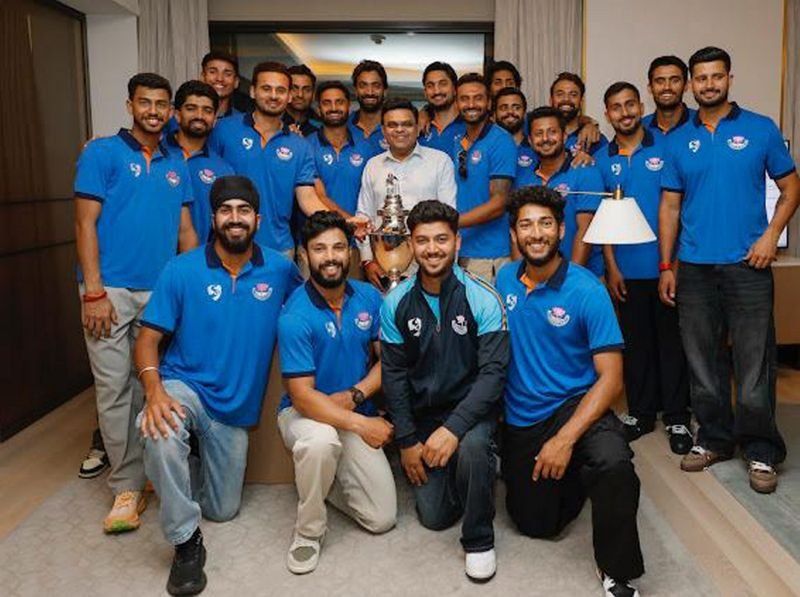

In the footprints of history, nothing is etched in stone. With the passage of time and changing perspectives, the past acquires meanings that can colour the present, just as the present can reshape our understanding of the past.Kashmir, with its many-layered complex history, is a place where cricket has often come to symbolise something beyond sport. The news that its state team will play ‘Rest of India’ for the Irani Cup — a regular annual fixture featuring the current Ranji Trophy champions — in the first week of October in Srinagar, therefore, raises intriguing possibilities.Before one jumps into a contest that pits Jammu and Kashmir cricketers against the might of India — or to be politically more precise, the Rest of India — there is a bit of disturbing history worth revisiting. It is history that may cast a long shadow over a cricket match that on the surface is merely about bat and ball.The year 1983 is embellished with the golden hue of India’s crowning glory: winning the World Cup of one-day cricket. It was an unlikely triumph that turned the established order of world cricket upside down. ‘Kapil’s Devils’, the epithet that a British newspaper bestowed on that all-conquering Indian team, became the phrase by which they are remembered. On that famous, sun-drenched afternoon at Lord’s on June 25, India had done the impossible — defeating the seemingly invincible West Indies to become world champions.Barely 110 days later, on October 13, 1983, the newly crowned world champions found themselves facing the same rivals, this time amid one of the most picturesque settings imaginable, the Sher-i-Kashmir stadium in Srinagar.The majestic backdrop of the mountains, with the massive Chinar trees shedding their golden-amber, paw-shaped leaves, provided an evocative setting for the first encounter between the two teams since the World Cup final.Post-Partition Kashmir had generated enormous heat, dust and turmoil, becoming a land of divided loyalties and competing narratives, with its place within India repeatedly contested, despite its accession in 1947 under certain constitutional provisions.To the utter dismay of those whose loyalty to India was unquestioned, the cricketing skirmish on the field was pushed into the background by spectators openly hostile to the Indian team. To the surprise, and perhaps delight, of the West Indies players, they found themselves being cheered as though they were playing on home ground.Many objective accounts and my own conversations with the cricket writers who chronicled the match helped build a picture of a place where anti-India sentiment was visible enough to stun those unfamiliar with Kashmir’s thorny past.These very journalists had just a day earlier partaken of the sumptuous wazwan, the traditional elaborate cuisine, laid out by the state’s Chief Minister for the teams and the Press. It was hard for them to digest being witness to a large crowd openly resentful of the Indian team, the next day.At the lunch break, a few mischievous elements stormed the ground and dug up the pitch, while the weather too played its part. The match had to be curtailed, with West Indies chasing the revised target without losing a wicket.The unsettling and unexpected outcome of that match was not the defeat, but the disturbing manner in which a festering wound had surfaced as a spectacle for the world to watch.More than four decades have passed since that day in Srinagar. It may be a long span in an individual’s life or a nation’s journey, but is barely a dot in the collective existence of Planet Earth. As of today, cricket has placed the erstwhile state in a pre-eminent position in India’s sporting structure. Jammu and Kashmir are no longer adjuncts to the country’s well-oiled cricket machine.They are now Ranji Trophy champions, while a new generation of homegrown players are staking their claim to the national team, with Auqib Nabi being part of the Indian team that toured Sri Lanka. Before him came Parvez Rasool, the pioneer who broke the barrier by representing India in an ODI.Politically, the landscape has changed dramatically. The violent uprising that began in 1989, the fratricidal killings and the cries of “azadi” belong to the past. The contentious Article 370 has been abrogated and the state has been reduced to the status of a UT. On the surface, a measure of calm prevails in the Valley that is intermittently broken by terror killings. Whether it signals the arrival of a lasting peace or is merely an ominous silence before the storm is a question only time can answer.Come October, the crowds will stream into the Sher-i-Kashmir stadium. Will they see the match merely as a sporting contest? In the context of the match, their opposition to Rest of India can in no way be seen as an act of treason as it was on that day in 1983, when the Indian team was booed and the West Indians cheered.Times have changed, but have the people changed enough to appreciate a cricket match for the sporting skills on display and not for what it could symbolise? In the long arc of history, the past can be reinterpreted from the gaze of the present. It is the future that remains as uncertain to predict as the toss of a coin that precedes a cricket match.— The writer is the author of ‘Not Quite Cricket’ and ‘Not Just Cricket’