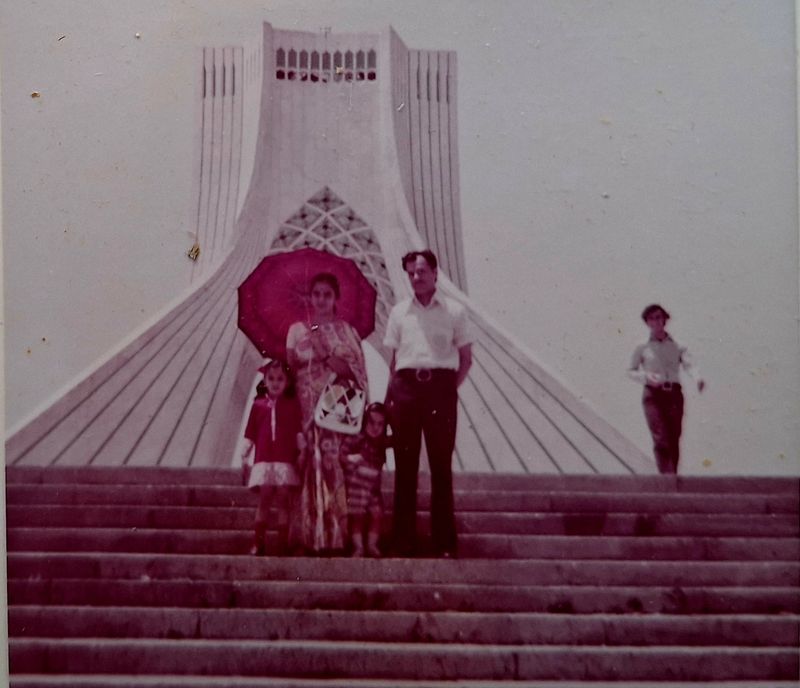

I was toddler when my family moved to Iran and much of what I recall takes one of two forms — visual snapshots or sounds and rhythms. Music is said to be the echo that stays even when the words have faded and one pre-revolutionary memory that stands out in my mind is a Farsi children’s poem, ‘Ma Golhoye Khandanim’ (We are the smiling flowers). It is a poem celebrating children as the future of Iran, their joy, innocence and national pride, a poem rendered particularly poignant by what confronts the people and children of Iran today. Here is an English translation:We are the smiling flowers, the children of IranWe cherish our pure Iran like our own soulsWe must be wise; we must be vigilant and observantFor the sake of protecting Iran, we must be capable.Be prosperous, O Iran; be free, O IranFrom us, your children, be joyful, O Iran.The truth is that Iran was an accident, but quite possibly the most wonderful accident that could ever have befallen our family. It was the 1970s and my father was working as an English language specialist at the Central Institute of English and Foreign Languages (CIEFL), Hyderabad, when a recruitment team from Tehran University arrived, seeking instructors. My father was quite settled and what with a baby — my baby brother — on the way, he had no plans for change. But then, the hand of fate intervened in the form of a well-meaning older colleague who persuaded my father to attend an interview. If nothing else, the colleague argued, it would be good practice and help to hone my father’s interviewing skills.I often wonder what our lives would have been like if my father had refused. But as it was, he not only attended the interview, but was also offered a job on the spot! My mother saw it as a wonderful opportunity to expand our horizons, to explore the unexplored, and so it was that after my brother was born, we moved to Tehran, Iran.Iran is an experience that touches the heart and soul in ways that are hard to describe. Rabindranath Tagore expressed it thus: “The spirit of Persia has always been a spirit of beauty and harmony. It is a land where the soul of the poet finds its home.” The country welcomed us with open arms and the extent of warmth and hospitality that we experienced there I have never encountered anywhere since. People we had just met invited us into their homes for meal after meal. The feeling of community and generosity of spirit was there for all to see, and I cannot recall ever feeling like an outsider. There was never any sense of being ‘the other’. The sizeable expatriate community, particularly Indians, played a part in this, of course. But it was more than that. There was a sense of connectedness, of shared humanity that seemed to be inextricably intertwined with Iranian culture.Winter in Tehran.Initially enrolled in a British-run international preschool, my brother and I then moved to the Indian School in Tehran, where we learned Hindi, Punjabi and Farsi, switching between them with ease. Of these my favourite was Farsi, a charmingly lyrical language that is pleasing to the ear. One of the most surprising things for me as a child — other than realising that it snowed in Iran, of course — was finding out just how much Indian and Iranian culture had in common, from language to food. The mouth-watering naan, pulao and faloodeh savoured in Iran I would later find in India. In language, I delighted in the discovery of shared words between Hindi and Farsi — words like zindagi, jaan and azad. And Iranians were always thrilled to learn that we were Indian. “Same culture, same civilisation!” they would enthuse. Keenly aware of their history, they knew of the deep historical and cultural ties that bind us, something I would learn about from my father, who was something of a history buff: how we came from the same family in the Steppes of Central Asia before migration separated us into Indo-Aryans and Iranians; how later, the highly Persianised Mughal rulers of India adopted Persian as their court language, influencing languages like Urdu and Hindi; how Sanskrit and Avestan from ancient Iran were sister languages, branches of the same tree. I would also learn that the paternal grandfather of Iran’s first Supreme Leader, Ayatollah Ruhollah Musavi Khomeini was born in Uttar Pradesh and fled India to escape British colonialism, eventually settling in Khomein, Iran in the 1830s. In the words of Jawaharlal Nehru, “Few people have been more closely related in origin and throughout history than the people of India and the people of Iran.”In fact, Iran’s connections were not restricted to India. Ancient Iran (Persia) was the dominant nation of West Asia for over twelve centuries, with Persian models of administration, trade and inclusiveness influencing Western nations as well. Pre-dating the Magna Carta by over 1,700 years, the Cyrus Cylinder is a Persian clay artefact from 539 BC that records Cyrus the Great’s decrees on religious tolerance and the restoration of displaced peoples to their homelands, including the return of the Jews to Jerusalem. Cyropaedia, a classic Greek study of Cyrus’s leadership, influenced Thomas Jefferson, one of the founding fathers of America, helping shape his ideals of tolerant and enlightened government. And the Iranians we met were both aware and proud of their rich cultural heritage and its contribution to other civilisations. More recently, I was reminded of this by the response of Iranian diplomat, Mojtaba Ferdosipour, to the American threat to destroy Iran’s 3,000-year-old civilisation. In an interview with the Associated Press, he was quoted as saying “…no fool would cut off the branch of a tree he is sitting on because he himself would fall first, and it is the sturdy tree that always stands, not the branches and appendages that have grown from it…” Regardless of one’s political inclination, the sense of pride is unmistakeable.Iranians’ pride in their past was balanced by an attitude of humility and curiosity towards learning. It was almost as if knowing where they had come from gave them the strength to explore and grow, like the spreading branches of a tree anchored by strong roots. Nowhere was this clearer than in my father’s students who seemed extremely eager to learn. Many of them sought extra classes and tuition in English, as did professionals like doctors and engineers who, despite being well-established in their fields, were keen on self-improvement. And when they came to our home for lessons, they were never empty-handed. Instead, they came bearing gifts for their Ustaad, because teachers and scholarship have always been highly regarded in Persian culture.My family lived in Iran for a decade and in the early years, thanks to the Shah’s alliance with the West, American influences were everywhere, shaping everything from fashion to television programs and music. Young Iranians, like their Western counterparts, often dressed in bell-bottoms and mini-skirts. Our neighbours were fans of Boney M and loved playing their music and dancing to their songs. I remember watching ‘Charlie’s Angels’ and ‘The Six Million Dollar Man’ — or ‘Marde Sheesh Million Dollar’ as it was known in Farsi — and as a young girl, was particularly delighted when ‘The Bionic Woman’ made her television debut!Nader Shah’s tomb in Mashhad.Everything changed after the Islamic revolution, and although as I child it felt like it had happened overnight, I would later learn that it had been years in the making. Still beautiful, Iranian women now covered themselves with chadors or hijabs and although as non-Iranians we did not need to, Iranian friends gifted me a pretty floral chador. On the way to school and back we now saw protestors holding up signs and chanting, ‘Mar bar Shah’ (Death to the Shah) and ‘Mar bar Amrika’ (Death to America). Much later, father would tell us the story of Prime Minister Mohammad Mossadegh and his plans to nationalise the oil industry — plans that triggered US and UK intervention and a chain of events leading, eventually, to the Islamic revolution. Oil, he said, had been both a blessing and a curse for Iran. I can still recall the lines of the revolutionary chants that eventually became the song “Iran, Iran”, which spoke of the rain of machine guns, of how from orphans’ tears and martyrs’ blood, tulips would eventually bloom. Sadly, the song seems as relevant to what Iranians are enduring today as it was in the days of the revolution.When I listen to the news now and see that centres of learning have been attacked, my heart breaks as I think of Tehran University and my father’s eager students, so hungry for knowledge, so hopeful about the future. When I watch cultural centres being bombed, I feel both anger and sorrow as I recall the beauty of Tehran’s Golestan Palace and the majesty of the Azadi Tower, its white marble edifice rising to meet the heavens. I feel too the disturbing dissonance of that split screen moment when we saw mankind reaching upwards for the moon on the one hand and reducing cities and towns to rubble on the other — the heights of our creation and the depths of our destruction captured in a single frame.Some have spoken of the elasticity of Iranian culture, its capacity to absorb other influences while not losing its own identity. The ability to bend without breaking. I can only hope that this resilience will help this glorious civilisation survive the challenges it is facing today. I can only hope that we heed the timeless wisdom of Persian Sufi poet and philosopher Saadi Shirazi, who eloquently emphasises our shared humanity and connectedness in his poem ‘Bani Adam’ (Children of Adam). The poem is inscribed on a magnificent Persian carpet adorning the wall of a meeting room in the United Nations’ New York office, and on a plaque beside it is this translation by Anglo-Indian politician, diplomat and orientalist, Edward Eastwick:All human beings are members of one frame,Since all, at first, from the same essence came.When time afflicts a limb with painThe other limbs at rest cannot remain.If thou feel not for other’s miseryA human being is no name for thee.One of the most memorable days of my time in Iran was when we bought our first Persian carpet. We had already visited a carpet weaving centre in Isfahan, watching transfixed as the craftsmen worked, patiently weaving and threading to create something captivating. And now we had our very own piece of magic! My brother and I would spend hours pretending it was a magic carpet that could fly us to anywhere we desired. And when we left Iran during the Iran-Iraq war that followed the Islamic revolution, it felt like I was leaving behind a piece of my heart.Leaving Iran was painful for all four of us, but more so for my brother and I who had always thought of it as home. For years after we left, my mother urged me to write about our time in Iran. People, she said, ought to know about what it was really like. And each time I would say “I will one day…” but sadly, she died before that day came. In 2024, my graphic memoir about growing up in Iran, Persian Nights: An Indian Child in Iran was finally published. It was, in many ways, a tribute to both my mother and a country which, like its exquisite carpets, are forever woven into the tapestry of my life.— The writer is a Singapore-based writer, educator and psychotherapist. Her graphic memoir ‘Persian Nights: An Indian Child in Iran’ was longlisted for the Valley of Words Awards 2025 and is on the Parag Honours List 2025