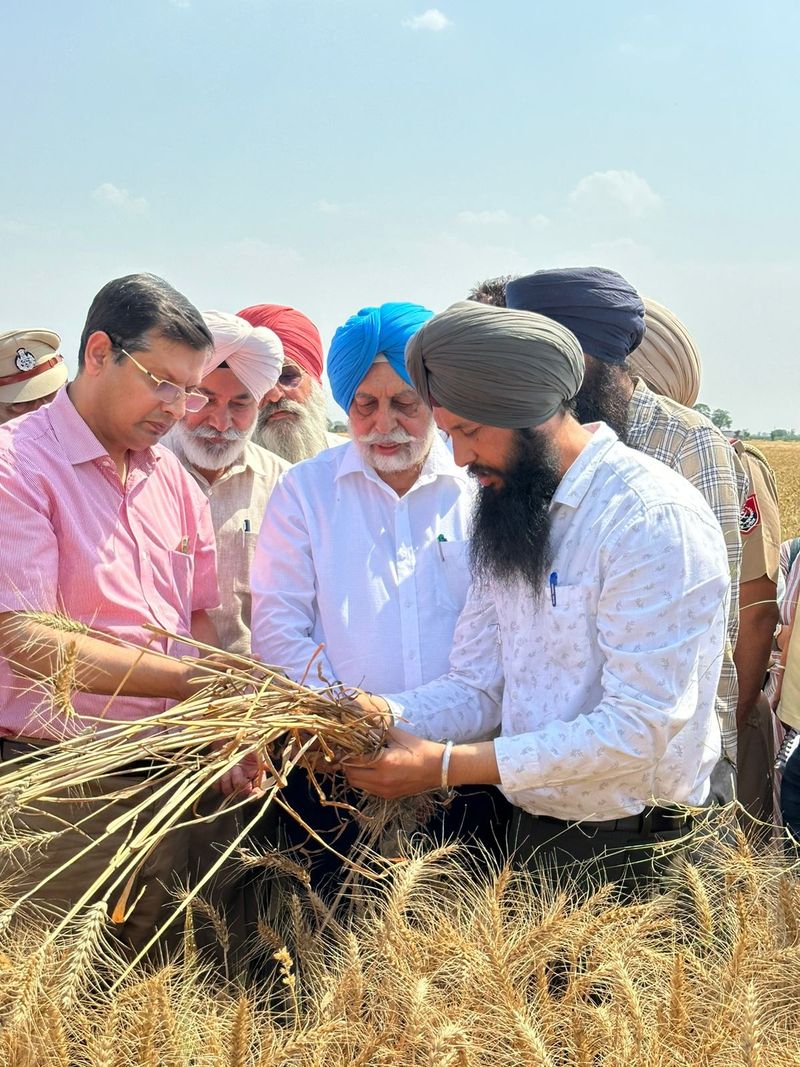

Meet Harinder Singh of Mutton village, who not only observes World Environment Day with his volunteers at RIMT University, Mandi Gobindgarh, every year, but also practises it back home. He in fact carries the message in his daily work throughout the year.Harinder, a professor, has become an environmental crusader in the fields. His protection of the soil is more than complete as he practises both direct sowing rice (DSR) and crop residue management (CRM) in his fields and has achieved success.His journey began during lockdown in 2020 when he was doing online teaching from home. He had enough time to experiment in the fields. He convinced himself to try what most farmers fear i.e. crop residue management. And yes, Harinder, instead of burning stubble that year, incorporated the paddy straw into the soil for sowing wheat on 2 acres. His experiment in the very first year was more than successful. “The incorporation of straw improved the soil health and increased the crop yield. It reaped rich dividends,” Harinder proudly claims.Then in 2024, he used the surface seeder, provided by the Punjab Agricultural University, ensuring that the residue acted as a protective mulch rather than waste. “The benefits appeared quickly,” says the professor.“The stubble in decamped state, not only enriched the soil, but also improved its water-holding capacity. I cut down sharply on pesticides as the mulched layer suppressed weeds naturally. Late sowing became a thing of the past as I had to plough without clearing. I also got the results much earlier and was prepared for the next sowing much in advance,” said the satisfied professor-cum-farmer, adding that the most satisfying thing was that his hands had been freed from the crime he used to commit by setting the fields on fire at one time. ‘My 2-acre trial showed that residue was not a thing to be burnt, rather a resource to be returned to the soil,” told Harinder.Following this, the professor turned towards a still bigger and more challenging research. He shifted from puddled transplanted rice to direct seeding. “With no transplanting, water use dropped by nearly one-third. While the water evaporates in a puddled field, in this case it percolates into the soil itself and can be recycled. Labour costs fell and the residue mulch taken forward from the previous wheat crop continued to suppress weeds and reduce my dependence on pesticides and insecticides,” expressed Harinder with a sense of satisfaction and achievement on his face.From here began his onward march, in which he earnestly asked his fellow farmers to get engaged in a similar manner. He began showing his results to them. He taught them about the benefits of mulching, the saving of time, the increase in yield and most importantly the choking of fields, especially in winters. “Farmers did try and succeed in adopting crop residue management for wheat sowing, but few are willing to risk a season on DSR. I have even gone to the extent of telling the hesitant farmers that if they try DSR on his advice and suffer a loss, he will pay from his pocket,” he shared.He believes that just sharing of knowledge by organising collective camps or distributing literature is not enough. If Punjab truly wants DSR to succeed then the officials of Agriculture Department must walk from field to field, demonstrate the method in spirit and build the same trust of owing financial loss.PAU’s senior agronomist Jasbir Singh, who especially visited his fields was all praise for this progressive farmer, who, he expressed, had gone a step ahead not only to harvest a chemical fertiliser-free crop with an increased yield, but also thought wisely and prudently about the constantly reducing water table, which should be each person’s concern.“If such far-sighted farmers begin to sow and harvest as per the pro-environmental norms, the day is not far when a farmer shall not only be called the son of the soil, but the preserver of planet earth as well,” the PAU professor added.wuw