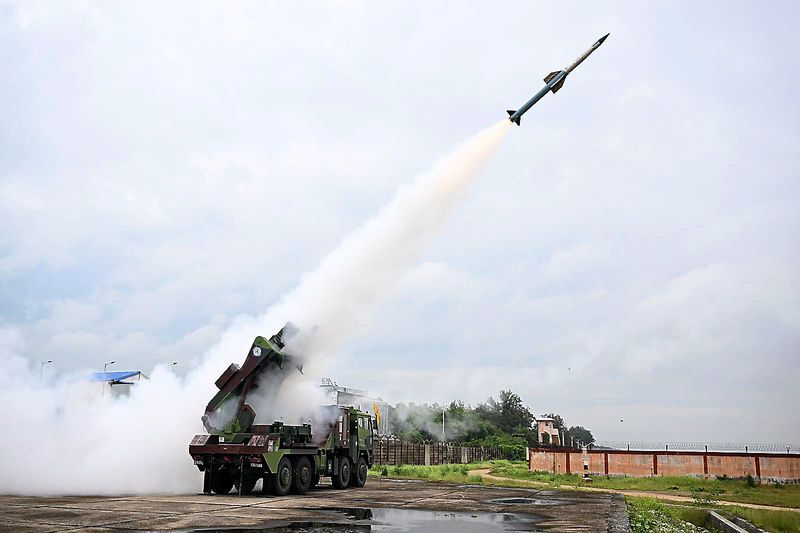

A year after the Indian Air Force’s Integrated Air Command and Control System (IACCS) came into the limelight for providing an impregnable air defence shield during Operation Sindoor, it is witnessing accelerated revamp and upgradation.IACSS equipment at seven locations across the country is being relocated and refurbished with new components and equipment “to mitigate single point of failure” at networked tactical nodes (NTN), according to a request for proposal issued to defence public sector undertakings by the IAF last week.NTNs are critical operational elements in the IAF’s air defence network.These form part of the control and reporting structure, integrating airborne sensors, ground-based radars and weapon systems, enabling seamless data fusion to create a networked, real-time air situation picture for faster decision-making and coordinated responses. The tactical air defence network of the Army, called Akashteer and that of the Navy, called Trigun, are also integrated with the IACCS.During Operation Sindoor, the brief but intense military confrontation between India and Pakistan in May 2025, the IACSS had effectively detected and neutralised hundreds of drones and missiles of various types launched by Pakistan against civilian and military sites in India.The operation was launched by India as retribution for the attack carried out by Pakistan-supported terrorists in Pahalgam on April 22, 2025, in which 26 tourists were killed. Precision strikes were launched by the Indian Armed Forces on several terrorist camps inside Pakistan, some located in the hinterland. When Pakistan tried to retaliate by launching drones and missiles, the IAF struck key Pakistani military sites, destroying radar bases and airfields.Developed by state-owned Bharat Electronics Limited, the highly automated IACCS rides on the Air Force Network (AFNet)), the IAF’s secure digital communication network and its first nodes were commissioned in 2011. These were focused on the western sector. The network’s second phase saw it being expanded to cover other parts of the country and island territories.The third phase, which is currently under way and accelerated post-Operation Sindoor, is focusing on multi-domain operations involving air space and cyber, integration of artificial intelligence for threat evaluation and prioritisation, enhanced sensor fusion, long-range threat handling, improved sensor-to-shooter connectivity for beyond visual range engagements, upgrading drone and counter-drone capability and greater tri-service inter-connectivity and coordination.With a multi-tiered air defence network becoming a critical component in contemporary warfare that is witnessing the proliferation of drone swarms, stealth aircraft and stand-off missiles, the IAF is also procuring different types of long-range and medium-range radars, surface-to-air missiles, airborne surveillance platforms and anti-drone systems to beef up the country’s air defence cover.