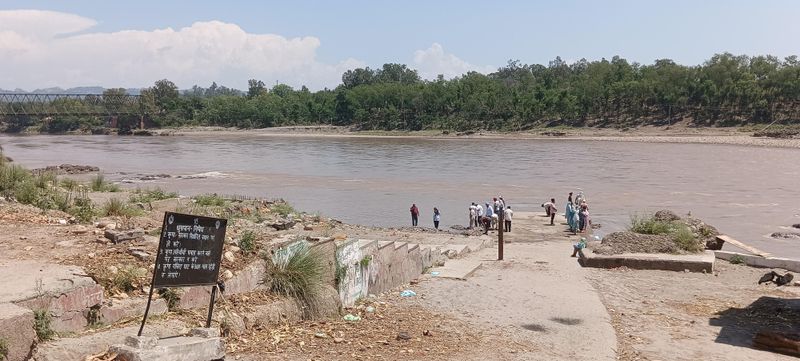

In the quiet town of Akhnoor, about 28 km from Jammu city, locals gather along the banks of the Chenab River—a fast-flowing river that eventually enters Pakistan. The developed riverfront, with seating and shaded areas, has become a popular spot for students and residents seeking fresh air and scenic views.Despite the suspension of the Indus Waters Treaty (IWT) last year following a terror attack in Pahalgam in which 26 people were killed on April 22, there appears to be no visible disruption in the river’s flow.Soon after the attack, sluice gates of the Baglihar Dam in Ramban district were briefly closed, leading to a significant drop in water levels. Visuals that went viral at the time showed people walking across parts of the riverbed that had run dry.“The river is flowing as usual, with no disruption. The water level had dropped last year after the government move, but now it is back to normal. Locals often sit by the river for the breeze and the view,” said Amit Sharma, a college student.During a ground visit, most residents noted that water levels typically decline during the summer and rise sharply with the onset of the monsoon. In Jammu and Kashmir, the Chenab flows through Kishtwar, Doda, Ramban, Reasi and Jammu districts before crossing into Pakistan.Several run-of-the-river hydropower projects have been built along the river, with more under construction, expected to generate thousands of megawatts of electricity.Recent media reports had suggested that all gates of the Baglihar Dam were closed, disrupting the river’s flow. However, sources associated with the project clarified that the sluice gates were shut primarily due to reduced summer water levels in order to store water. The reservoir has a capacity of nearly 475 million cubic metres.The dam has an installed capacity of 900 megawatts across two phases and is equipped with six turbines, each capable of generating 150 megawatts. All turbines operate for about six months annually, depending on water availability.According to sources, stored water is currently being channelled through diversion tunnels to run the turbines, generating between 450 and 600 megawatts of electricity. After power generation, the water is released back into the Chenab.They added that the dam gates are opened only when water levels rise significantly.Harbans Singh, a local visiting a gurdwara near the river, recalled instances when cattle were swept away due to sudden surges in water levels in the turbulent stream.