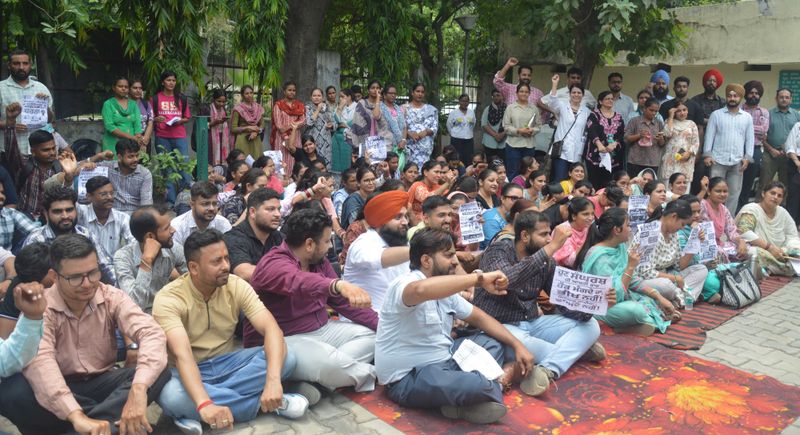

A series of strikes by sanitation workers, ministerial staff in the Deputy Commissioners’ offices, and contractual staff at Aam Aadmi Clinics has become a cause for concern for the AAP government. Their restiveness is not just threatening the delivery of essential public services but is also putting a question mark over the party’s governance ahead of the 2027 Assembly poll.The only silver lining for the government, vis-a-vis the agitating employees, was the calling off of the six-day strike by employees of Punjab State Power Corporation Limited (PSPCL) today after an assurance from Finance Minister Harpal Singh Cheema that a committee constituted to look into their demands would send its report soon. As a result, the power supply, distribution and maintenance services to lakhs of consumers resumed.The MGNREGA employees have been on a strike for more than a month, demanding a regular pay scale and clearing of their dues. Members of the Berozgar Sanyukt Morcha have been sitting on a dharna in Sangrur from December 2025 onwards, demanding relaxation in the upper age limit for recruitment in the education and health departments. Sukhwinder Singh, convenor of the morcha, said their agitation would continue until their demands were met.Though each agitation is centred around different demands—ranging from regularisation of services and better wages—the simultaneous protests have exposed a growing sense of dissatisfaction among sections of the government’s workforce.Sukhchain Khera of the Sanjha Mulazzam Manch said employees in all government departments were protesting because the present government made promises and then chose not to fulfil them. “On August 7, 50,000 employees will protest in Chandigarh to demand the old pension scheme, withdrawal of orders that fixed the pay scale at par with the Centre’s employees, and a reduced probation period of employees from three to two years,” Khera said.Political observers said the state had nearly 4 lakh government employees, besides 3 lakh pensioners, including contractual workers and outsourced staff. “Their issues and demands not only affect their voting decisions but also have an impact on their family members. Thus, they constitute an influential vote bank,” they said.Traditionally, employee unions have enjoyed considerable organisational strength and have often influenced public opinion.The impact of these protests is already being felt on the ground. Heaps of garbage, closure of OPDs at Aam Aadmi Clinics, and a strike by ministerial staff have impacted citizen-centric services. Further, contractual employees of the Transport Department have announced protest rallies on August 3 to press for their demands.Though the government has deputed several ministers to hold immediate parleys with the unions to end the protests, a prolonged strike threatens to turn public anger against the state government.In Punjab, employee unions have historically intensified their movements in the run-up to elections, calculating that governments become more responsive when political stakes are high. The objective is to maximise bargaining power before the model code of conduct comes into force and fiscal decisions become politically sensitive. The pattern has repeated itself across successive governments, be it the Congress or the SAD-BJP governments.Cabinet sub-committee on the jobFinance Minister Harpal Singh Cheema, who heads the Cabinet sub-committee to look into issues of all employees, said he and his other colleagues were holding parleys with different unions on a regular basisLate Monday evening, Local Government Minister Harjot Singh Bains offered to increase the salary of the protesting sanitation workers from Rs 14,000 to Rs 20,000