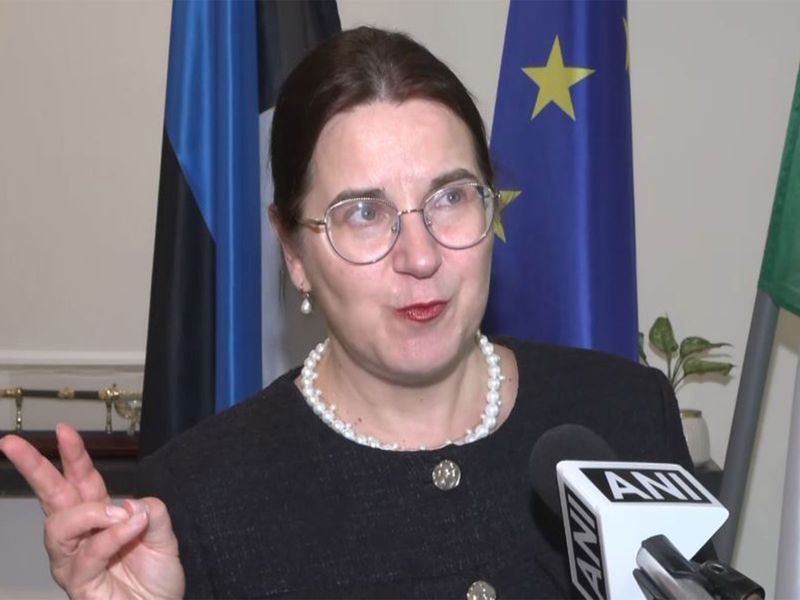

New Delhi [India], October 9 (ANI): Amid growing global calls for stronger safeguards and a coordinated approach to the rapid development of artificial intelligence, Estonia’s Minister of Justice and Digital Affairs, Liisa Pakosta, on Friday stressed the need for international regulations, clear safeguards and accountability mechanisms for AI, while emphasising that public trust is fundamental to digital societies.She also called for AI systems to protect smaller languages and cultures from misrepresentation and propaganda.In an interview with ANI, Pakosta said India and Estonia could strengthen cooperation in responsible AI, cybersecurity and digital public services as technology rapidly transforms governance and economies.“In Estonia we say that you need some kind of regulation to build trust. So digital society is always about trust. People trust their digital data to the government, and in Estonia it’s people that control the government, not vice versa. So it means actually that you have to build this trust, and for trust you need some kind of regulation,” she said.Pakosta said clear and predictable rules could help companies innovate while making it easier to expand products and services internationally.She called for international regulations, open-source systems and safeguards that allow users to understand how AI systems reach decisions.“Secondly, there is a clear guardrails structure, and you can also follow the calculations. You can follow how the decisions were made within the LLM,” she said.The Estonian Minister also stressed the need to ensure that AI systems accurately represent smaller languages and cultures and prevent propaganda from distorting national histories and narratives.“These are one part of examples, but also all the small languages and cultures, that there would be an obligation that these are correctly presented, and that there wouldn’t be any, like, Russian propaganda taking over our history, our narrative and our stories,” she said.The remarks come amid growing debate over the rapid development of increasingly capable AI systems and calls within the technology industry for stronger safeguards and greater international coordination.On cybersecurity, Pakosta recalled Estonia’s experience of cyberattacks in 2007, which she said prompted the country to strengthen its digital security standards.“Estonia is written into the world history of cybersecurity because in 2007 we were the first country ever to be attacked, cyberattacked by another country. Of course it was Russia then. But even before that, but especially after that, we have built the strongest standards of cybersecurity,” she said.She said India and Estonia were already collaborating in cybersecurity and saw further scope for cooperation, particularly as AI agents create new forms of cyber threats.“This is, by the way, one of the areas where we are collaborating with your country, with your talent, and we see very much also cooperation in the future,” she said.Pakosta also identified AI as an opportunity to improve public service delivery rather than simply reduce government employment.“We are using, for example, in the public sector, AI in a very organised way, and we see that yes, it means that some people have to change their jobs. They have to do something else. But we are not speaking about that we will make the public sector smaller. We are speaking about that we will offer more services, more and better and even quicker services to our people,” she said.She added that Estonia aimed to provide more services by using technology to improve efficiency.“So in Estonia it’s actually a standard that you get a public service in less than a minute. So now we would like to offer more services because we have some people who are able to offer more services,” she said.Pakosta said Estonia was also keen to learn from India’s research and development capabilities and innovative cybersecurity products.“The research and development you are doing here is excellent. We are interested in using this,” she said.She pointed to Estonia’s X-Road system, which enables secure data exchange and interoperability between digital services, as another area where the two countries could exchange expertise. (ANI)(This content is sourced from a syndicated feed and is published as received. The Tribune assumes no responsibility or liability for its accuracy, completeness, or content.)