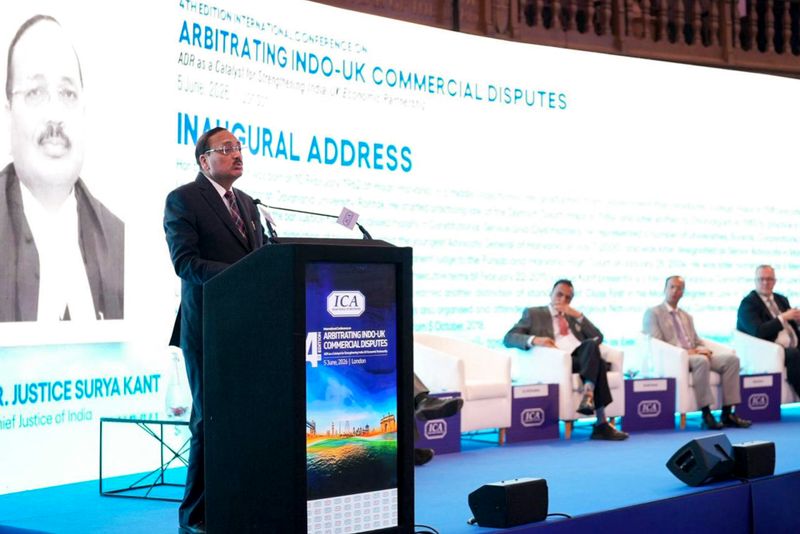

An individual tried to disrupt an event addressed by CJI Surya Kant in London by suddenly raising an issue unrelated to Artificial Intelligence (AI) – the topic of discussion.Some videos of the event circulating on the social media showed an attendee expressing concern about what she described as “growing hostility to dissent within India” to attempting to address a question to the CJI.However, an organiser immediately intervened. “With all due respect, I’m so sorry, I would not be able to take up that question since the topic is concerning artificial intelligence and international law. I am extremely sorry! We have to cut it off,” the organiser was heard saying in the video.CJI Kant was delivering a lecture on ‘Artificial Intelligence and International Law’ at Birkbeck, University of London, on Thursday when the disruption happened during an audience interaction.The High Commission of India in London on Friday condemned the disruption caused at the event addressed by CJI Kant – who is on a six-day visit to the UK.“A lively discussion followed his address. Thereafter a certain individual tried to disrupt the event,” the Indian High Commission said in a statement released on social media.“Such indecorous audience behaviour is unacceptable and inconsistent with respectful engagement that should govern public discourse. Differences of opinion are a natural part of a democratic society. However, they must be expressed in a manner that is civil and respectful,” the High Commission stated.Earlier, describing artificial intelligence as an operational reality reshaping governance, commerce, warfare, communication, public administration, and the exercise of judicial and sovereign power, CJI Kant emphasised that technological power must remain accountable to constitutional values, democratic legitimacy, and human dignity.He underlined that choices made during this decade will shape the future relationship between technology, power, freedom, and justice as it posed one of the most significant tests for international law in its modern evolution.“Technology itself is neither inherently benevolent nor inherently harmful. Its impact depends upon the legal, political, and ethical frameworks within which societies choose to deploy it. The responsibility of law, therefore, is neither to resist technological progress nor to surrender unquestioningly before it. Its responsibility is to ensure that technological power remains accountable to constitutional values, democratic legitimacy, and human dignity,” the CJI said.Justice Kant said unlike previous technological revolutions, AI did not merely enhance human capacity; it increasingly participated in decision-making processes that were historically considered uniquely human.“Governments now utilise algorithmic systems to allocate welfare benefits, assess immigration applications, monitor borders, regulate financial systems, and support policing functions. Militaries are rapidly developing autonomous capabilities. Courts across jurisdictions are beginning to confront questions involving AI-generated evidence, automated decision-making, and digital due process.On Friday, he delivered the inaugural address at the Indian Council of Arbitration’s (ICA) international conference on ‘Alternative Dispute Resolution (ADR) as a Catalyst for Strengthening India-UK Economic Partnership’.Terming the India-UK free trade agreement an unquestionably historic moment for both nations, CJI Kant stressed the need for a robust alternate dispute resolution (ADR) architecture that converts commercial confidence into day-to-day practice.Speaking at the fourth edition of the international conference on ‘Arbitrating Indo-UK Commercial Disputes’ organised by Indian Council of Arbitration in London, CJI Kant said it must be ensured that arbitration is not a privilege of scale, but an instrument of justice.He said contemporary international arbitration asks parties for a profound act of trust, and when they step away from their national courts and submit their dispute to a private tribunal, they are entitled to expect a process that is fair, proportionate and timely.