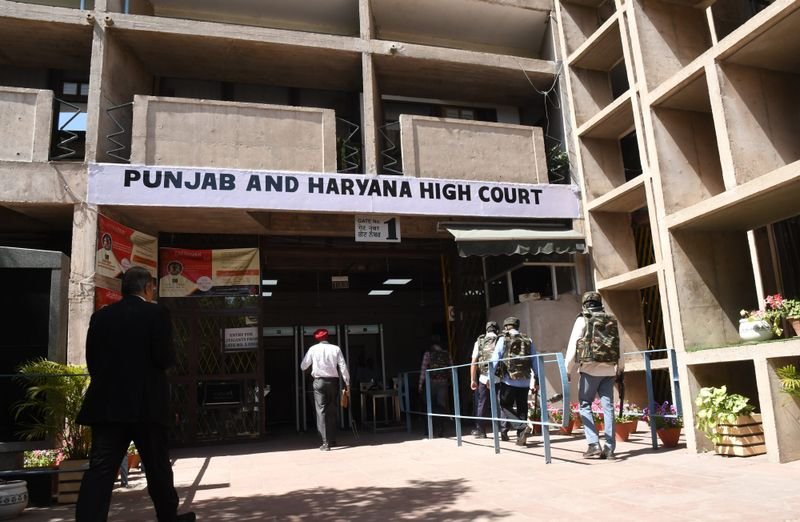

The Punjab and Haryana High Court has ruled that an accused cannot be deprived of the liberty granted through bail merely because he chooses to pursue legal remedies against the complainant in the criminal case.The observation came as the High Court refused to cancel the regular bail granted to Ramesh Sanka, a former DLF executive, holding that approaching courts cannot, by itself, constitute a violation of bail conditions or an attempt to intimidate, threaten or influence the complainant or prosecution witnesses.“Resorting to legal remedies cannot, by any stretch of imagination, be said to be an act which may be termed to be a violation of the conditions of bail or which may amount to inducing, threatening, intimidating or influencing the petitioner and/or the prosecution witnesses,” Justice Vikram Aggarwal observed.The ruling came on a petition filed by DLF Limited seeking cancellation of regular bail granted to Sanka through an order dated December 9, 2025. Dismissing the petition, the High Court ruled that cancellation of bail was an exceptional measure requiring cogent grounds and could not be ordered mechanically.The case originated from an FIR registered on August 8, 2024, at the DLF Phase-I police station in Gurugram under Sections 381, 385, 409 and 506 of the Indian Penal Code and Section 66 of the Information Technology Act, 2000, on a complaint submitted by DLF Limited.According to the allegations levelled by the company, Sanka remained associated with it from June 1, 2004, to July 2, 2014, and was elevated to the position of Managing Director of DLF Cyber City Developers Limited.Among other things, it was further alleged that he “started blackmailing the petitioner-company by threatening to misuse/leak their confidential data with a view to extort a sum of Rs. 311 crores.”After being released on bail, Sanka instituted a number of cases against the company before the Supreme Court and different High Courts, alleging, among other things, evasion of tax and other violations.Examining whether the circumstances justified cancellation, Justice Aggarwal reiterated that the power could not be exercised merely because an accused had continued to pursue legal proceedings after securing bail.The Bench observed that there had to be “cogent and overwhelming circumstances” to form an opinion that bail deserved to be cancelled. Referring to the principles laid down by the Supreme Court, Justice Aggarwal identified the circumstances that could justify cancellation –– interference or attempt to interfere with the due course of administration of justice or evasion; attempt to evade the due course of justice; abuse of the concession granted to the accused in any manner; and the possibility of the accused absconding.The Bench also referred to the Supreme Court’s principle that bail, once granted, should not be cancelled mechanically without considering supervening circumstances that made it no longer conducive to a fair trial to allow the accused to retain his freedom.Applying these principles, Justice Aggarwal observed: “The question which arises for consideration of this Court is as to whether the respondent can be said to have violated the conditions of bail warranting its cancellation. The answer to the said question is definitely in the negative,” the Bench held.Before parting with the order, Justice Aggarwal noted: “Having considered the matter in its entirety and having gone through the contents of the FIR and the order granting bail to the petitioner, the petitions instituted by respondent and the arguments addressed by senior counsel for the parties, this Court does not find it to be a case of cancellation of bail granted to the respondent at this stage. The present petition is found to be devoid of merit and the same is accordingly dismissed”.