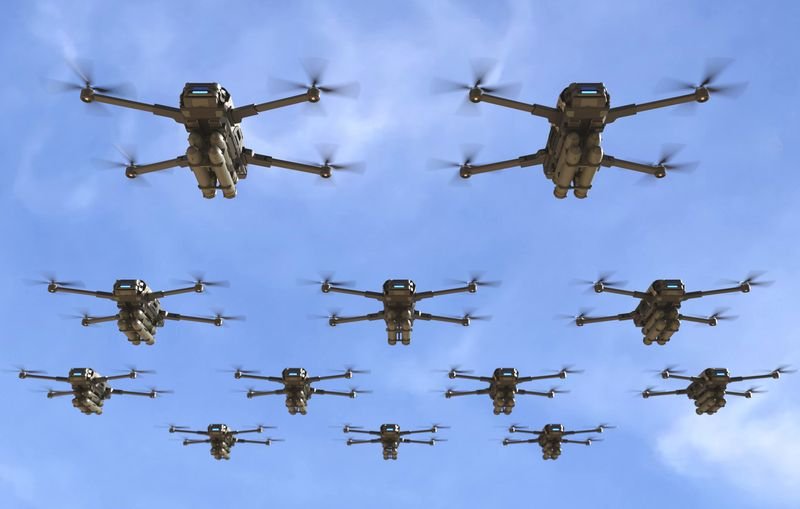

The Army is constructing multi-tier anti-drone steel mesh screens to protect sensitive buildings in field areas from attacks by drones and unmanned aerial systems (UAS), which are being used increasingly across the battlefield.A total of 863 drone intrusions along the India-Pakistan border were reported in 2025-26, including 854 incidents in Punjab and Rajasthan, according to the Ministry of Defence (MoD). During this period, 237 drones were brought down, including five carrying war-like stores, 72 carrying narcotics and 161 without any payload.“These activities signify greater attempts by the adversary to employ drones for various nefarious activities like reconnaissance and smuggling of arms, ammunition and narcotics along the International Border, especially in Punjab,” the MoD’s annual report for 2025-26 states.The screens, measuring about 37 m in length and 20 m in width, will comprise three adequately spaced layers of different types of steel mesh designed for staged interception, energy dissipation and progressive arrest of incoming aerial objects, according to a request for information issued by the Army on September 25. These defences will initially be installed at several locations in the Western Sector.The outer layer will incorporate camouflage and concealment features to minimise visual and thermal signatures from aerial and ground observation. This will be achieved by blending exposed structures with the natural terrain and using non-reflective coatings and multi-spectral camouflage paint.The structures are intended to provide an additional layer of protection against swarm drones and complement existing anti-drone measures such as guns, lasers and jammers. Small and low-flying drones are generally more difficult to detect and neutralise than larger UAS.The Army is already using steel meshes and synthetic nets to provide overhead protection to frontline equipment, bunkers, observation posts, artillery guns and vehicles, including tanks. Some of these anti-drone measures for vehicles were also displayed during this year’s Republic Day Parade in New Delhi.The use of metal meshes to counter drones first gained prominence during the Russia-Ukraine war, when advancing Russian tanks were spotted with such protective structures mounted on them.Drones emerged as a key component of that conflict, which escalated in February 2022. Three years later, the Indian subcontinent witnessed extensive use of drones and counter-drone systems during Operation Sindoor in May 2025, marking a significant shift in the conduct of military operations and underscoring the growing emphasis on non-contact warfare.The operation saw large-scale tri-service deployment of drones and missiles for precision strikes deep inside Pakistan, rather than manpower-intensive formations being massed along the border and troops engaging each other directly. The armed forces also neutralised hundreds of enemy drones and missiles launched across the western frontier through an integrated air-defence shield.With automated systems and AI-enabled platforms becoming integral to modern warfare, the armed forces, through in-house projects and collaboration with the industry, have accelerated the development and induction of indigenous drones and counter-drone systems. They are also putting in place a vast training infrastructure to produce technologically enabled soldiers.A core committee has been constituted to take decisions on the induction, proliferation and deployment of UAS and counter-UAS equipment in the Army and to coordinate all related aspects.As many as 30 types of UAS and loitering munitions, covering 80 variants across five categories — surveillance, strike, air defence, special roles and logistics — have been identified for deployment in different operational scenarios and terrain conditions. In addition, several existing air-defence weapons have been modified to detect and destroy small drones as part of the broader air-defence network.