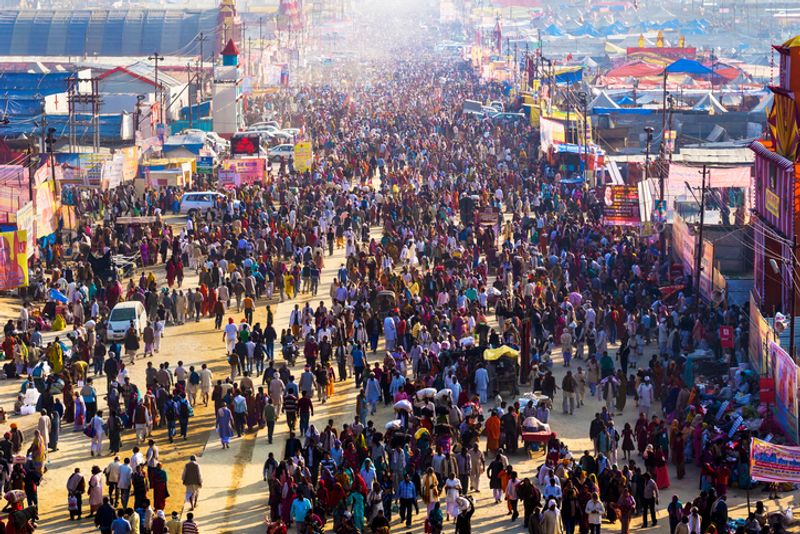

A new study has projected that as countries urbanise, only 38 per cent of the world’s population will be residing in large cities by 2100.Researchers said the world is urbanising fast—about 11 per cent of the world’s population lived in cities with more than one million inhabitants in 1975.“Today, we estimate that share to be about 24 per cent,” author Andrea Musso, junior fellow at the Complexity Science Hub in Austria and a PhD Student at ETH Zurich, Switzerland, said.Projections suggest that over the next 25 years, one billion people will move into cities—roughly the equivalent of adding one New York City every two months, the researchers said, adding that decisions about infrastructure, housing, transport, energy, and climate adaptation all depend on where people will live.“Our projections suggest that 38 per cent of the world population will be living in cities with more than one million people by 2100,” the authors wrote in the study published in the Proceedings of the National Academy of Sciences.“Compared with simply extrapolating current trends, our model projects about 450 million fewer people living in million-plus cities by 2100 — a difference much larger than the current population of the United States,” Musso said.The gap in projections is driven by the study’s discovery about a life cycle that urban systems follow, determining how fast large cities grow relative to smaller cities in a country.In countries only beginning to urbanise, large cities grow much faster than smaller ones, with people moving to urban centres where jobs, hospitals, universities, and other opportunities and amenities typically concentrate, the study showed.But as a country urbanises further, the magnetic pull weakens.Between 1975 and 2025, cities with more than one million inhabitants in less urbanised countries, including those in Asia and Africa, grew about 7.3 per cent faster than the average city in the respective country, Musso said.In highly urbanised countries, including much of Europe and the Americas, cities with more than a million inhabitants grew at roughly the same rate as the national average over the past 50 years, which meant that smaller and larger cities then grew at similar speeds, the researchers said.They used satellite and micro-level census data to study urban growth consistently across countries and over time, covering 99 countries—representing about 94 per cent of the global population in 2025 — and spanning the period from 1975 to 2025.Using satellite imagery, the team tracked cities as they physically expanded across the landscape.