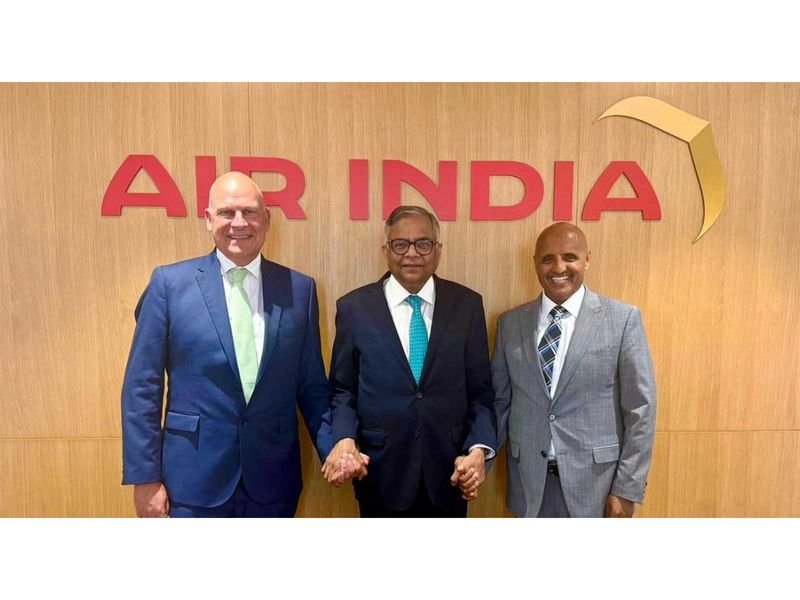

Air India’s incoming CEO and MD Tewolde Gebremariam on Monday sought the support and cooperation of the airline’s staff and called for minimising disruptions.Addressing employees at a town hall, along with outgoing CEO Campbell Wilson and Tata Group Chairman N Chandrasekaran, Gebremariam said Air India had a powerful heritage, a strong brand and enormous potential. Vowing to “make Air India great again” (MAGA), he said, “If we do the right things at the right time, the sky is the limit.”Meanwhile, after four years of rebuilding Air India under the Tata Group and a difficult 18 months marked by the AI171 tragedy, geopolitical disruptions, airspace closures and volatile fuel costs, Chandrasekaran on Monday outlined the airline’s priorities for its next phase: safety above all, rebuilding customer trust, sharper execution and tighter cost discipline.Chandrasekaran made it clear that Air India should not merely match the safety standards of the world’s leading airlines, but aim to surpass them.“Air India must be known for caring about safety above everything else. Our safety record should not just match the best airlines in the world, it should be better than the best,” Chandrasekaran told employees.“Safety is not about what we say. It is about what we do every day,” he said, stressing that the next phase would require world-class processes, rigorous compliance and personal accountability across the airline.The remarks come as Air India enters another crucial stage of its transformation following a difficult period for the carrier. Chandrasekaran acknowledged that the past 18 months had been particularly challenging, with the AI171 accident, geopolitical upheaval, closure of airspace and fuel-price volatility affecting the airline’s operations and performance.At the heart of the next phase, he said, would be trust. “The most important thing Air India should aspire to have is trust in the minds of people,” Chandrasekaran said.The message signals a shift in emphasis as the airline moves beyond the initial phase of its post-privatisation transformation. While fleet expansion, aircraft refurbishment, network growth and integration have driven much of the turnaround so far, Chandrasekaran indicated that the coming phase would have to be built around consistent execution, from the cockpit and engineering to airport operations and passenger service.He also underlined the unusual public scrutiny that comes with running the former national carrier, describing Air India as more than another company in the Tata portfolio.“For me, bringing Air India back to the Tata Group is one of the most important milestones of my career, a very significant event. Air India belongs to a billion people. It is not just another business,” he said.“It is probably the only business that a billion people talk about, have views on, criticise fiercely and appreciate at times. But one thing we should always remember is that all these one billion people are rooting for Air India. That is our biggest strength,” he added.Alongside safety, Chandrasekaran identified consistency in customer experience as another priority and called for greater agility in dealing with a rapidly changing aviation environment.Financial sustainability will also form a central part of the next phase. Chandrasekaran called for a stronger culture of cost consciousness across the airline, placing responsibility not only on management but across the workforce.“Every individual in Air India can contribute to improving cost efficiency,” he told employees.