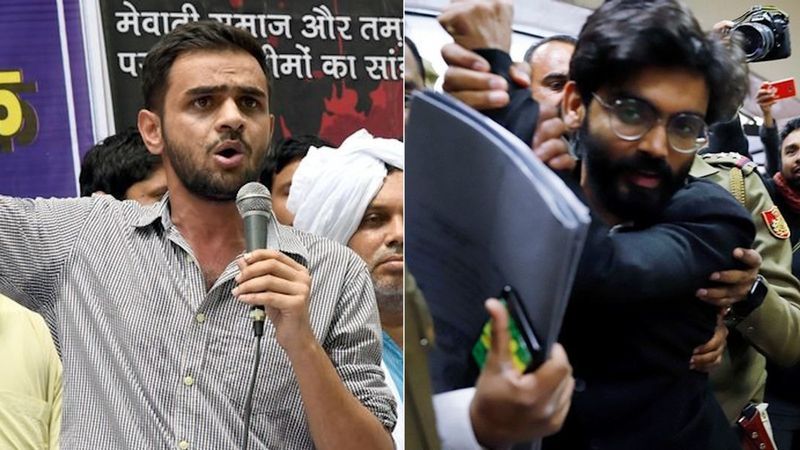

More than four months after a two-judge Bench of the Supreme Court denied bail to Umar Khalid and Sharjeel Imam in the 2020 Delhi riots conspiracy case, another two-judge Bench on Monday questioned it for ignoring a ‘binding precedent’ laid down by a three-judge Bench in the KA Najeeb case.While granting bail to Syed Iftikhar Andrabi, who has been under custody for more than five years in a narco-terrorism case under the Unlawful Activities (Prevention) Act, 1967 probed by the NIA, a Bench of Justice BV Nagarathna and Justice Ujjal Bhuyan said a two-judge Bench was bound to follow a judgment of a three-judge Bench.“The material suggests involvement at the level of planning, mobilisation, and strategic direction, extending beyond episodic or localised acts. The statutory threshold under Section 43D (5) of the Unlawful Activities (Prevention) Act, 1967, therefore stands attracted qua these appellants,” a Bench of Justice Aravind Kumar and Justice NV Anjaria had said on January 5 while denying bail to Khalid and Imam.However, the Bench of Justice BV Nagarathna and Justice Ujjal Bhuyan expressed reservations about it.“A judgement rendered by a Bench of lesser strength is bound by the law declared by a Bench of greater strength. Judicial discipline mandates that such a binding precedent must either be followed, or in case of doubt, be referred to a larger Bench. A smaller Bench cannot dilute, circumvent or disregard the ratio of a larger Bench,” Justice Bhuyan said, pronouncing the judgment.Justice Bhuyan underlined that the three-judge Bench in the KA Najeeb case (2021) ruled that prolonged incarceration was a ground for constitutional courts to grant bail under the UAPA despite the rigours under Section 43D(5) of the Act.“The statutory embargo of Section 43D(5) of the UAPA must remain a circumscribed restriction that operates subject to the guarantee of Articles 21 and 22 of the Constitution. Therefore, we have no manner of doubt in stating that even under the UAPA, bail is the rule and jail is the exception. Of course, in an appropriate case, bail can be denied having regard to the facts of that particular case,” the top court said on Monday.Section 43D(5) of the UAPA says that notwithstanding anything contained in the CrPC (replaced by the Bharatiya Nagarik Suraksha Sanhita (BNSS), no person accused of an offence punishable under Chapters IV and VI of the UAPA shall be released on bail or on his own bond, unless the public prosecutor has been given an opportunity of being heard on the bail application.Further, the proviso to Section 43D(5) says that such accused person shall not be released on bail or on his own bond if the court on a perusal of the case diary or the final report (charge sheet) is of the opinion that there are reasonable grounds to believe that the accusation against such person is prima-facie true.However, Justice Bhuyan said, “We have serious reservations about judgment in Gulfisha Fatima (in which Khalid and Imam were denied bail). The judgment in Gulfisha Fatima would have us believe that Najeeb (verdict) is only a narrow and exceptional departure from Section 43D(5) (of the UAPA), justified in extreme factual situations.“It is this hollowing out of the import of the observations in Najeeb that we are concerned with. The broad reading of Najeeb suggests that the mere passage of time, if it arises from all surrounding circumstances, mechanically entitles an accused to release,” he said.“We make it clear that Najeeb (verdict) is binding law and entitled to the protection of judicial discipline. It cannot be diluted, circumvented, or disregarded by trial courts, High Courts, or even by Benches of lower strength of this Court,” the Bench of Justice BV Nagarathna and Justice Ujjal Bhuyan said on Monday.Andrabi, a resident of Handwara in Kupwara district of Jammu and Kashmir, arrested by the NIA on June 11, 2020 for allegedly being a part of a cross-border drug syndicate procuring heroin from the Tangdhar border area and channelling the proceeds to fund terror outfits such as Lashkar-e-Taiba and Hizbul Mujahideen.A Special NIA Court IN Jammu denied him bail in August 2024 and the order was upheld by the High Court of Jammu and Kashmir and Ladakh at Jammu, forcing the accused to approach the top court.He is facing charges under Sections 8, 21, 25 and 29 of the Narcotic Drugs and Psychotropic Substances Act (NDPS Act), Sections 17, 38 and 40 of the UAPA and Section 120-B (criminal conspiracy) of the Indian Penal Code.