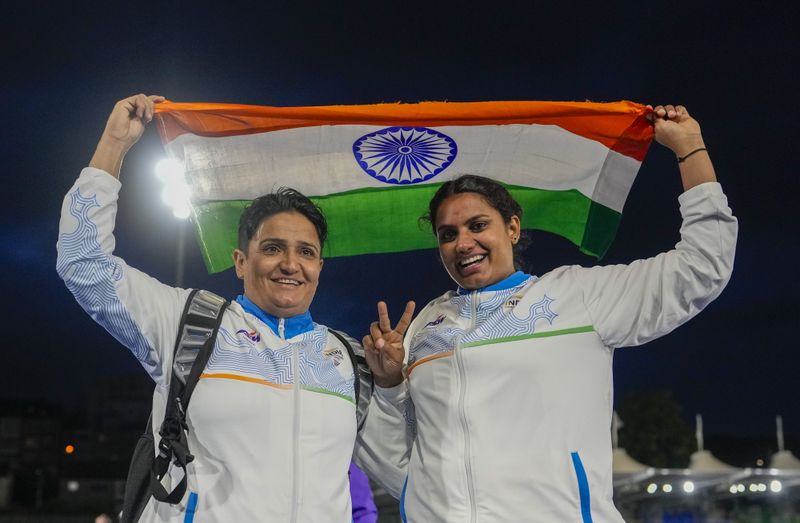

When Sharmila Dhankar’s husband abandoned her with their younger daughter barely 37 days old, it brought a painful but much-needed end to years of abuse that she had endured in the hope that things would one day get better.At that time, the polio-afflicted and traumatised Sharmila did not know where life would take her. More than a decade later, the now 40-year-old stood on top of the Commonwealth Games podium with a gold medal around her neck after winning the women’s F57 seated shot put title, a triumph that is as much about resilience as athletic ability.“Everyone said it would stop, so I stayed,” the vivacious para athlete told PTI as she recalled her time with her alcoholic first husband, who beat her for giving birth to two daughters. She said even their elder daughter was a victim of domestic violence.Still, Sharmila stayed, hopeful of things improving at some point. They never did.“My husband did not earn. He kept selling off everything. He used to hit me because I gave birth to two daughters. He also beat my elder daughter,” she alleged.The violence only intensified after the birth of their second child.“After my second daughter was born, he would hit the elder one. When the younger one was just 37 days old, he threw us out of the house. Then my family came and got me divorced from him.”With nowhere else to go, Sharmila returned to her parents’ home with her two daughters. For the next six years, she rebuilt her life, one day at a time.Hardship, however, had followed her long before marriage.She had contracted polio when she was just two years old, leaving her right leg permanently impaired.“When I was two, I contracted polio. They gave me an injection for fever and because of that my right leg was affected,” she said unsure whether she was a victim of medical negligence.She grew up in a family where every rupee mattered. Her mother was blind and had been married to a man 20 years older than her.Despite the odds, her parents insisted that their children go to school.“There were a lot of financial issues. But they made us study. From Class 1 to 10, I never came second, not even in one test. I was always first,” she said with a smile.But education had to take a backseat due to resource constraints.“Because of money issues, I was married off (young),” she said.But Her second marriage became the turning point that changed the course of her life.“My second husband introduced me to sports. Whatever he had, he invested in my sport.”When that was not enough, her mother sold her land.Coach Tek Chand, the 2018 Asian Para Games seated shot put bronze medallist, quickly recognised Sharmila’s potential and guided her towards the event.“In the beginning, I never thought I could win,” Sharmila admitted.The belief grew with every competition. She finished fourth at the Birmingham Commonwealth Games in 2022, won gold at this year’s Fazza International Para Athletics Championships and, in Glasgow, finally climbed to the top step of the Commonwealth podium.The victory meant more than a medal. It was validation for everyone who had stood by her when life seemed to have reached a dead end.Her biggest supporters are her two daughters, who have already begun chasing sporting dreams of their own.“My daughters are 15 and 12. The older one is a javelin thrower and the younger one is a long jumper.”“They have told me that at the next Commonwealth Games in India, all three of us will compete for India and all three will win medals.”