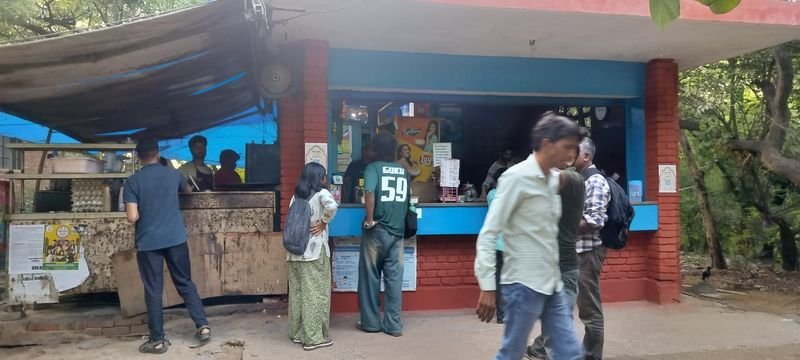

At Jawaharlal Nehru University (JNU), some debates begin in classrooms, some on protest sites and many continue over a cup of tea at Ganga Dhaba.For more than four decades, the modest eatery has been a familiar part of JNU’s night life. Students have gathered here over inexpensive food, exchanged political arguments, discussed campus issues, made friends and, sometimes, simply sat for hours watching university life unfold.But Ganga Dhaba’s story is as much about the people behind the counter as those sitting around its tables.From a night food cart to a campus landmarkThe journey began in 1984, when Tejvir Singh, father of the present owner Bharat Tomar, started a small food cart near the Ganga bus stand.“There was no particular inspiration. It just started like that,” Tomar told The Tribune.His father’s journey to JNU was unconventional. “He had been thrown out of the house by his father,” Tomar recalled.Singh initially worked at a cycle shop in Meerut and later went to jail following an incident involving a fight. He subsequently came in contact with a person named Chaudhary, who helped him find work.At JNU, Singh began with just three offerings.“He used to sell only tea, samosas and lemon water at night,” Tomar said.The business subsequently moved through several locations, including Ganga Hostel, which was then a boy’s hostel. After the girl’s hostel was constructed, Singh shifted to a small shop near the bus stand. The dhaba finally moved to its present location in 1993.After Singh’s death in 1990, his brother managed the establishment for several years before Tomar took over in 2012.Where the chai meets campus politicsGanga Dhaba grew alongside JNU’s famously intense culture of political discussion. Its tables became an informal space where students from different schools, hostels and political groups could sit together, argue and exchange ideas.That wider political culture has produced several prominent student activists, including Umar Khalid and Kanhaiya Kumar, whose names became nationally prominent during the student politics debates of the 2010s.Their political journeys form part of the broader history of JNU’s student movements, within which informal campus spaces such as Ganga Dhaba have acquired a lasting cultural significance.The dhaba has also witnessed the rhythm of JNU’s protest culture, students gathering before demonstrations, returning afterwards, and continuing their discussions late into the evening.And the relationship has not always been one-sided. Ganga Dhaba itself became the subject of student protests in 2014 and 2016, when moves concerning its existing arrangement triggered opposition on campus. For many students, the issue went beyond the future of a food outlet. They saw the dhaba as a symbol of JNU’s inexpensive, informal, and argumentative campus culture.Tomar, however, says protests have never been a major problem for the business.“We do not face any difficulty during protests. Once the protest is over, people come in the evening, have tea and leave. We have never had any problem with the students,” he added.The cheapest food and an open doorFor Tomar, keeping the dhaba affordable is part of its identity.“I probably sell some of the cheapest food in the entire JNU. My margin is low, but because things are sold in bulk, we can save a little,” he said.Sometimes, he added, students cannot afford even that.“There are many students who don’t have money. We don’t turn anyone away because of that,” Tomar said will speaking to The Tribune.Perhaps that is why students who arrive as strangers gradually develop an attachment to the place.“Once they get used to the place, they don’t want to go anywhere else,” he said.A lifetime inside JNUTomar’s connection with the campus is almost as old as the dhaba itself.“I have spent my whole life here,” he said.The same continuity can be seen behind the counter. Workers including Sachchidanand, Harish and Sham have been associated with the dhaba for nearly 25 years.“We have spent 25 years in JNU together,” Tomar said.That may be the real story of Ganga Dhaba. Its chairs have held generations of students, its menu has remained affordable, and its tables have witnessed arguments that began with campus politics and stretched into discussions about the world outside.The protesters have changed. The political slogans have changed. The students have graduated and returned as alumni.But the chai keeps coming.And perhaps that is why Ganga Dhaba became a JNU landmark without ever trying to become one, through 42 years of ordinary evenings, extraordinary conversations and a campus that never really stops debating.