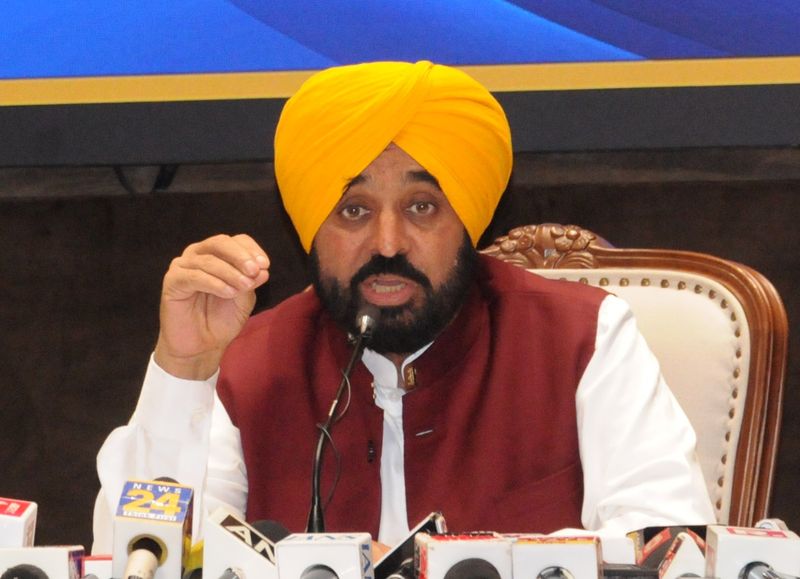

To address the grievances of “inadequate returns” under the Land Pooling Policy, the Punjab Government has decided in-principle to further enhance benefits and extend new concessions to landowners affected by the massive acquisition drive across Greater Mohali and New Chandigarh.The decisions were taken at a high-level meeting held recently, which was also attended by the sarpanches of a majority of the villages falling under the Aerotropolis acquisition area. A formal notification listing the enhancements was likely to be issued shortly, top government functionaries told The Tribune.Speaking to The Tribune, Chief Minister Bhagwant Mann reiterated his government’s commitment to making farmers equal partners in Punjab’s development. “We are determined to ensure no farmer who gives up his land for development walks away feeling shortchanged. Our government will ensure those contributing their land to build the Punjab of tomorrow are compensated generously. The land of our farmers is sacred to us. The development in Greater Mohali and New Chandigarh belongs to them as much as it belongs to the future,” he said.The most direct enhancement under the revised package covers the core land pooling entitlement itself. For every acre of agricultural land surrendered under the mixed use or general category, the commercial SCO plot allotment has been increased from 200 square yards to 210 square yards per acre, applicable on holdings of one acre and above. The residential entitlement of 1,000 square yards per acre in this category remains unchanged. For the residential category, the per-acre allotment has been raised from 1,600 square yards to 1,630 square yards, again applicable on one acre and above.Given that the combined market value of developed plots under the existing Land Pooling Policy is already estimated at approximately Rs 16 crore per acre, more than double the current post-notification market price of land and over three times the pre-notification value of approximately Rs 5 crore per acre, even a marginal increase in plot area adds substantially to the total benefit available to a farmer, officials said.In one of the most significant benefits, oustee quota certificates will be issued to all farmers whose land is being acquired, including those who have already opted for or will opt for cash compensation instead of land pooling. This is a notable departure from the earlier position, which restricted oustee quota benefits primarily to those opting for plots.Under the oustee category, plots will be allotted at “scheme price”. Farmers with up to half an acre under acquisition will receive a 200 square yard plot; those with between half an acre and 2.5 acres will get a 300 square yard plot; and farmers with more than 2.5 acres will receive a 500 square yard plot.The validity of the Sahuliyat Certificate, the facilitation document issued to farmers that grants them stamp duty exemption when using compensation proceeds to buy alternative land anywhere in Punjab, has been proposed to be extended from the current two years to four years.The window for availing priority tubewell connections, which was earlier tied to the two-year Sahuliyat Certificate validity, has also been extended to four years. The department concerned has been directed to ensure installation of tubewell connections within two months of an application submitted along with the Sahuliyat Certificate.In another concession, conveyance deeds for original landowners will be executed free of cost. This benefit will, however, not extend to transferees of letters of intent.On the allotment of plots, a long-standing grievance has been addressed: all plots, both residential and commercial, including preferential location plots that were earlier being retained by GMADA, will now be included in the draw of lots, ensuring every farmer has an equal and equitable opportunity at a prime location.The Tribune first exclusively reported in June 2025 that the state had notified the Land Pooling Policy proposing compulsory pooling of 65,533 acres statewide, triggering widespread farmer protests backed by the Congress, Shiromani Akali Dal and the BJP. It was followed by an interim stay from the Punjab and Haryana High Court, and ultimately the complete withdrawal of the policy in August 2025.A revised policy was introduced in November 2025, offering farmers a choice between developed plots or statutory cash compensation as part of the 11,103-acre acquisition drive.