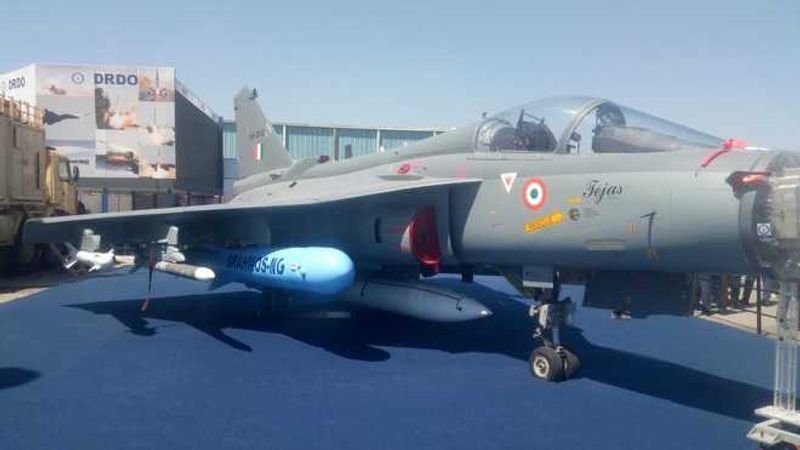

India and Russia’s jointly produced BrahMos missile is undergoing an upgrade, with the first prototype of the next version, named BrahMos-NG, expected within two years.BrahMos-NG will be an air-launched variant, smaller and lighter than the existing version of the missile, allowing it to be mated with Tejas fighter jets, which are smaller than the Sukhoi-30MKI.The Indian Air Force (IAF) and public sector aircraft maker Hindustan Aeronautics Limited (HAL) have modified some 40 Sukhoi-30MKI jets to carry the BrahMos, which was used during Operation Sindoor in May last year.BrahMos Aerospace Chief Executive Officer and Managing Director Jaiteerth Joshi was quoted by news agency ANI on Thursday as saying, “The BrahMos-NG system was under development”.This would feature higher indigenous content, new technologies and advanced materials, requiring extensive research and development work, Joshi said, adding, “We expect to develop the first prototype by 2027 or 2028.”Sources said BrahMos-NG would be lighter, enabling other jets such as the LCA Tejas, which has much less payload capacity than the Sukhoi, to carry the missile. It is being made into a sleeker version, with composite materials being used to make the missile lighter.BrahMos-NG could weigh approximately 1.2 to 1.5 tonnes and measure less than six metres in length. It is designed to operate at Mach 3.5, with Mach being a measure of speed relative to the speed of sound. Ground integration and design validation are in advanced stages, and the first flight runs are scheduled to take place, with series production targeted to begin by 2027-28 at the new facility in Lucknow.Separately, BrahMos Aerospace is working on a future plan to develop a missile with a range of 1,500 km. “It remains part of its future roadmap and is currently at the conceptual stage,” Joshi said.While BrahMos-NG tackles the challenge of putting supersonic power onto lighter aircraft, the long-range missile programme transforms BrahMos into a strategic deep-strike asset.The development of a longer-range BrahMos is gradual. The IAF has tested an extended-range air-launched variant beyond 450-500 km. It achieves this range through upgraded ramjet propulsion management and optimised fuel efficiency. The Army wants a range of more than 800 km, allowing it to execute stand-off precision strikes deep into adversary territory from safely inside domestic borders.In 2016, India formally joined the Missile Technology Control Regime (MTCR), and the restrictions on range, capped at 290 km, became redundant.BrahMos has also found eager customers in a group of countries around the South China Sea — Indonesia, the Philippines and Vietnam. All three have opted for the anti-ship variant of the missile launched from the coast.BrahMos has a variant that is fired from a ship at a land target, which has not been exported so far. The Philippines and Vietnam are locked in an ongoing maritime territorial dispute with China in the hydrocarbon-rich South China Sea. Indonesia also has a small coastline along the same sea but is not part of the dispute.